The political centre has moved, someone should tell the strategists.

Originally posted on The Standard

Trust in politicians is at a record low. This is true for the UK during its General Election Campaign, with multiple surveys showing that most voters are dissatisfied with how the UK is governed. In Aotearoa, this depressing trend is also reported in polls. What is causing this trend?  Much of this is due to hubris and poor decisions by politicians. In part, however, outdated thinking and a failure to understand public opinion by the political establishment have caused this situation. Ironically, the tactics used to overcome this problem 30 years ago, are today perpetuating it.

30 years ago, we had Dot Matrix printers, Windows 95 and brick cell phones. Today we live in a world of AI, Tik Tok and 5G. While technology changes have been embraced, including in political campaigns, strategies and methods to connect with voters seem stuck in the MS-DOSS era.

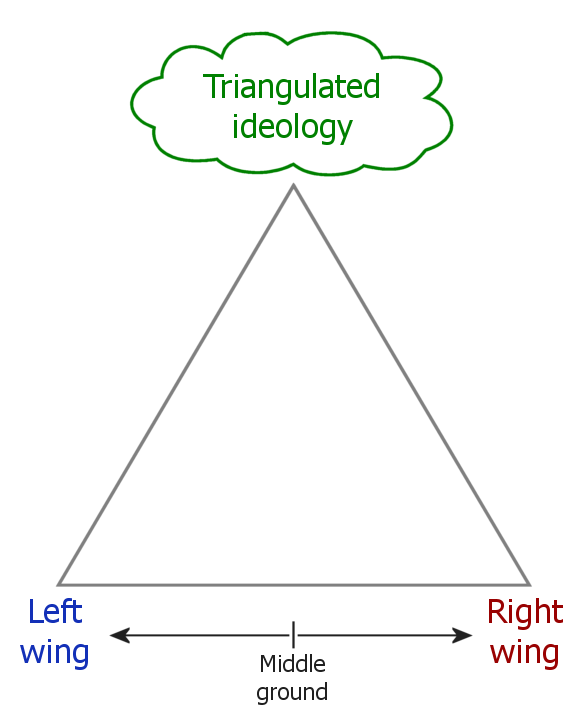
Triangulation is a political strategy whereby a politician presents a position as being above or between the left and right sides (or “wings”) of a democratic political spectrum. In the 1990s Clinton used this tactic to successfully win “centrists” who had supported Reagan in the 1980s, as did Tony Blair’s New Labour Government. The economic reforms of Thatcher and Reagan were left in place, but with a more socially liberal agenda and more resources for health and education, though often in partnership with the private sector.

Whether it was right or wrong, it is entirely understandable in 1997 that Tony Blair’s new Labour had no appetite for increasing taxes, especially after losing the 1992 election after the Tories painted Labour as the high tax party. Or if we go further back, in the 1979 winter of discontent, where the streets were strewn with rubbish because of striking binmen, was the death knell for the Callaghan Labour Government. So again, rightly or wrongly, New Labour was cautious about giving too much power to the union movement.

Smarter minds have clocked that much has changed since 1997. Whereas in the 1990s free market reforms still enjoyed reasonable support, after the 2008 financial crisis, followed by years of government austerity policies, this is no longer the case. It was the equivalent of Y2K, except it actually did cause chaos.  

Following the pandemic, advocating small government, low taxation and bestowing the virtues of the market is now met with derision by all but the most hardened libertarians.

Sections of the UK media have grasped that society has changed, as have the more credible think tanks and forward-thinking academics. Many political strategists have missed the memo. Or they just have no idea how to adapt to modern politics. They continue to pitch to “the centre”, or at least to where “the centre” was 30 years ago.

Labour’s New Deal for Working People, billed as a “plan to make work pay, ensure security at work and provide the work-life balance everyone deserves”. The policy specifics are broadly similar to those introduced in the first term of Jacinda Ardern’s Labour-led Government in 2017; raising the minimum wage, banning zero-hours contracts, improving sick pay provisions and requiring employers to issue contracts which reflect actual hours worked with compensation for cancelled shifts. In a country where most people are poorer than they were at the last election, policies that lift people’s incomes are popular.

Days before the General Election was called, Conservative Home commentator Chris Hopkins argued that workers’ rights would be the wrong dividing line for the Conservatives to challenge Labour on. Chris argued that where previously the Conservatives could argue for flexibility and a lightly regulated workforce on the grounds that it would boost economic growth, now voters have “wised up” and that the “old political rules no longer apply”. He goes on to say:

Where the public may once have conceded workers’ rights for a perceived higher standard of living via growth and jobs, they have lost trust in the Conservatives as effective stewards of the UK economy.

Think of it like this. If your main job is now more precarious, your mortgage has significantly increased and you are working a second gig to make up for it, I’d imagine stopping ‘fire and rehire’ and having the ‘ability to switch off’ would look like a pretty good offer. And it would look good to Conservative supporters as much as anyone else.

Have the Conservative Party taken heed of this sound analysis? Conservative Business Secretary and future Tory leadership hopeful Kemi Badenoch has claimed “Labour’s new employment regulations are going to make it very hard to hire, strangling employment”. Despite 14 years of weak employment protections failing to stimulate the economy, Badenoch and her colleagues in government still think this is a strong dividing line with Labour.

She is not alone in this. Lord Peter Mandelson, Business Secretary in the Blair/Brown New Labour Government warned in March that Labour’s employment law changes must not be rushed or go further than “the settlement bequeathed by New Labour”. Mandleson was one of the architects of New Labour and has advised the current Labour leadership on strategy and policy. While the ‘Black Prince’ is undoubtedly a smart cookie, his fingers are not on the pulse of public opinion on this issue.

Sharon Graham, the General Secretary of Unite, the largest Labour Party-affiliated trade union in the UK has warned that Labour has watered down proposals to ban fire and rehire, and sectorial bargaining plans have been delayed. It is no surprise that the Unite leader wants to push Labour further, but in this case, what is being asked is quite modest. A union representing over 1.2 million workers in the UK, which is growing each year, should not be dismissed out of hand.

Another example of triangulation leading to poor policy positions is tax. The Conservative Party have made a key pitch of the 2024 campaign that Labour will increase taxes and they will cut them. Labour has in fact ruled out increasing income tax, VAT or national insurance, which are the main taxes which bring in government revenue.

Taxes have risen since 2019 despite the Conservatives promising to cut them in their previous manifesto. The tax burden has risen to 36% of national income, the highest it has been since 1949. This has been due to a freeze on the income tax threshold, increases to corporation tax and a windfall tax on energy companies.

While Tory party faithful decry their party breaking their 2019 promise, the economic reality is that the government cannot cut taxes without harsh cuts to public services. The election of Liz Truss as Tory leader was largely a response to this, and the harsh reality of unfunded tax cuts destroyed the Conservative Party’s reputation as sound economic managers. The voting public is more interested in public services that work than tax cuts which fuel inflation and do little to help people.

The British public would much rather the government invest in crumbling public services like the NHS, and polls have consistently shown this for some time. The public can see roads full of potholes, schools falling down, the NHS overwhelmed and there not being enough police on the streets.  

The recent debate on how quickly each party would increase military spending in the next term was another example. The public knows that whatever is promised now, if the situation in Ukraine, Gaza or elsewhere in the world deteriorates further, the government will have no choice but to increase military spending. In this context, it is no wonder that the Conservative Party’s promise to cut taxes, without a proper explanation of how it will be paid for, has fallen flat.

Labour has ruled out tax increases and is banking on economic growth to help them fund public services, as it did during the Blair/Brown Government. While measures like planning reform and improving the trade deal with Europe will help, there is no guarantee that economic growth will happen fast enough to fix Britain’s woes in the next parliamentary term. The Shadow Chancellor’s commitment to having the fastest-growing economy in the G7 is ambitious, to say the least.

In New Zealand, the decision of the Labour Government in 2023 to rule out a ‘wealth tax’ saw the party’s polling decline, albeit from an already poor position. It confirmed voters fear that Labour had no serious plan to fix public services in a third term if re-elected. By contrast, the UK has had 14 years of Conservative Government and the public is crying out for change. Once in Government, a future Labour Government will face the same challenges if they rule out new forms of revenue, especially if aspirations of economic growth fail to materialise.

The UK Institute for Fiscal Studies has said there is a ‘conspiracy of silence’ on how public services will be funded if there are to be no tax rises in the next five years. My Dad has a theory that given the choice of conspiracy or cock-up, it is almost always a cock-up. The cock up here is parties making political calculations on old models, based on public attitudes 30 years ago.

Society is a much more complex place in 2024. We carry smartphones with 10 times more memory than 1990s PCs, which give us access to vast amounts of information online. We also are much more connected and events which once took hours or days to be reported are now on our phone newsfeeds in seconds.

People’s political views and voting intentions are vastly different now from what they were in the 1990s. The size of political swings in democratic nations has increased substantially in recent years. The so-called political centre was always lazy shorthand to describe a section of the voting public who broadly speaking decided elections. Society, much like technology, is much more complex than it was in the 1990s. The politicians who are first to adapt to this change will be the ones who ultimately succeed.  

Trade unionism: does it have a future?

In mid-2016 the former president of the New Zealand Council of Trade Unions Helen Kelly (no relation) came to speak to PSA staff at morning tea. Helen had been diagnosed with stage 4 lung cancer and would sadly die later that year. At the time some of the PSA staff thought it would be an idea to start singing at meetings or union gatherings. These would either be Waiata (Maori songs) or old union protest songs. On that morning the decision was that we should all sing We shall not be moved. Helen was very polite and thanked us for the welcome, but then responded: “I’m sorry to break it to you, but we’ve been moved.”

Filmmaker Tony Sutorius on Helen Kelly's last stand

Above: Former NZ Council of Trade Unions President Helen Kelly

Helen went on to give a speech I heard her make in various forms throughout her term as CTU president. As a movement, unions ‘needed to evolve’ to organise the current workforce. Most workers ‘had no contact’ with unions and our structures were a barrier to most workers getting involved. Helen and I worked together for most of her time as CTU President. We did not always see eye to eye on everything but on this, she was absolutely spot on.

In these blog posts about my time in the union movement, I have talked about some of the challenges that unions face organising workers in the 21st century. I have discussed some of the debates in the movement regarding small or industry-specific unions vs larger general workers organisations. I have talked about the role of peak bodies, and the role they are meant to play, and how at times they can be disconnected from the members they serve. This disconnect is even worse with the global trade union movement, who do important but often completely ignored work. I have also mentioned the toxic role that competitive unionism has on trying to organise workers.

It is easy to feel demoralised about the state of trade unionism in the early 21st century. At times it can feel like parts of the movement are stagnant and at times moribund. There are plenty of exceptions to this and it would be wrong to dismiss the good work that many in the movement do day in day out. And there are some unions with well thought out strategies, democratic structures that empower their members to improve their workplaces, industries and wider society. But the brutal fact is that most union organisations and structures are not strategic, they often lack democratic accountability and simply are not organisations or structures that are appropriate for organising workers in the 21st century.

I am not going to give specific examples of unions that are not performing. And these comments are not specifically aimed at New Zealand, England or any other country. The union movement globally needs to seriously rethink its structures and its culture. One of the difficult issues in trade unions is it can be seen as disloyal to criticise the movement as a whole. Also, union leaders can see any criticism of the way their union is run as a personal slight. This inability to accept criticism is unfortunate, especially when only one in five workers are members of trade unions, and in many sectors, there is no trade union representing workers at all.

My personal experience of working in the trade union movement was one of the greatest experiences I ever had. I was privileged enough to attend international conferences as a youth representative. I was put forward for leadership roles and to be exposed to the structures of the movement at all levels. Also, I made lifelong friendships and still consider myself part of the union family. However, the limitations and frustrations of working within the existing union structures over time became wearying. I felt like much of what we were doing was servicing, aka maintaining the status quo. Much of the time was spent on personal cases looking after members on the job, which is, of course, vital work, but unions need to be more than social workers and legal counsel. I was privileged enough to be working with colleagues who were doing ground-breaking work – an example the Care and Support settlement for care and disability workers in 2017.

The biggest frustration was that union structures have not evolved. In the last 20-30 years, the increasing number of casual, fixed term or contractor roles has increased significantly. The Union movement is set up to organise permanent employees – and this was fine in 1955 when the workforce was mostly that. In 2020 it is not. For example, in construction, there has been a shift towards contracting and people setting up as self-employed or starting their own small businesses. Another example is Uber, where people are freelance drivers contracting to Uber, rather than employees. Unions in London have tried to argue these drivers are employees and want people who work them to be treated as such. Problem is many uber drivers, construction workers and others engaged in this way are not actually seeking to be permanent employees with fixed hours or salaries. The union movement wants a workforce that fits with their structure, rather than finding new ways to organise people in contractor type setups.

The rise of casualisation and fixed-term employment has led to work being more precarious and helped to drive down wages and conditions. Understandably the union movement wants this to stop. Trouble is, while this precarious work does cause all these problems, it also allows greater flexibility, something both employers and many workers desire. A rigid system of shifts and rosters works in some industries, in others, flexibility works for everyone. There are clearly employers who take the piss such as McDonald’s in the UK who put their staff on zero-hour contracts despite the fact these workers were given regular work rosters each week. But there are plenty of examples of industries where variable hours are necessary such as event management. For too many unions they want the world of work to fit in their box.

One of the issues unions face is that they have been told since the 1970’s that they are dinosaurs. When unions are more moderate or pliable to the employers or business they are called ‘modern’ or sensible. This is what the rival union trying to undermine the Tramways Union in 2007 was called by the employer. The reaction to this is a view that defending the old ways of organising or running the union is principled and a way of resisting neoliberalism. That some unions change by becoming ineffective wet blankets does not mean everyone who changes is a sell-out. There is a difference between ideology or principle and strategy and tactics. Yes, the goal is to get through the brick wall, but this does not mean smashing your head against it is the only principled course of action.

Above: Manufacturing & Construction Workers Union Graeme Clarke speaking at the 30th anniversary of the Wellington Trades Hall bombing.

The other issue is that unions do not understand the capitalist system they work within. For all their talk of socialism, the role of unions is to improve the pay and conditions of workers within the current economic order, in effect making it more palatable for workers. One of the things that keep capitalism going is the process of creative destruction, whereby the old and inefficient is replaced by the new and vibrant. A recent example of this is again the rise of uber, which has undermined the Black Cabs in London. Sections of the union movement have fought hard to defend the black cabs, and at times it seemed, were wanting to work with Transport For London (TFL) to wipe Uber out. When over three million Londoners have Uber accounts, and thousands of people drive/work for them this is foolish. Worse, many Uber drivers are looking to organise to campaign for better rates per job, and the old union movement structures are unable to accommodate or are standing in the way of this happening.

That unions defend their own outdated structures is one thing, that they then fetishize inefficient or outdated businesses or structures of capital is just bonkers. Yes, it is understandable that unions want to resist redundancies or restructuring where workers lose jobs or are engaged in inferior employment conditions. But becoming the defender of the old, when often the old was not that great for workers, is both uninspiring and ultimately defeating. Rather than react to or resist change, unions need to understand the process of creative destruction and respond accordingly. Part of the problem is the workers themselves will often not wish to accept that their industry is dying. When New Zealand abolished car tariffs in the 1990s the campaign to save car jobs fell flat. They were arguing for jobs whereby people were reassembling cars that had already been built overseas. These reassembling jobs were created to satisfy government tariff restrictions, meaning the cost of cars in NZ was considerably more expensive. Instead of trying to defend this, the unions needed to campaign for these workers to be transferred into new industries and to be given retraining. They needed to put pressure on industry and government to ensure people were not thrown on the scrap heap.

The other thing unions do is they rely far too heavily on the state to protect the rights of workers. Yes, of course, it is the government’s role to legislate to ensure workers have decent employment and health and safety laws. Unions should be pushing for governments to do this. However, they cannot rely on legislation alone to improve employment conditions. The role of unions is to be an independent collective voice for workers. They need to be a movement that can both win and defend better terms and conditions of employment regardless of who is in power. As my previous post outlined, unions affiliations with certain political party’s can be problematic. It can mean political relationships and loyalties are prioritised over organising. This can also mean strategies are made which rely on the centre-left winning elections, which in many countries only happens occasionally if at all, and even then there is no guarantee that centre-left governments can or will implement the wishes of the union movement. To really make a change, they need to build political support for policies that make it difficult for governments of any colour to resist.

In recent years the New Zealand CTU has called for the reinstatement of industry bargaining, based on the old award system that existed before the 1980s. This system still operates in Australia, and similar systems operate in certain European nations. The idea is that instead of just bargaining between the union and employers, there will be a second tier of bargaining across an industry which is facilitated by the state. The idea is that this will improve the minimum standards of employment across the union movement. The Award system was introduced in New Zealand and Australia as a way of quelling militant unionism at the end of the 19th century. The benefit is that it sets a baseline for pay and conditions, but it can also limit the ability for well-organised workplaces to campaign for conditions that are better than that in the award or industry agreement. For example, in the bus driving sector, awards would benefit the companies where there is no union, and drivers are paid minimum wage with no overtime rates or other benefits. In all likelihood, bus drivers in the bigger cities where union membership is much higher, this sort of industry agreement would be used as leverage to remove conditions like penalty rates that were significantly better than what would likely be in an industry-wide agreement. The other problem is that an industry agreement would apply to people regardless of whether they were members of a union or not. From this, there is little opportunity to build a union movement that can fight to improve workers’ rights. The experience in Australia which kept its Award system was that union membership was much the same as New Zealand where Awards were scrapped in 1987. Further, often the Award conditions in Australia are not that great, especially if the state generally has right-wing governments. In New Zealand, calls for industry agreements have to date had no traction, even under the present Labour Government. The union movement has failed to convince even its own membership, let alone the wider voting public, of the merits of such a change. Sadly, this has been the only real big picture strategy from the NZ trade union peak body to improve employment law, with most other proposals focussed more on tinkering with current legislation rather than challenging fundamentals.

When I started my journey into radical socialist politics in early 2001, I met with lifelong socialist and trade union activist Don Franks. He told me many on the left often threw their hands in the air and say “the trade union movement is fucked.” The problem with this as Don pointed out, there is nowhere to go after that.

Trade Unionism is about people working together to achieve a common interest, something which people have done throughout human history. Where there is injustice, humans will band together to fight against it collectively. It’s what we do. Trade unionism is human nature – working together to achieve a common goal and to help out one another. Talk about the trade union movement dying is nonsense. In the past, I have talked about certain unions being moribund – this does not mean I think unionism is. What is moribund is old ways of working, old inflexible structures that do not correspond to the modern world and the modern workforce.

The future of trade unionism needs to be about engaging the 80% of the workforce who currently do not belong, cannot belong or who have next to no contact with trade unions. It is about building a new democratic movement that is run by workers for workers. This movement would need to actively engage in politics at all levels, and rather than blindly aligning to a party it will have a strategy built by members that advance the interests of working people and creates a political climate where no government want to attack workers’ rights. There needs to be a structure that accommodates for the fact that people often work multiple jobs, across multiple professions or sectors – at present people may need to join 2-3 different unions to cover their different roles. There also needs to be a union movement where if someone becomes unemployed they remain in the union and continue to be supported by the wider movement – rather than the current situation where unions throw the unemployed on the scrapheap the same as the rest of society does.

Building a new responsive union movement that is appropriate for the 21st century will require a lot of work and energy. Many parts of the existing trade union movement can provide a basis to build the new one that is needed, but sadly quite a lot of it rather than being a useful foundation will actually be little more than a hindrance. In the same way that capital uses creative destruction to discard the inefficient and outdated for the new and dynamic, the union movement must be brave enough to do the same. While it is great to celebrate the history of the union movement and record its past struggles, we cannot preserve union organisations out of nostalgia if they no longer do what we need them to. And in this, I do not just refer to smaller craft unions, many of the larger or multi-sector organisations can be just as useless.

One of the difficulties or fears union organisers have is that they will struggle to find work outside of the union movement. I am living proof that union organisers can go on to do other things, but I also have to say that it can be difficult. In part, this is due to hostility from certain employers towards unionist who they view as troublemakers. But even in left circles, working for a trade union can be a barrier to gaining other roles, as a perception exists that unions are ineffective at campaigning or strategy. Many unions and unionists are great at campaigns and strategy, but many others are not and this undermines the credibility of the whole movement. Many unions are stuck with organisers and other employees who would love to get out but do not feel they can. At the same time, many other unionists would love to get a job in a union but struggle for years to get in. For that reason, I left when I knew it was right for me, and always thought at some stage I would move on. Part of being a strong sustainable union movement must be creating an environment where people can get involved and do their best work, but also go back into the wider workforce and do other things when its right for them to do so. Having people with broader work-life experience than just organising or union work is crucial. Otherwise, you create this weird subculture of union workers who lose the ability to relate to the wider working class. Some people want to just work for unions their whole working life, and that is great, they should. But for too many, including those in union leadership roles, they do not feel they can be employed outside the union movement so stay out of fear.

There is no blueprint for building a stronger more effective trade union movement. There are many, who each and every day wake up and do exactly that. I have had the privilege to work with and learn from these people. Both union staff and active union members make a huge difference every single day, and they rightly should hold their head high with the work they do. And it is for them, and for the workers everywhere who want and deserve a better working life, that we need to build a much stronger, vibrant, democratic, and successful trade union movement.

Earlier posts in this series:

Why Trade Unionism

“Its a shit job, it pays shit money and if you don’t like it you can fuck off” – My introduction to bus driving

Tramways Union: From new driver to union president in 18 months

Go Wellington bus driver lockout 2008

Buses, bikes and pedestrians collide: Unions supporting health and safety

Tramways Union: Strikes, sex scandals and solidarity

Wellington buses now: how a local authority harmed public transport

NZ Public Service Association & the Soviet Union partnership plot

Public Service International – global unionism

Local Government – crucial and undervalued

Working in the Public Sector – the defence force goes on strike

Union peak bodies: a beacon of hope for all workers

Trade unions and political affiliations

Earlier Blog posts about Nick:

School uniforms and the young Nick Kelly

Why the Labour Party

Radical Socialism

University and Student Politics

The Iraq War

Student Fees

VUWSA Campaigns

Blogs and the Political Establishment

The Student Union Building

VUWSA President – the realities of leadership

Post VUWSA Executive