Buses, bikes and pedestrians collide: Unions supporting Health and Safety

When one talks to people about unions, if they have heard of them, they generally think of them running campaigns to get more money for members. This is indeed one of their key functions. However, a good trade union should be doing considerably more than just this.

One of the major things that unions do is campaign for health and safety. Some prioritise this significantly more than others. In a world where people must sell their labour power to live, at a minimum they should not lose their lives at work. Yet every year thousands of working people globally go to work and never come home.

When you work in the transport industry, health and safety is something you need to be aware of every minute. As a bus driver you are responsible for getting hundreds of passengers safely to their destination each day. Drivers must navigate busy narrow streets, and try to avoid hitting cars, pedestrians, and whatever other obstacles the city tries to throw at you.

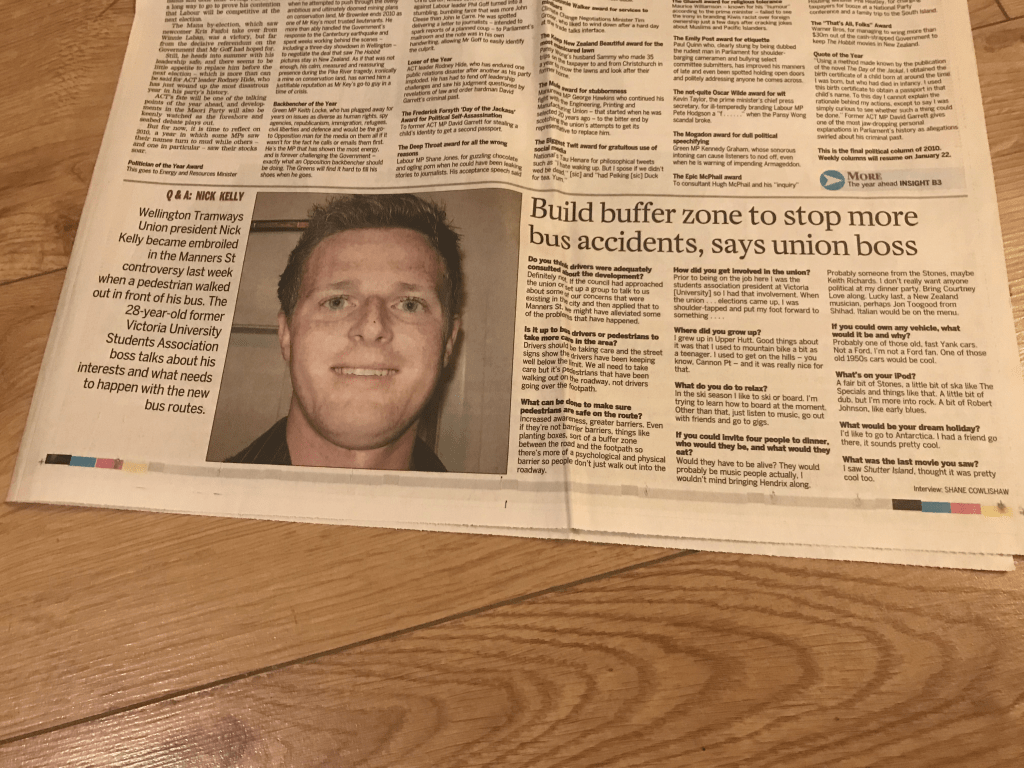
Early in my time as Tramways Union President, it became clear that there were some significant health and safety issues the union needed to champion. When incidents happened in the city, media reports tended to automatically blame the driver or imply the bus driver was to blame. If someone runs out into the road without looking, is it really the bus drivers’ fault that they couldn’t break in time? It was clear that bus drivers needed a voice, and the union needed to be that voice.

In 2009 the bus company ordered several new buses. Investment in the fleet was of course welcomed by everyone. Initially there was a degree of consultation with drivers about the design and layout of these vehicles, but when drivers started asking tough questions this soon stopped. New buses were ordered with dashboards which were significantly higher than in the older ones. In earlier buses you could see 2.5 meters in front of the bus from the driver’s seat, in the newer buses the dashboard meant you could only see 3.2 meters ahead. The design was taken from long haul truck and coach vehicles but was totally inappropriate for urban driving. Tramways Union Vice President Chris Morley was particularly vocal about this having been one of the drivers to first raise it. Eventually, the buses with these higher dashboards were retrofitted with mirrors so drivers could see the space blocked out by the high dash.

In a city with narrow streets and generally poor road layout, cyclists are a hazard. Inner city cycling is immensely popular these days and they have vocal lobbyists. Former Wellington Mayor Celia Wade-Brown used to cycle to work and told a National Radio reporter that the city needed to “civilise the bus drivers.” Aside from the middle-class contempt for low paid workers, this showed a considerable lack of understanding by the Mayor as to what the issue was. A decision was made by the council to allow cyclists to use the bus lanes. So 5pm, on a dusky late autumn evening, you are driving up a bus lane past the Wellington Botanical Gardens. You go around the corner and there is a cyclist in the middle of the lane, not wearing reflective clothing and not moving fast. On your right there are cars and there is extraordinarily little room to get around the cyclist. If you stick behind them the bus will run late, but when you overtake the cyclist, they scream blue murder and get irate that you got too close to them.

In 2010 I was part of a bus drivers and cyclists forum where the goal was for each group to get a better understanding of the others perspective. The Campbell live clip of this can be viewed below:

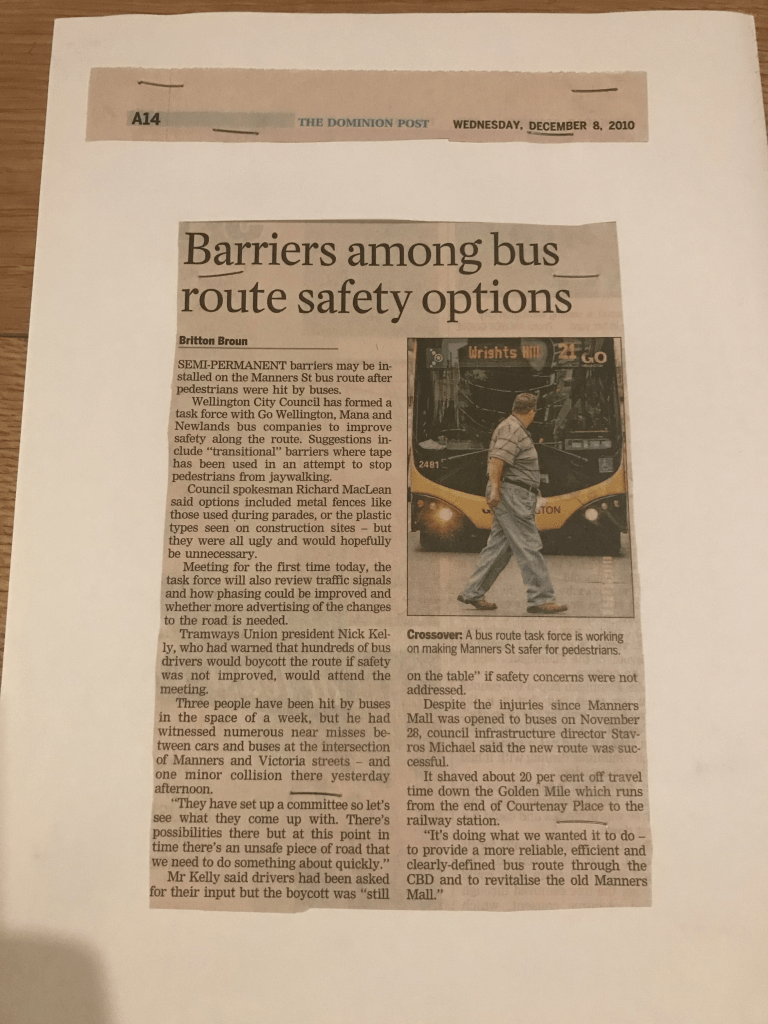
One of the major health and safety issues, aside from the design of the vehicle was the design of the city streets. In 2010 Wellington City turned a pedestrian Mall in Manners street into a main bus carriage through the city CBD. The city planners felt this shouldn’t create any major problems, especially as they lowered the speed limit to 20km per hour.

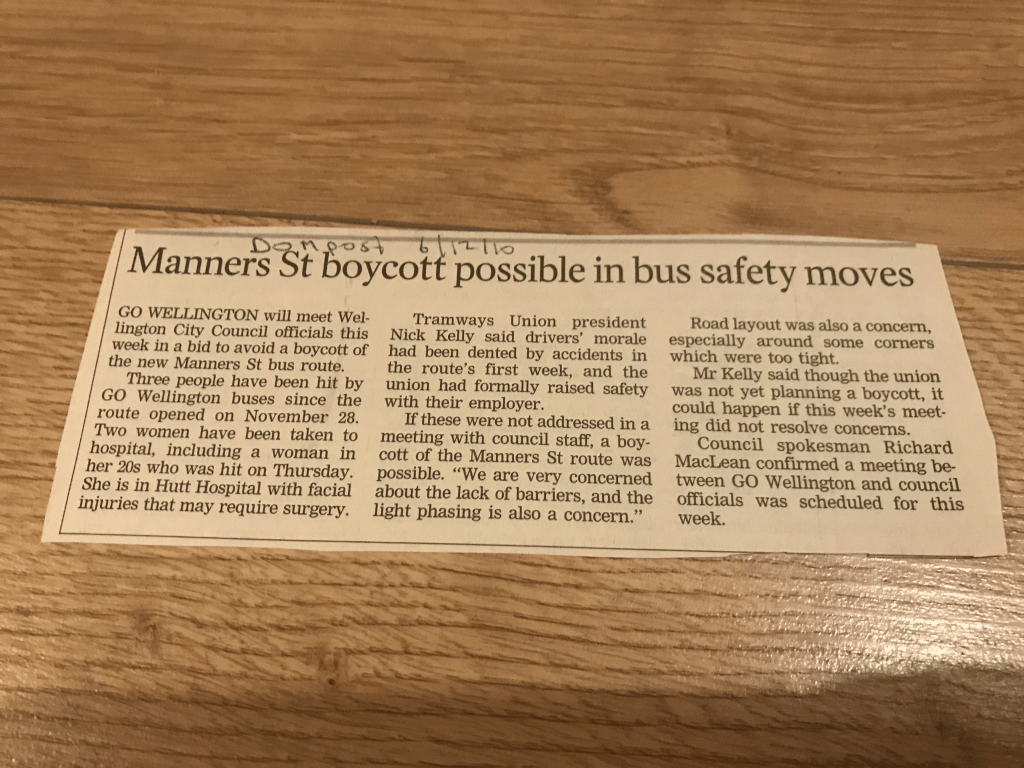
Within a week of the Manners Street bus carriage opening there were 3 people hit. At first drivers were accused of speeding. This was proved false when those signs showing drivers speeds were put up through the route. The trolley buses, being electric were notoriously quiet, and because they were going under 20km per hour pedestrians did not notice them. Also, after 30 years of Manners Street being a pedestrian mall, old habits die hard and people continued to walk through the street.

I issued a statement saying if the council did not put adequate safety measures in place, drivers would boycott the route. This threat got significant media attention.
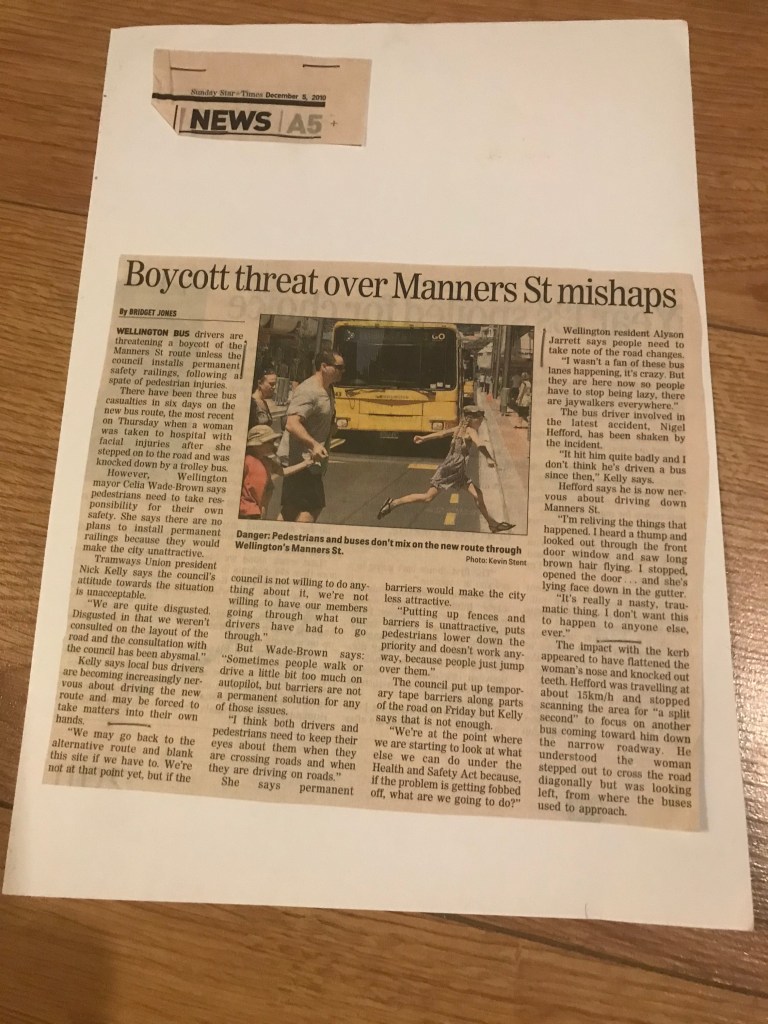
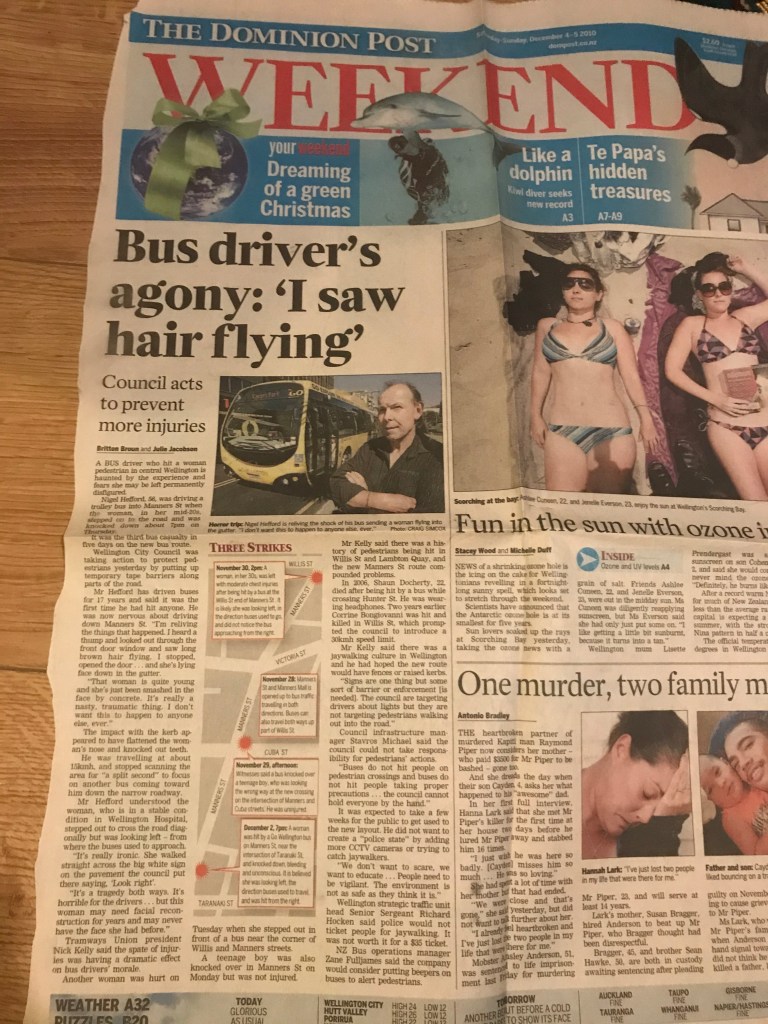
Eventually after the council transport team agreed to meet with the union. From this and continued pressure, some safety measures were put in place – such as barriers or additional signage.

Earlier posts in this series:

Why Trade Unionism

“Its a shit job, it pays shit money and if you don’t like it you can fuck off” – My introduction to bus driving

Tramways Union: From new driver to union president in 18 months

Go Wellington bus driver lockout 2008

Earlier Blog posts about Nick:

School uniforms and the young Nick Kelly

Why the Labour Party

Radical Socialism

University and Student Politics

The Iraq War

Student Fees

VUWSA Campaigns

Blogs and the Political Establishment

The Student Union Building

VUWSA President – the realities of leadership

Post VUWSA Executive

Go Wellington bus driver lockout 2008

20 days after being elected President of the Wellington Tramways and Public Passenger Transport Employees Union (we just called it Tramways), drivers at the Go Wellington bus company I worked for were locked out. The city nearly ground to a halt with thousands unable to get to work and traffic congestion a nightmare. Certain journalists were quick to call this a communist conspiracy. Then Council of Trade Unions President Helen Kelly even warned me not to keep doing media as it would be used against the drivers – I ignored her and she later admitted I did very well.

In September 2008 it seemed likely NZ Bus and the Tramways Union would be heading into dispute. However, in the final day of negotiations, after a number of “final offers” from the company that were well below what drivers were asking, the company did offer something we felt we could take back to union members. The background was that globally the financial crisis had hit, and there were fears that if we didn’t take the offer, we may end up worse off. Graeme Clark from the M&C union was strongly of this view. The members were of a different view.

Drivers voted 2:1 to reject the company offer. On September 24th the Tramways Union were set to hold 1-hour stoppages during the morning peak hour commute. The company responded by issuing a lockout notice for all union members on September 25th 2008.

On the morning of the 24th we commenced our industrial action as bus drivers. Managers were running around the Kilbirnie bus depot in a panic. There was a bit of confusion as to what the action was – so as the union president I needed to intervene. A decision was made to gather drivers at The Wellington Station bus depot. Three buses left Kilbirnie depot bound for the station – I was later accused of stealing all three, a level of multi-tasking even I am not capable of. I also jumped on the radio and called on all drivers to finish their current runs and proceed to Wellington station. One driver over the radio asked, “who is this” so I replied, “this is Nick Kelly, Wellington Tramways Union President, please all finish your trip and proceed to the rail.”

At the rail a mass gathering of drivers was held in the station in full view of thousands of passengers trying to get to work. Graeme Clark rallied the troops and talked about how we would outlast the company in the lockout. I started doing media interviews on TV, radio and print media. My colleague Kevin O’Sullivan the Union Secretary was at first reluctant to do media interviews, so I made sure media got in touch with me.

Probably my favourite clip was the Campbell Live interview done while I was driving my afternoon bus run. This was screened at 7pm on the evening of the 25 September 2008 and can be viewed here:

The lockout on the 25th of September only lasted a day. Not a single bus left the Kilbirnie or Karori bus depot. By lunchtime businesses were crying out for the dispute to end, not least because Wellington was hosting the World Wearable Arts Festival that weekend, and no public transport would cause havoc. Deputy Mayor Ian McKinnon, who served with me on the University Council, called on the bus company to look at its wage rates and urged both sides to end the dispute. By 4pm the lockout was lifted.

Above photos taken on the picket outside the Kilbirnie bus depot in Wellington, NZ 25/09/2008. 

Link: Dominion Post columnist Karl du Fresne claiming Marxist agitators Graeme Clarke and Nick Kelly had inspired the dispute at Go Wellington

In negotiations we were able to secure an 11% increase on all printed rates over 22 months, with 7% backdated to the start of April, though the company took weeks to pay this. The union also managed to stop any claw-backs of hard-fought conditions.

The final agreement of the deal was that any potential litigation from the lockout would be dropped. Go Wellington had made an error when issuing the lockout notice and not printed the names correctly. More significantly they had locked out the controllers (the people who did bus dispatch and were first response on the radio). In exchange the deal was the company wouldn’t take any disciplinary action against me for “stealing 3 buses.”

Tramways Union members voted 2-1 to accept the deal. There were a few drivers who felt we should have held out for more, but the prevailing view was that we would take the offer and come back in 22 months. This also meant the expiry date for this agreement aligned with that of the two other major bus companies in Wellington (one also owned by NZ Bus), meaning we would be negotiating for all drivers at once in 2010.

The lockout was a baptism of fire for me as the union president and for the rest of the new union executive team. The dispute established our authority as union leaders and united the bus drivers. By the end of 2008 all but one of the 300+ Wellington bus drivers were in the Tramways Union.

Earlier posts in this series:

Why Trade Unionism

“Its a shit job, it pays shit money and if you don’t like it you can fuck off” – My introduction to bus driving

Tramways Union: From new driver to union president in 18 months

Earlier Blog posts about Nick:

School uniforms and the young Nick Kelly

Why the Labour Party

Radical Socialism

University and Student Politics

The Iraq War

Student Fees

VUWSA Campaigns

Blogs and the Political Establishment

The Student Union Building

VUWSA President – the realities of leadership

Post VUWSA Executive

Tramways Union: from new driver to union president in 18 months

My first year or so on the Wellington buses I was just learning the ropes. Firstly I had to learn all the bus routes. Then I had to remember to stop and pick up passengers. Thirdly I had to relax driving something the size of a small building around the narrow hilly streets of Wellington – many of which are narrow in the car.

Unionism played a prominent role in the life of the bus depot. As mentioned in my previous post, at the time I started there were two unions (one brought in by the company) trying to sign up new drivers. Our first couple of weeks training were held away from the bus depot. Our trainer was clear when asked about the union situation – “don’t join the tramways union, filthy Phil is no good.” Filthy Phil was the long serving secretary of the Tramways Union. He was well known for wearing shorts and jandals all year around. He’d been the secretary at the time of the bus company being privatised, where the union had against the odds held on to penalty rates and other conditions of employment. Not surprisingly, he made a few enemies within the bus company.

My first involvement with the Tramways Union was giving evidence in the Employment Relations Authority that during training the company had promoted one union over the other. The Filthy Phil quote was included in my evidence. The Tramways Union eventually won the case and the other union were no longer on site.

My first drivers stop work union meeting was an eye opener. It had been some years since the Tramways Union had held full branch elections, and a number of drivers were irate. Further drivers were very angry about the company trying to attack penal rates. Phil attempted to run this meeting amid constant heckling, in particular from one vocal driver called Josie Bullock who seemed to have a real axe to grind with the union. The purpose of this meeting was to approve claims for the next bargaining round. At the end of the meeting they were nominating members of the bargaining team. I hadn’t really thought about it, but before I knew it one of the drivers had nominated me. So a few months after starting I was representing drivers at negotiations.

The first bargaining meeting was interesting. The company presented their claims, which from a driver’s point of view looked like the script of a bad horror movie, where conditions were slashed and where the company would shift the balance of power firmly to the employer and a long way away from the drivers. Examples of this were the reports, complaints and enquiries procedure in the collective. The existing clause had a robust process for investigating complaints which incorporated the principles of natural justice. The company proposed to replace this with wording that would have made it much easier to sack bus drivers on flimsy complaints. As a negotiating team we worked hard to stop that. We also tabled our own claims, which included a significant increase to all printed pay rates in the agreement. By the end of the meeting it was clear we were miles apart.

At the start of the next negotiations, the union decided to meet a few hours beforehand to plan our response. Phil was half an hour late. We tried to call him but he wasn’t there. Kevin O’ Sullivan the union president and Graeme Clarke from the Manufacturing and Construction Union (who was advocate for the workshop workers) went around to Phil’s house. When they got there they discovered he had died.

Phil’s funeral in June 2008 was well attended, and buses in the city stopped for hours. Phil had played a massive role in the Wellington Tramways Union, and there was concern about what would happen to it now he was gone.

Negotiations continued, and we as a bargaining team made some progress on getting the company to moderate their position. However getting movement on pay increases was slow. Mediation services got involved with the hope of bringing us together. However we felt it was likely that industrial action would follow.

At first I hadn’t seriously considered running for the union executive. Kevin O’Sullivan the president had become acting secretary and was considered the front runner for the role. Former union president Morris Dawson had joined us on the bargaining team, but he didn’t want to be more than a site delegate at that time. Chris Morley was considering running, but was more interested in the Vice President role. Kevin O’Sullivan asked if I’d consider running, and my initial response was that I was too junior. But I thought about it. I then remembered that my old adversary from the Labour Party, Paul Tolich, had once been the Tramways Union President. Shortly afterwards I decided to run.

Karori Depot bus driver and friend Alan St John. After the 2008 Tramways Union elections Alan joked “Chris Morley, Kevin O’Sullivan and Nick Kelly, the bloody Irish Catholics have taken over the union

Page 7 of this Rail and Maritime Union newsletter reports on the Tramways Union election and looming industrial dispute at Go Wellington.

I was elected by a fairly sizeable majority, as were Chris and Kevin. The negotiations were progressing, but we still hadn’t lifted the pay offer to an amount that drivers would accept. My first few weeks as Union President were about to become very busy.

Earlier posts in this series:

Why Trade Unionism

“Its a shit job, it pays shit money and if you don’t like it you can fuck off” – My introduction to bus driving

Earlier Blog posts about Nick:

School uniforms and the young Nick Kelly

Why the Labour Party

Radical Socialism

University and Student Politics

The Iraq War

Student Fees

VUWSA Campaigns

Blogs and the Political Establishment

The Student Union Building

VUWSA President – the realities of leadership

Post VUWSA Executive

“Its a shit job, it pays shit money, and if you don’t like it you can fuck off ” – My introduction to bus driving

In April 2007 I became a bus driver in Wellington. A job which originally I thought would last a few months ended up being a five year assignment.

My induction from the depot manager Bruce Kenyon was a great introduction into the working class. His words to us new drivers were “Its a shit job, it pays shit money, and if you don’t like it you can fuck off.”

Why did I become a bus driver when I finished University?

I have been asked this question many times, and given various answers over the years. Well in an exclusive to this blog (which I have been told is all about me – yeah take a look at the blog name haha), I will give the real reason.

At the end of 2006, I finished up as Students’ Association President. I had various offers of jobs, mostly through connections I’d made in the university. These offers would have given me some good career paths into the public service, or further within the university sector. I even had some options to pursue a role using my history degree for one public entity. I do wonder what would have happened if I’d followed one of these paths instead. But 24 year old me had other ideas.

In early 2007 I was still very much a follower of socialist politics, and had only been kicked out of the NZ Labour Party a few years prior. I had some earlier experience working at the ferry terminal in Wellington as a student, where one of my jobs was driving luggage trucks on and off the boat. But this was next level.

My usual car is a 1982 Toyota Starlet which you can follow on Facebook. So driving double axle buses through a city with notoriously narrow hilly streets was a challenge. In my second week on the job I managed to demolish a cleaning shed at the depot, learning that in large diesel vehicles, you need to wait for the air to build up before you move.

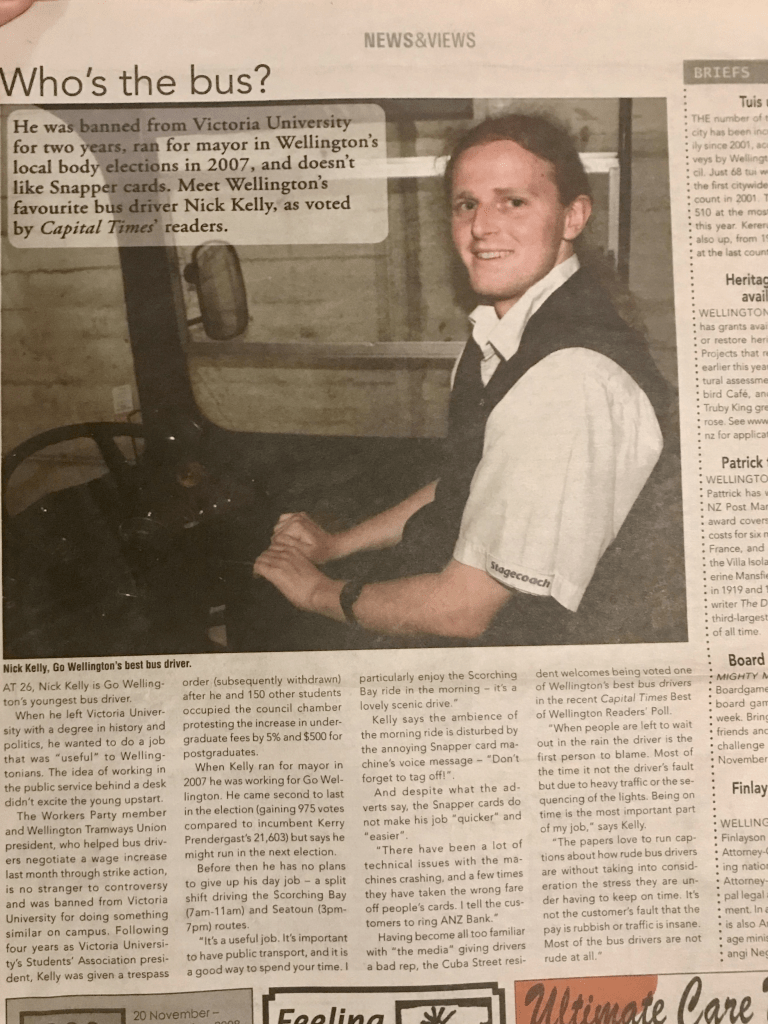
Within 18 months I was voted one of the top three bus drivers of the year in Wellington. I had regulars who would bring me coffee and biscuits, even the odd offer of weed (I didn’t accept). It became a job were I made life long friendships and really grew and developed as a young adult.

Capital Times on Nick being voted “Go Wellington’s best bus driver”. 19-25 November 2008

Why did I decide to go this way? In early 2007, Stagecoach Wellington (soon to become NZ Bus) decided to change all the drivers’ shifts. The aim was to cut penalty rates for drivers. In the late 1980s, the government deregulated the public transport sector. The result was councils having to privatise the bus services and run competitive tendering processes. In most cities drivers faced job losses and significant cuts to pay and conditions. In Wellington, the Tramways Union, (founded when the city still had a tram network) managed to hold this off. One reason for this was the trolley bus network, which created a barrier to entry for bus companies. Instead of breaking up the city network and having companies undercutting each other on tenders (and cutting drivers pay to cover it), in Wellington, Stagecoach and later NZ bus kept all of the CBD networks till 2018. The other reason drivers in Wellington maintained their penalty rates and other employment conditions, was that the vast majority of drivers belonged to the union.

In 2007 there was an attempt to break the union. Another union was brought in and they offered an inferior collective agreement where there was no penal rates or other conditions, but had a marginally higher hourly rate. Few drivers bought into this, despite the company actively pushing them. The shift changes made in early 2007 were designed to cut hours back so there would be less overtime, thus encouraging drivers to give up penalty rates. This didn’t work.

Fellow socialist Don Franks suggested I work on the buses for a bit. He’d been talking to a driver called Chris Morley who was active in the union. They thought the job could do with a firebrand who wouldn’t be afraid to lead the drivers into battle, and that I was the perfect candidate.

They weren’t wrong…

Previous posts in this series:

Why Trade Unionism

Earlier Blog posts about Nick:

School uniforms and the young Nick Kelly

Why the Labour Party

Radical Socialism

University and Student Politics

The Iraq War

Student Fees

VUWSA Campaigns

Blogs and the Political Establishment

The Student Union Building

VUWSA President – the realities of leadership

Post VUWSA Executive

Why Trade Unionism

Trade Unions are in their simplest form, people working together to achieve a common interest. The concept is nothing new, as the story of Spartacus from Roman times shows, people throughout history have stood together in solidarity. Collectively people are stronger to stand up to power structures than they are as individuals.

Industrial trade unionism that we know today is barely 200 years old and came out of the industrial revolution. When people moved from rural based peasant society to urban industrial capitalism, the working class was formed. This economic system meant people to survive had to sell their labour power to capital. Exploitation, unsafe working conditions, child labour and other terrible working conditions were common. The response of working people was to act together to demand better working conditions and better wages.

The Tolpuddle Martyres story of workers trying to organise in early 19th century Britain was a significant moment in trade union history. Unionism was initially illegal in the UK and most other industrialised nations. In Tolpuddle six agricultural workers were arrested in 1834 for attempting to organise and were sentenced to deportation to Australia. Mass protests resulted in the six being pardoned two years later. Through these sorts of actions, eventually it was accept that unionism and workers organising collectively was inevitable under industrial capitalism.

Celebrating Martyrs – History Workshop
The Tolpuddle Martyres

Many of the current global union organisations are products of the early to mid 20th century. The late 19th and early 20th century is the era that the modern trade union movement grew and made most of its political gains. Unions became a significant industrial and political force who often fought long hard struggles to improve the lot of their members.

Trade unions have a place and an important role in improving our working lives. Things that many of us in the developed world take for granted today such as weekends, sick pay, health and safety standards, anti discrimination laws, the end of child labour and countless other working conditions are the results of often long hard struggles by unions and their members.

Since the 1980s union membership has been on the decline globally. The official union/left response to this has been that this was the result of Neo Liberalism and attacks by the right. Certainly, the end of the post war boom and the attempts to offset this through Laissez-faire economics made life tougher for unions. However it is very easy to claim unions were victims of a right wing attack, rather than look any deeper.

Austerity and the free market economics we’ve lived under since the 1980s has held down wages and have failed to achieve the significant economic stimulation promise. But unions and the political left generally have not had a coherent response or proposed alternatives to this. Responses have been either to accept the changes and wonder why workers turn away from the organisations. Alternatively unions have harked back to the good ol’ days and proposed solutions that effectively ignore a) the causes of the post war boom to end b) development and changes in technology and c) solutions that in many cases weren’t that effective when they were in place 40 + years ago.

This is the first in a series of blog posts about my time working in the union movement. Like earlier posts, it will talk about my life and involvement with events. From this perspective, I will also talk about where I see the unions and the future of work.  I will be challenging in these posts. But I have no intention of writing a series of articles arguing ‘unions are moribund’. But nor will it be a series of posts filled with glib cliches about workers solidarity and references to 1930s folk songs. These posts will will express my views, without sugar coating or spin. These posts will record certain events from my perspective (including photos and media). My hope is it will add to a useful discussion about the future of work, the future of collective organising and how to achieve a better working life for everyone in the future.

Earlier Blog posts about Nick:

School uniforms and the young Nick Kelly

Why the Labour Party

Radical Socialism

University and Student Politics

The Iraq War

Student Fees

VUWSA Campaigns

Blogs and the Political Establishment

The Student Union Building

VUWSA President – the realities of leadership

Post VUWSA Executive

Black lives matter

“African slavery lacked two elements that made American slavery the most cruel form of slavery in history: the frenzy for limitless profit that comes from capitalistic agriculture; the reduction of the slave to less than human status by the use of racial hatred, with that relentless clarity based on colour, where white was master, black was slave.” Howard Zinn, A People’s History of the United States.

This week race has yet again dominated American politics and society. Over 150 years after the civil war and the end of slavery, 56 years after the passing of Civil Rights legislation, racial conflict and hatred remains an ugly scar on the country.

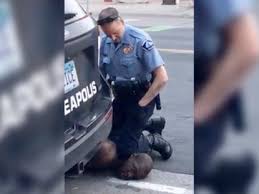
On 25 May 2020 George Floyd was murdered in custody by the Minneapolis Police. The cause of death was four police officers restraining Floyd for eight minutes and forty six seconds, kneeling on him to restrain him and eventually suffocating him to death. Floyd’s last words to the police restraining him were “I can’t breathe“, which has now become the rallying cry for protest movements throughout the world.

Decision made on possible charges against cops in Floyd case - New ...
Police officers in Minneapolis kneeling on George Floyd moments before he died.

From 2013 to present US police have killed 7,666 people. Despite making up only 13% of the US population, black people are two and a half times more likely than white Americans to be killed by the police. This map published by Aljazeera shows the states where Black people are most disproportionately killed by police in the United States.

The Black Lives Matter campaign was founded after the 2013 death of Trayvon Martin in police custody. Months later the officer responsible for Martin’s death was acquitted, as so often is the case with black deaths in custody in the US. Over the last 6 years this campaign has done much to highlight police killing of black people in the US, and has fought for those officers responsible to be brought to justice. This movement has continued to grow and raise awareness of this serious issue.

Large scale protests against black deaths in custody and more broadly against the way black people are treated by law enforcement in the US have been happening for years. In 1992 the city of Los Angeles erupted into riots after officers who had brutally beaten Rodney King were acquitted. During these riots the US Marines were sent into LA to try and restore law and order.

Despite the COVID-19 pandemic, large protests have turned out both in the US and throughout the world to condemn the Murder of George Floyd and the racism that fuelled this act of hate. Many of these protests have turned violent resulted in mass arrests and destruction of property, including police precincts. This violence has been condemned, and many have bemoaned the fact that people haven’t engaged in peaceful protesting. The below meme highlights why things have in fact turned violent:

Why don't they protest peacefully?" : The_Mueller

President Trump has taken a strong stance against protesters. In a tweet in response to the protest Trump quoted 1960’s Miami Police Chief Walter E. Headley who in response to the civil rights movement said “when the looting starts, the shooting starts.” Twitter placed a warning on Trump’s Tweet claiming it was hate speech, to which Trump has hit back saying his free speech has been stifled.

Trump has threatened to use the military to stop riots throughout the US. This week Trump used tear gas, rubber bullets and flash bangs to move protesters in Washington DC. Having cleared the protesters out of the way, he posed outside a church in DC holding a bible while talking to media. This act has been widely condemned by Christians and other faith leaders as opportunistic and disrespectful.

Trump has been consistently appalling on race relations. When running for President in 2016 he refused to condemn the Klu Klux Klan whose leaders had endorsed him for president. In August 2017, President Trump infamously said there was “fault on both sides” in Charlottesville when a woman was killed protesting against white supremacists. It would be easy to turn the heat on Trump, and he has certainly fanned the flames of racial division as President. But this problem goes much deeper.

Since European settlement of the Americas, racial violence and white supremacy has been a common feature. From the clearing of indigenous people of their lands, to taking African slaves to America to work the fields for white farmers, The United States has been built on the idea that White Europeans are superior and that their lives matter more. The civil war may have ended slavery, the civil rights movement may have changed the legal framework ending segregation in Southern States, but the idea that White people’s lives matter more has survived into the 21st century.

The United States claims to be a democracy. In a democracy, all citizens who pay taxes should be given the right to vote. Yet despite this in recent years there has been a trend of voter suppression in the US, and this has been targeted at America’s African American Community. One state that is now moving towards greater voter suppression, is the state of Minnesota in which the city of Minneapolis is situated. This is another example of how black people, and in particular working class black people are not given the same rights as white people in the United States. When black peoples voices are silenced in the democratic system, inevitably white privilege and white supremacy will go unchecked within the justice system.

Racism is not inevitable, and people are not born to hate others due to their skin colour or ethnic origin. White supremacy is a disease that has infected the United States since European colonisation of the region since the 15th century. It is a disease that sadly is not isolated to the United States, but has taken a particularly strong hold since Spanish and later British colonisation of the continent. Columnist for The Guardian Afua Hirsch has this week written an insightful article on the origins of this racist thinking which is well worth reading. The mistaken and dangerous idea that certain people are more intelligent or superior based on their racial origins has been long since dis-proven, yet this thinking persists. When a country has in the very bedrock of its foundations the ingrained idea of white supremacy, change has proved to be slow and difficult. But it doesn’t need to be.

One crucial way of challenging racism, both in the US and throughout the world, is to listen to the voices of those who have suffered at the hands of racism. We need to listen to the leaders of the Black Lives Matter movement, and understand the systematic racial prejudice that exists within the US police and justice systems. We also need to listen to those who have experienced racism, prejudice or have suffered from the actions or in-actions of those who are ignorant to how white privileged works. And finally, we need to stand with those whose voices and votes are being suppressed by white supremacists within the US political system. Black lives matter and we need to stand with those who are fighting for this. We all will be better off when the scourge of racial violence and institutional white supremacy is gone forever.

How Africa has weathered the COVID-19 storm

The World Health Organisation (WHO) has said that COVID-19 has so far made a “soft landfall” in the continent of Africa – with nearly 100,000 cases throughout and a relatively low number of deaths. Compared to other regions, Africa has been spared high infection and mortality rates.

The relatively low levels of infection are a combination of luck and good management. Many African nations implemented lockdown measures early, having seen the results of the virus spreading in countries like Italy or the UK. That Africa was not one of the early regions to suffer gave it time to take preventative action. Its leaders also had the good sense not to call COVID-19 “a little flu”, and subsequently not take appropriate action and condemn many of their citizens to death.

One of the factors that may have made a considerable difference in Africa is the actions of the African Union currently chaired by South African President Cyril Ramaphosa. Under his stewardship, the African Union have worked closely and effectively with the WHO on measures to stop the virus spreading throughout the region. They have also worked closely with the United Nations Economic Commission for Africa (UNECA) to push for debt restructuring in response to the global economic crisis this pandemic has caused. Unlike the European Union, the African Union has proactively helped the 55 nation members work together to combat this virus.

South African President Cyril Ramaphosa has stood out as a leader during this pandemic, implementing one of the toughest lockdowns in the world to stop the virus. His act fast, act hard policy has been widely praised as showing decisive leadership that has saved lives.


Cyril Ramaphosa at NASREC Expo Centre in Johannesburg where facilities are in place to treat coronavirus patients. Photo by JEROME DELAY/POOL/AFP via Getty Images.
South African President Cyril Ramaphosa has been praised for this decisive leadership during the COVID-19 pandemic.

Ramaphosa has no doubt learnt from his predecessor Thabo Mbeki’s abysmal response to the HIV crisis in South Africa where inaction by the government caused the virus to spread quickly. Sadly it’s through these sort of deadly mistakes that politicians learn the importance of prevention in public health.

The picture isn’t all rosy in Africa. As virus numbers rise, South Africa is warning it could run out of ICU beds in June. There are also grave concerns for the state of the South African economy as a result of the lockdown, given it was already struggling before this crisis.

Issues in South Africa pale in comparison to the issues in Tanzania, where the government is suspected to have covered up the infection rate and death toll. President John Magufuli has led a crackdown on anyone who criticises the government handling of COVID-19, and opposition politicians have had their phones tapped. Tanzania has been an exception in Africa where most governments have implemented a shutdown. In Tanzania, the president has fired health experts and refused to implement a lockdown. Africa Centers for Disease Control and Prevention has urged the Tanzanian government to share data on COVID-19 infection rates and remains worried at the lack of data coming out of the country to date. Kenya has closed its border with Tanzania apart from cargo traffic and imposed testing measures on Tanzanian truck drivers after more than 50 of them tested positive for the virus in a single day.

Tanzania is the outlier, with most other African nations acting responsibly and listening to WHO guidance. 100,000 cases of COVID-19 out of a population of 1.216 billion throughout the African continent is a very good result. Africa is the poorest continent on earth, and only a few decades earlier suffered from European colonisation. HIV and Ebola have added further suffering to a war-torn and impoverished region. The actions of the African Union, and the majority of its member states to prevent the spread of COVID-19 could well be a turning point for Africa. While much of the continent remains economically deprived, Africa has now shown the world that its leaders can take decisive action to save lives and prevent suffering. If crippling debt imposed on African nations by better-off countries (who in many cases were former colonisers of the region) can be written off, this region has a real chance to develop over the coming decade.


UK Social Care – a longstanding policy failure

The COVID-19 pandemic has brought to the fore the longstanding policy failure in UK social care. The UK has the second-highest COVID-19 death toll on the planet, and this is in no small part due to the virus spreading rapidly through residential care homes. But the problem in the care sector is bigger than COVID-19, this is a sector which has suffered decades of neglect and indecision by policymakers and the result has been deadly.

2m extra Government funding for MK Council to tackle coronavirus ...
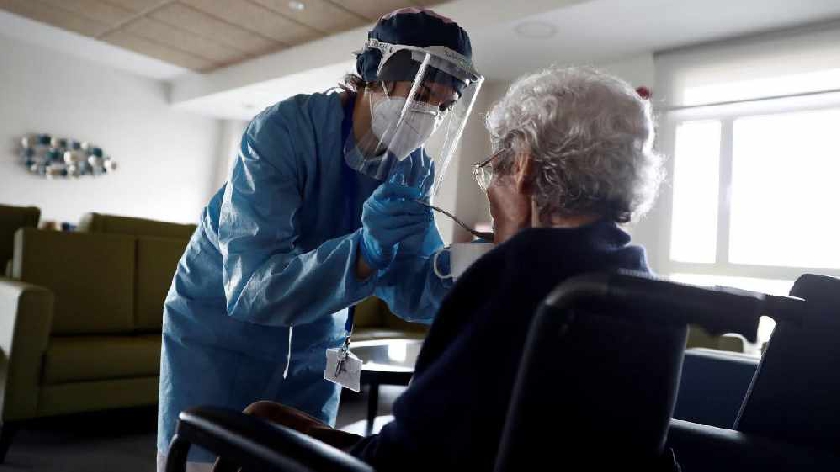
The UK care sector has suffered decades of neglect and indecision by policymakers

As levels of testing for coronavirus in the UK remain abysmally poor it is difficult to give precise figures. It is estimated that nearly half of the 36,000 COVID-19 deaths in the UK have occurred in residential care homes. Thousands of carers and those needing care have contracted the virus, though many still have not been tested. Some providers estimate that of those showing signs of coronavirus fewer than 25% have been tested. Of those who have been tested, many have had to wait days for their results to come back. In certain parts of the country such as Cumbria, care staff have been told they need to travel two to three hours to the nearest testing centre. Given all this, and the woeful lack of PPE given to care-workers, it is not at all surprising that the virus has spread in the residential care homes so quickly.

To be fair to the government, once the crisis hit the were prepared to spend money, but it hasn’t got to the right places. The government pumped £3.2 billion into the adult social care to support the sector during this difficult time.  Just this week, the government announced an additional £300 million would be given to funding infection control, specifically testing and contact tracing. As Care England CEO, Professor Martin Green pointed out when giving evidence at the Health & Social Care Select Committee this week, the money isn’t going to where it is most needed. In the UK, local authorities are responsible for managing social care. Recent government funding has been given to local councils who are then expected to pass this onto care providers, unfortunately, this has not always happened. As Martin Green explains, both local councils and care providers are very stretched right now, and the underlying problem is they are trying to manage an unsustainable social care system.

The number of people needing social care has been increasing in recent years. It is predicted there will be a 33% increase people living till 85 or older over the next 20 years (and many of these people will be living with long term health issues), so the demand for social care will continue to grow. Despite this clearly looming large as a policy area in need of attention, the response from successive UK governments over the last twenty has been to duck the issue.

The fundamental problem is that unlike the National Health Service (NHS) which is free at the point of delivery, social care is not. At present, anyone who has more than £23,000 in assets must pay the full cost of social care if they or their family members need it. The UK social care arrangements are a legacy of the English poor laws. When the Beveridge Report of 1942 was produced proposing to create the welfare state, there was no assumption that people would start living longer into retirement, often requiring ongoing care. When the NHS was established a few years later in 1948, a National Care Service was sadly not created as an appendage to it. Worse, no government in the intervening 72 years has thought to extend the NHS to cover social care, despite it quite clearly being part and parcel of the public health system.

As already explained, local authorities are responsible for providing social care in their communities. Through local government, there are publically funded social care services for people who have no ability to pay. However local government struggle to meet the demand, especially over the last decade of austerity where funding to councils from central government has been cut drastically. At the same time demand continues to grow. According to The King’s Fund 400,000 fewer older people have access to publicly funded social care than in 2010.

When people need social care, whether this is residential care or support in their own homes, it can cost them and their loved ones many thousands of pounds a year. Many are forced to sell their homes or spend their life savings to cover this cost.

Most care providers in the UK are contracted through private providers. During the COVID-19 crisis, many of the smaller operators have struggled to keep going due to empty beds (either due to COVID-19 deaths and people being reluctant to move into care facilities). The situation at present is that many of the current providers are struggling to keep going, and additional funding from the government is said to not be getting through to care providers. At the same time already stretched local authorities are facing ever-increasing demands for social care in their communities. Add to this the cost of purchasing PPE which remains scarce and expensive.

The other major challenge in the care sector is the lack of investment in staffing. Working in adult social care is not well paid, and people in the sector complain about a lack of parity with staff working in the NHS both in terms of pay and status. Social care workers will often be inaccurately described in the media as ‘low skill’ when nothing could be further from the truth. There are approximately 100,000 vacancies in the social care sector at any given time, and poor pay and stressful working conditions are seen as major contributing factors. The UK government points-based immigration system will likely make it harder care providers to recruit migrants, despite the care sector relying of overseas labour at present.

It would be wrong to suggest that the social care sector in England and Wales is completely broken. In Greater Manchester, the council under Mayor Andy Burnham has established a partnership between the NHS and social care to facilitate joined-up thinking and improve service delivery. The council signed a devolution deal with the government and is now responsible for the health and social care spending in the Greater Manchester area. Initiatives such as this are to be commended, however, there shouldn’t be a postcode lottery as to whether there is a well functioning social care system linked to the NHS.

After the 2019 election, when the Conservatives secured a large majority, Prime Minister Boris Johnson called for a cross-party consensus on how to solve the social care “crisis”.  Social care has been a political football in recent years. In the 2017 election the Tories had to back down on their “dementia tax” policy to pay for social care. This policy was deemed to be an additional tax on those with dementia or those needing long term care, and was very unpopular with the British electorate. Prior to this in government, the Conservatives had passed the Care Act of 2014 based on the principles in the 2011 Dilnot whereby after a lifetime contribution cap, individuals would be eligible for full state support in receiving social care. The Tories in coalition with the Liberal Democrats passed the bill in 2014, but in 2015 once governing alone announced a delay in funding the provisions in the Care Act, and this delay continues to this day. The bizarre situation of the government passing a law, only to then not fund or implement it would be quite funny were it not for the many thousands of people needing social care who have been left in limbo by this action. Social care has been placed in the too hard basket by politicians and clear decisive leadership to resolve the crisis has been sorely lacking. A cross-party consensus would be great as this would provide certainty to the sector, but this would still require making tough decisions, something that has been a distinct lack of to date.

There needs to be a National Care Service connected to the NHS, which is publicly funded to a level that nobody who needs care misses out due to financial hardship or a lack of appropriate care services. The cost of implementing this would not be cheap, and there would need to be an honest public debate about this being funded through general taxation. However, NHS figures showing the number of people admitted to A & E due to lack of social care and the cost and pressure this places on the health system would highlight the need to fund social care. Millions of pounds are spent each month treating dementia patients or others who end up in hospital when they really need social care to remain safe and healthy. In Scotland the devolved government has introduced free social care for people aged 65 years and over, there is no reason other parts of the UK can’t do the same.

That it has taken a global pandemic, where deaths in residential care homes have meant the UK has the second-highest COVID-19 mortality rate in the world, for policymakers to really sit up and take notice is a disgrace. Now is the time for making bold decisions to address the many challenges in adult social care.


Brazil – where the drug gangs show more leadership than the President

One of the more bizarre twists during the COVID-19 pandemic has been how the crisis has unfolded in Brazil. The country’s populist right-wing government has failed to implement social distancing measures, leaving the gangs to implement them in the poorest urban areas.

The response of Brazillian president Bolsonaro to the virus has been to describe it as “a little flu”, and encouraged people to keep going to work. There has been no official government lockdown in Brazil, and the country’s Health Minister was sacked by Bolsonaro for advocating social distancing. Current COVID-19 figures from Brazil are that 193,838 people have caught the virus, and 13,618 have died – meaning the country has the sixth-highest coronavirus infection rate in the world and by far the worse in South America.

Brazilian president Jair Bolsonaro denounced for joining pro ...
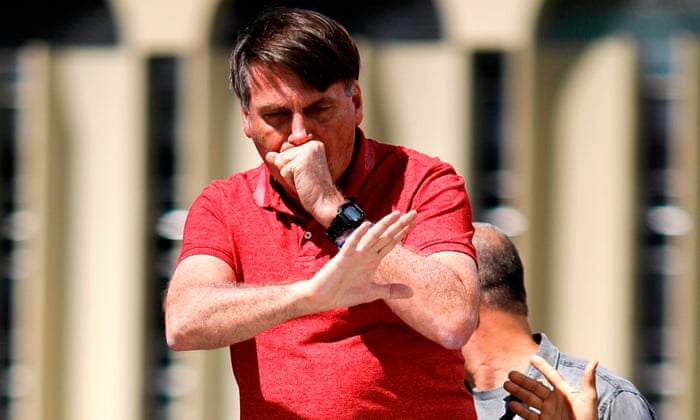
Brazilian President Jair Bolsonaro coughing while addressing a protest in Brazil recently. This protest was demanding a return to a military dictatorship in the country, a call the president appears to support.

To paraphrase Aristotle, power abhors a vacuum and the presidency of Bolsonaro certainly failed to provide leadership during this crisis. In the absence of the government taking responsibility, it has been left to the drug gangs to implement social distancing measures in the favelas. These gangs have been using WhatsApp and other social media tools to send out messages to people living in the slums of Rio de Janeiro. Below are a couple of examples:

“Whoever is caught on the street will learn how to respect the measure. We want the best for the population. If the government is unable to manage, organised crime resolves,”

“We are on the streets taking risks so that you can sleep in peace, we leave our families to protect yours, so, then respect the order we have given. If you are caught out on the street after 10pm, it will be bad”

What is the motivation for organised crime to take this action during this pandemic? Firstly it is good business sense to protect the lives of the people you make money out of. Mass death in the favelas is bad for business, as these are the people who buy your drugs.

Many of Brazils favelas were constructed in the 1970s when rural workers moved to Brazil’s cities. They are often poorly built and in close proximity to one another.

The second reason is ethos (ethical appeal to convince an audience of someone’s credibility or character). These gangs are about building and maintaining power in their communities. One of the key things needed to gain and sustain power is credibility, mass support and appeal. The evidence is pretty clear from the WHO and the scientific community that social distancing is required to stop the spread of the virus. This is logical reasoning or Logos to win support. It is the poorest, most densely populated areas which will be worst affected by the virus spreading. People in these areas will feel vulnerable and scared, so a group providing leadership to save lives will gain emotional appeal or Pathos. So at a time when people fear the virus and science is clear on what course of action is needed to prevent its spread, the way to gain credibility or ethos is to take the logical and popular course of action that the government should have but didn’t.

The third reason is the age-old story of organised crime. Anyone who has watched Peaky Blinders will know that criminals in gangs are usually looking for a way to turn legitimate. Making money from illegal activities poses a significant level of business risk. Though the returns may be high, the cost of being arrested, shut down or murdered by rival gangs or law enforcement is considerable. Providing public health leadership during a pandemic is a great way to establish yourself as a community leader, and get into local politics. There is a well-trodden path from organised crime to mainstream politics and there are many transferable skills when switching from one to another.

It is certainly not an enviable situation where your local drug dealer understands power, politics and leadership better than the man elected to be your country’s president. Much worse is that these same criminals, who make their money off selling additive substances that destroy lives, have shown greater respect for people living in the favelas than the government.

People in the favelas face threats of violence and intimidation from these gangs if they leave their homes during the pandemic. This is a horrible situation to live in. Yet at the same time, the crisis provides an opportunity for the gangs to implement this level of power and control with a level of legitimacy they would have never gained in normal times.

The conditions in the favelas are such that even with social distancing, it is difficult to stop the spread of COVID-19. Houses are built in very close proximity, and often large families are confined into a small living space. In these sorts of environments, it is next to impossible to stop the spread of coronavirus. Attempts to implement social distancing are the best chance people in these areas have of slowing the spread and saving lives. Whilst it is highly undesirable that this preventative public health measure is being run by criminals, someone needed to.


Little Richard 1932 – 2020: the King and Queen of rock’n’roll who gave us everything (NME obituary)

Below is the NME obituary tribute to musical legend Little Richard Sometimes you want to say something but someone has already said it best….so you repost their work on your blog:

One of the founding fathers of popular culture has died at the age of 87. RIP

It’s almost impossible to imagine what middle America must have made of Little Richard when he first emerged in 1955; this bisexual black guy, covered in make-up, standing up at the piano and banging out songs about bumming. The original lyrics to his seismic – and, really, that’s too weak a word for a song that tore a hole in the space-time continuum and brought the onset of modern popular culture crashing forward – first hit ‘Tutti Frutti’, changed at the behest of record label Specialty, went, jaw-droppingly: “Tutti frutti / Good booty / If it don’t fit – don’t force it / Just grease it / Make it easy.

Little Richard would still be outrageous and boundary pushing if he was making music in 2020, more than six decades after he conjured the spirit of freedom and rebellion in nine syllables. When he roared, in the opening moments of ‘Tutti Frutti’, “Wop-bop-a-loo-bop-a-lop-bom-bom!”, it was the big bang that ignited rock’n’roll, the birth of the teenager, the spark that lit the fuse that careered through the sounds of Elvis Presley and The Beatles, and which still courses through the veins of anyone – and anything – hell-bent on resisting the status quo.

Little Richard, who has died at the age of 87, was born Richard Penniman in 1932 in Macon, Georgia. One of 12 children, he earned his nickname due to his diminutive frame, which was not helped by an uneven gait that, some in the local community suggested, gave him an effeminate air. “I look back on my life, comin’ out of Macon, Georgia – I never thought I’d be a superstar, a living legend,” he later admitted. But Little Richard was different from the very start.

His father, Charles “Bud” Penniman, sold moonshine at a bar named the Tip Inn. Richard soaked up the black gospel music from the local church and was taught to play gospel piano by a male musician named Eskew Reeder, Jr., who went by the stage name Esquerita and wore heavy make-up and a flamboyant pompadour wig, which would later become Little Richard’s signature look. He combined these influences – the naughtiness of the bar, the passion of the church and Esquerita’s single-mindedness – with a love of boogie-woogie, which he began to play at travelling vaudeville shows as a teenager.

He spent the early 1950s recording rough blues songs for RCA Camden, a cheapie subsidiary of RCA Records, but it was with the Los Angeles-based Specialty Records that he concocted the raw-edged songs – ‘Tutti Frutti’, ‘Slippin’ and Slidin’’, ‘Lucille’, ‘Rip It Up’ – that, charged with his electric voice, would form the alchemical base of rock’n’roll. The man who would later hail himself as ‘the King and Queen of rock’n’roll’ was washing dishes at the Greyhound bus station in Macon when he was summoned to Specialty’s New Orleans studio to lay down the tracks.

Little Richard has passed away
Little Richard, circa 1957. (Photo by Michael Ochs Archives/Getty Images)

His 1957 debut album, ‘Here’s Little Richard’, which reshaped music forever, ran to just 28 minutes and 30 seconds. It reached Number 13 on the Billboard Pop Albums chart, gave him two hit singles in ‘Long Tall Sally’ and ‘Jenny Jenny’ (‘Tutti Frutti’ had already reached Number Two on the Billboard Rhythm and Blues chart) and led to his eponymous 1958 follow-up. By this time, though, he’d already denounced rock’n’roll and declared that he would dedicate himself to God. Speciality cobbled together the 1958 album ‘The Fabulous Little Richard’ from leftover studio sessions and added on gospel backing vocals to pad out the arrangements.

He claimed that God Himself told him to leave rock’n’roll, sending him a vision of a plane on fire. The prophecy caused him to fly home from his Australian tour 10 days early. Sure enough, the plane he was originally due to catch crashed into the ocean.

Despite his beliefs, Richard supped deep from the cup of rock’n’roll: he indulged in bisexual orgies and angel dust (the hallucinogenic drug PCP) and once claimed that he and burlesque dancer Angel Lee, who became his lifelong soulmate, had a threesome with Buddy Holly. “One time Buddy came into my dressing room while I was jacking off with Angel sucking my titty,” he told GQ. “She was doing that to me and Buddy took out his thing… He was having sex with Angel, I was jacking off and Angel was sucking me when they introduced his name on stage. He finished and went to the stage still fastening himself up.”

His initial dalliance with rock’n’roll was short-lived, but in this time he trademarked the musical cornerstones that would inspire others to push boundaries in the decades to come: The Beatles cribbed his “hooo!” vocal tick; Mick Jagger, Richard claimed, borrowed his lithe and suggestive walk; and David Bowie took his deliciously ambivalent approach to gender norms and rode it to the moon and back.

After three gospel records, Little Richard himself returned to rock’n’roll with 1964’s ‘Little Richard Is Back (And ‘There’s A Whole Lotta Shaking Going On!)’, though he would never recapture the reckless abandon that defined those first two albums (who could?). He later became a kind of pop culture curio, watching from afar at the chaos he had unleashed on music; he returned to gospel music and in 1970 became an ordained minister.

Through all this, though, he continued to play with his outrageous reputation, becoming a muse to the filmmaker John Waters, the self-styled ‘Pope of Trash’, and granting eyebrow-raising interviews in which he addressed the rumours around his sexuality. “Sex to me is like a smorgasbord,” he once explained. “Whatever I feel like, I go for… ‘What kind of sexual am I? I am omnisexual!’”. He was still touring as late as 2013, whenever armed with an eye for the absurd – he claimed “a baby aspirin” saved his life after he suffered a heart attack backstage in Nashville. He denied rumours of his death in 2016, and insisted: “I’m still singing.”

Credit: Getty

Little Richard didn’t invent rock’n’roll single-handedly – he, Elvis, Chuck Berry and Carl Perkins, all now gone, shared the weight between them alongside Jerry Lee Lewis – but it was Richard who, more than anyone, embraced the wildness, the raucousness, the contrariness and the untamed personal freedom that rock’n’roll represents.

In the mid-1950s he brought male bisexuality to a mainstream that’s still that not comfortable with the idea, then rejected the label as reductive; he was a founding father of rock’n’roll, then shunned the culture in favour of God. Little Richard fizzed with the transgressive energy that rock’n’roll passed onto punk, and which punk then passed onto hip-hop, the most super-charged and riotous music of the now. The man was volcanic, his red-hot spirit and blazing attitude continuing to burn through popular culture, and we have him to thank for everything. A-wop-bop-a-loo-bop-a-lop-bam-boom.