As well as working in local government at the Public Service Association (PSA), I also had responsibility for various Central Government entities. In my first three years at the PSA I organised several the smaller ‘State Sector’ organisations. These tended to be government agencies or government own organisation but were not core government departments or ministries. In 2015 I moved teams at the PSA and worked with the Inland Revenue Department and the New Zealand Defence Force.
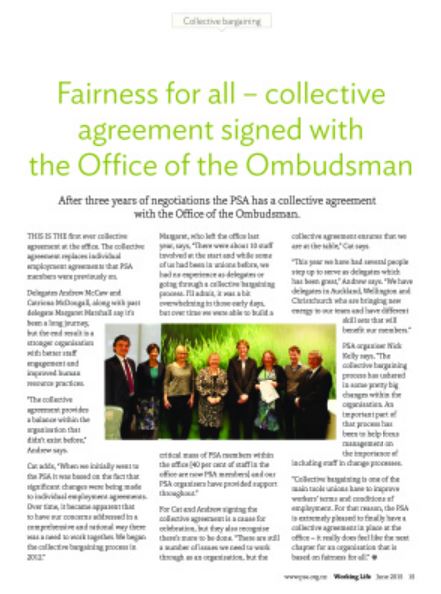
One of my first assignments at the PSA was to start a bargaining brief for the Office of the Ombudsmen. Prior to 1988 public sector employment conditions were set by the State Services Commission (SSC) for all Government Departments. After the 1988 State Sector Act was passed each department could then negotiate its own employment conditions with the PSA or individuals. This was followed by the 1991 Employment Contracts Act which heavily encouraged individual bargaining and discouraged unionism. As a result of this history, the Office of the Ombudsman did not have a collective agreement for PSA members. This worked ok for a while when they were a small team and had a fairly paternalistic employer who treated staff OK. As the Office of the Ombudsmen got bigger, it needed to stop running like a family business and more like other government agencies of a similar size.

Above: The PSA centenary parade in Wellington, October 2013
The process of negotiating that first collective at the Office of the Ombudsmen took over 3 years and was like a prolonged root canal. We started off presenting a model agreement from a PSA or government employee perspective. The employer came back with a fairly vague response, seemly hoping that we would just back down and accept the existing employment contract as the new collective. When it was pointed out that many of the policies and employment practices had significant flaws or were not necessarily in line with modern employment practice. After a few months of circular arguments and little progress, we meet with Dame Beverley Wakeham the Chief Ombudsmen to try and get things on track. She brought in Peter Cullen, another ex VUWSA President to lead the negotiations from their side.
Negotiating an employment contract in an organisation full of lawyers is a challenge. Everyone was very detail focussed and each clause of dissected and analysed multiple times. Neither side found it easy to compromise, especially on the particularly big issues of pay, pay systems, performance measures and restructuring and redundancy clauses. Whilst the PSA membership slowly and steadily increased during these negotiations, we started off with only the minority of staff in the union. A further challenge was while the delegates (elected worker representatives) were reluctant to compromise, they also did not see taking industrial action as viable. Some difficult conversations about the need for leverage in negotiations had to be had. From the employer side, the issue of having to invest time and energy into negotiations should have encouraged them to conclude sooner by trying to reach an agreement. This did eventually happen in 2015, by which time everyone just wanted it done.
The NZ Teachers Council:
The New Zealand Teachers Council were the registration body for NZ teachers. Like the Office of the Ombudsman, the Teachers Council did not have a Collective Agreement when I took over responsibility for them. Negotiations at the Teachers Council took 18 months, which was still long but a much quicker process than the Ombudsman. The Teachers Council started off with a very low PSA membership, but a small group of workplace leaders who were determined to improve things.
Working with this group was a joy. We quickly put together a model employment agreement that our members all endorsed. In early 2013 bargaining started, and though at first the process was not well understood by the employer, the discussions were positive. Within a few weeks we’d found agreement in a number of areas, and where there were differences there seemed to be a strong problem solving attitude which allowed us to keep making progress. It almost felt too good to be true, and we soon discovered it was.
The problems at the Teachers Council started when we tried to build a new remuneration system. Not only had the Teachers Council employees gone many years without a pay increase, there was a nominal performance pay system where in reality nobody got a pay increase regardless of performance. While we were able to make some progress on the elements of the system, the Teachers Council were insistent on using Hay pay data. The issue here was the data they chose to use was total remuneration where things like superannuation and various other allowances were added into the total salary package. This caused issues with transparency, as in it quickly becomes bloody confusing trying to understand people’s remuneration package. The other problem is that the Hay data used reflected a sample of the market movement and could not be relied upon to truly reflect the cost of living increases.
Remuneration was one issue with the Teachers Council, but soon the other areas where we had made such good progress began to unravel. In early 2014 we met with the employer negotiating team to try and finish off bargaining. At this meeting, the employer presented a new “clean” document they had been working on with their lawyers. Having already agreed things in bargaining the employer were now trying to back track. Legally this was not smart as it breached the ‘good faith’ obligations both employers and unions/worker representatives must adhere to in bargaining. This also is a very quick way to really annoy your workforce.
The PSA up to this point still had relatively low membership at the Teachers Council, meaning taking industrial action was a challenge. Despite this our members were willing to try, agreeing to start with low level collective action and build up. We started with holding PSA morning teas where we would hand out flyers and pens. We started signing up more people to the PSA taking our membership from barely over 25% to 50% in a short space of time. As former PSA colleague Bronwynn Maxwell once told me in a training session “the most effective form of industrial action is to sign up more people to the union.” And it was.
As the Teachers Council staff joined the union, and the PSA legal team hit the Teachers Council up about breaching their duty of ‘good faith’, the pressure was mounting. We agreed to mediation to get bargaining back on track. After a few sessions the Teachers Council agreed to drop the ‘clean’ document and go back to the clauses they’d agreed to in 2014. After a few changes we got what looked like a reasonable employment agreement. On remuneration, we did not get everything we wanted, but council staff got a significant pay increase and we agreed a process where the PSA and the employer would analyse relevant market data each year before pay rates were adjusted. To quote the Rolling Stones, “you can’t always get what you want, but if you try sometimes, you get what you need”.
Public Trust:
Public Trust had a close personal connection to me. My Grandfather had been the former head of the organisation in the late 1970s, and my Dad worked there for many years as a solicitor and manager. Both had been active PSA members on site. When I started working with Public Trust in 2014 I was often referred to either as Noel’s Grandson or Chris’s boy.
The New Zealand Public Trust Office was set up in the 19th century by the Government to provide a trustee service provided by the state. Since 2001 Public Trust as operated as a state owned enterprise providing a service in Wills, estate management and trusts.
Public Trust suffered from something that many government agencies have in recent decades, that being constant restructuring and change management. Every 2-3 years there would be a change of CEO/Senior Leadership Team/Board. Public Trust from when it founded in the 1870s through to 1998 only made a loss in one financial year. In the last 22 years the business has shrunk, and its balance sheet continues to worsen. The proposed remedy each time is another restructure, despite the previous restructure usually being the cause of the last loss. The Public Trust management team were usually external appointments from banking or insurance and had no real idea what the organisation did. Usually by the time they worked it out they walk before they get blamed for the latest crisis.
When I took over as the Public Trust Organiser the management had just imposed another round of grand-parenting, whereby staff employed after a certain date would no longer enjoy certain employment conditions. Specifically, Public Trust were enthusiastic about abolishing the redundancy clause as they were spending a fortune each year laying people off.
In the intervening 18 months between bargaining rounds, Public Trust announced yet another restructure. This was complimented by yet another expensive computer system, which staff were promised would actually work this time (it did not). Management were quite openly hostile to people who had worked at the organisation more than 3 years, probably because they would know more. I ended up representing several members in “disciplinary” meetings, where in reality someone with 20 years + experience was questioning their line manager who did not understand how the business worked. Confidential ‘exits’ or performance improvement plans (aka bully the staff members till they crack and leave) were managers way of dealing with people they had not managed to restructure out.
The 2015 Public Trust bargaining started out with the employer proposing to ‘modernise’ the employment agreement. What ‘modernise’ meant in reality was strip all hard-won employment rights out. The employer wanted to determine work hours and abolish overtime, they wanted to get rid of redundancy so they could sack long serving staff without the annoyance of paying compensation, impose strict caps on sick leave and were not at all interested in bargaining pay rates. And when we did not agree we were told that we were dinosaurs and that younger workers would prefer what they were tabling. We were told they were being reasonable; we were not and this was their final offer. This was in day two of bargaining.
We agreed to take their offer out, without recommendation by the PSA. Instead we suggested the CEO and their bargaining team attend our union meetings and explain the offer directly to PSA members. This was helpful to counter the idea that the PSA and staff reps on the bargaining team were not representing the wider membership, an allegation Public Trust had made a few times. At the meetings, the CEO received a frosty reception and some very tough questioning, not only about the negotiations but also about how the business was being run. We ran an electronic secret ballot of members, and only 1 person voted for the employer’s offer.
It took a further 6 months to get an agreement with Public Trust. The end result was not amazing, but considerably better than the offer members had rightly rejected before. Like the Teachers Council, we ended up involving mediation services. My boss Jeff Osborne got involved (at my request) to show that we were wheeling out the big guns. Having Jeff involved proved useful as he could talk about agreements at other organisations and to explain that what Public Trust was proposing was not ‘modern’ it was just command and control management.
Having moved (mostly) out of Local Government and completed bargaining at the Ombudsman and the Teachers Council, I was ready for a new challenge. The PSA moved me into what they called the Core Public Service – which were the main government departments. I picked up NZ Inland Revenue Department (IRD) and the NZ Defence Force.
Inland Revenue:
Inland Revenue was one of the biggest government departments and the 3rd biggest enterprise that PSA was responsible for. I was one of two organisers with national responsibility for IRD, Diarne Grant, Josh Gardner and later Cheryl Reynalds were my counterparts. We were responsible for managing the national delegate team, a great group of highly motivated and hard working individuals – but also a group that at times struggled with its own internal politics.
IRD had a legacy computer software system which dated back to the 1980s. At the time I started with IRD they were about to implement bespoke tax software system to manage the countries tax revenue. The department were under considerable pressure from the government to get this implementation right, as if it went wrong New Zealand’s tax revenue would be at risk.
Alongside this technology change, IRD were implementing significant organisational change. Over a 5-year change process, every single role was to change significantly. While many would be reassigned to new roles, the total head count at the department was set to decline. Many of those who had been employed in processing roles were set to lose their jobs as paper tax returns were to be replaced with online forms, though other new roles would be needed to be created to go through tax information submitted online.
The PSA’s strategy of constructive high engagement was tested through this process. The PSA wanted worker input into the new design and to be represented in all relevant decision-making forums. The challenge here to not be seen as just being part of the IRD management team rather than advocates for their employees. This was especially tricky when it became clear that the departments commitment to high engagement was more a commitment to tell the union what was happening, rather than have genuine engagement from their front-line staff.
The other challenge was that PSA, whilst the biggest union on site, was in competition with two other unions. One was a small union with few members, but the other, Taxpro, was an in-house conservative union with a significant membership. Traditionally IRD would do collective bargaining with Taxpro first as they would agree to what the employer wanted, meaning PSA was undermined when they came to bargaining shortly after. Over time the PSA had increased its membership and Taxpro were forced to work with them to remain relevant. One of the tensions within the PSA delegate teams (and at times with our PSA staff team) was the difficult relationship with Taxpro.
One of the projects I was involved with at IRD was their pay and employment equity review to end the gender pay gap in the department. At the time I was completing my History Honours degree at Victoria University and writing my dissertation on the Jean Parker vs IRD equal pay case of 1956. In 2016, 60 years after the first successful equal pay case in the public sector taken by the PSA, IRD still had a 20% pay gap between men and women in the department. In the working party the department took the position that the gap was almost entirely because fewer women were in middle management positions than men, and if it were not for that the numbers would not so bad. The PSA’s request to research this further than accept this assumption was not met favourably by the HR person assigned to this working party. This fight continued after I had left the PSA. Whilst I hated leaving unfinished business, the gender pay gap at IRD had been a battle the PSA had been fighting for over a century, and not something I was able to resolve in the 2 years I was involved.
When I picked up the New Zealand Defence Force (NZDF) role, my manager Basil Prestidge went through the history of organising civilian employees at NZDF. Much like Public Trust, NZDF had suffered from years of grandparenting and erosion of employment conditions. People who had started at NZDF prior to 2008 were covered by the grand parented document called ‘Part C’, and everyone employed after 2008 were covered by the new document called ‘Part B’. There were many differences, but the most significant was pay. NZDF decided in the mid 2000s that they no longer wanted to bargain rates of pay. They were aided in this by an omission in the Employment Relations Act 2000 which was silent on whether collective agreements needed to include rates of pay (for individual employment agreements it was clear that it did) or that these rates should be subject to negotiation. The result was those on the ‘Part B’ agreement were told by NZDF what their pay rate was, and the union had no ability to bargain the rate. Not surprisingly, union membership declined at NZDF after the implementation of this ‘Part B’ document. At the end of the briefing with Basil, he said with a smile on his face “you can’t make things any worse at NZDF.”

Above: Nick Kelly outside Devonport Navel base during NZDF industrial action, 27 April 2017
Just before we went into bargaining with NZDF, another union had won a court case against Jacks Hardware who had refused to bargain pay when negotiating their Collective Agreement. Whilst a legal strategy alone would never be enough, this provided some much-needed leverage. In addition, we had a national delegates team of worker representatives who were a) prepared to take on the fight and b) could see the bigger picture implications of this legal case both for NZDF and the wider public service.
The negotiations began in mid-2016, and as expected the employer team were not prepared to budge on the issue of pay. Having visited military bases up and down the country, we heard from civilian employees that in many cases pay rates were poor and they wanted something to be done. For the pre 2008 employees on ‘Part C’ NZDF had offered little to no increase in previous negotiations. On the eve of the 2016 negotiations, NZDF increased pay rates for those on ‘Part B’ and made it clear that ‘Part C’ people would get an increase much sooner if they switched over. For many on ‘Part C’ there were other additional allowances which made switching over uneconomical, but also for many there was a broader principle at stake. NZDF entered negotiations by playing divide and rule and refusing to seriously entertain the idea that rates of pay should be subject to bargaining, regardless of when someone commenced employment.
The PSA strategy was a two-pronged attack. The first was to take a legal challenge against NZDF on the grounds that under the duty of good faith they needed to bargain pay with the union. The second was to encourage members to take industrial action. At the commencement of bargaining we surveyed our members asking them a) what issues they wanted the PSA to push in bargaining and b) what collective action they were prepared to take to support these claims. This helped sow the seed that collective action maybe required as part of bargaining and started workplace conversations about what this would look like. There had been previous industrial action at NZDF, however it was still a rare event. Most NZDF civilian employees are ex-service and feel a loyalty to the military. Voting to take industrial action was a big step for PSA members at NZDF when they did in 2017.
In April 2017 we had a week of revolving action throughout the country. The action varied from place to place depending on what would be more effective. On certain bases such as Devonport, Linton and Trentham members stopped work and formed pickets either outside their bases or in prominent public areas nearby. On other bases members refused to answer calls or emails at certain times or stopped doing certain tasks that they knew were a priority for NZDF.
I left the PSA in 2017 having decided to move full time working for my company Piko Consulting.
Shortly after I left the PSA won the case against NZDF. This determination meant that NZDF could not refuse to bargain pay as this was not acting in good faith. Alongside the legal win, there was a broader political strategy at play with the NZDF bargaining. We hoped to use the industrial action and strategic litigation as leverage to get employment law changed so pay would need to be bargained and rates of pay published in collective agreements. In early 2017 Basil and I met with the Iain Lees-Galloway the then Labour opposition employment spokesperson. After talking to us about the NZDF situation and other unions facing similar issues with employers refusing to bargain pay, Iain agreed to table a member’s bill to correct this part of NZ’s employment legislation. 2017 was an election year, and when we met Iain the polls were suggesting it was unlikely Labour would win this election. But as the old adage goes, a week is a long time in politics and things can change quickly. In October 2017 Labour formed a coalition government, and Iain became minister of employment. When the incoming government made changes to NZ’s employment legislation, including pay in collective agreements was one of the amendments that went through.
Being an employment advocate can be a truly amazing job where you get to make real changes to people’s working lives. It can also be immensely slow and frustrating, and it requires an enormous amount of energy and patience to push through the many frustrating road blocks. As an advocate you play an important leadership role, but ultimately the key to success is having a strong team. The successes I had as an organiser could not have happened without my amazing colleagues on the PSA staff and the PSA members I was working with. It was a great opportunity to be part of the organised labour movement and help people in both big and small ways. I do not for a second regret my involvement, but I also realise that by 2017 it was time for me to move on.
Media report of NZDF industrial action 2017:
Pay promts protest against NZDF at Devonport military base
NZDF civilian strike “a last resort”
Stand Together for NZDF Civilian Staff
NZDF’s intimidating letter to strikers “appalling”
Radio New Zealand: Defence Force accused of intimidating striking staff
NZDF undermining tactics continue
Earlier posts in this series:
Why Trade Unionism
“Its a shit job, it pays shit money and if you don’t like it you can fuck off” – My introduction to bus driving
Tramways Union: From new driver to union president in 18 months
Go Wellington bus driver lockout 2008
Buses, bikes and pedestrians collide: Unions supporting health and safety
Tramways Union: Strikes, sex scandals and solidarity
Wellington buses now: how a local authority harmed public transport
NZ Public Service Association & the Soviet Union partnership plot
Public Service International – global unionism
Local Government – crucial and undervalued
Earlier Blog posts about Nick:
School uniforms and the young Nick Kelly
Why the Labour Party
Radical Socialism
University and Student Politics
The Iraq War
Student Fees
VUWSA Campaigns
Blogs and the Political Establishment
The Student Union Building
VUWSA President – the realities of leadership
Post VUWSA Executive



 Nick Kelly