Local Government provides some of the most crucial and front-line public services we have in society. Yet internationally, voter turnout and engagement with Local Government is generally abysmal.
The services provided by local and central government vary from country to country. Certainly, living in the UK Local Government plays a much stronger role in social housing, public health, and education than in NZ where these are the responsibility of Central Government.
In 2012 I started working at the Public Service Association (PSA), the union for public servants in New Zealand. The PSA organised the core public service, health workers, community public services (including social care) and Local Government. The PSA had merged with the Northern and Central Local Government Officers Union in the 1990s. The Southern Local Government Officers Union merged with the PSA in 2015 while I was working in the sector.
Local Government was often viewed as the poor cousin both within the PSA, and more broadly within the public sector. From a union perspective, much of the sector was not well organised and often it proved difficult promoting PSA membership to council workers. There were notable exceptions to this. When the Auckland councils merged into one super council in 2010, the PSA successfully signed up thousands of members and played a crucial role in protecting and improving employment conditions in the new council.
One feature of Local Government, at least in New Zealand was that it often had a small ‘c’ conservative workforce. Where unions, or specifically the PSA did not have members it would generally be a slow painstaking exercise signing people up. The chicken and egg situation always were that you needed members to win decent conditions, but to sign members up you needed to promote the good work the union had done. If there were previous bad experiences of the PSA or any other union, this became 10 times harder. Talking about good work done at other workplaces only went so far, as people wanted to know what you could do in their workplace. Eventually, we would always breakthrough, but it was often a slow process.
The other problem with local government was the general lack of knowledge about what it did. When trying to promote local government or campaign to save or improve services, the initial step is to raise awareness. Very often the public does not realise what services are provided by their local council. Even fewer can tell you what is provided by a local council vs a unitary authority or regional council.
The other significant challenge in local government from a union perspective was the multiple unions working in the space. This was often down to historical issues, such as one union organising all the gardeners or parking wardens when another organised the clerical staff. These demarcation lines were seldom clear and would often lead to competitive unionism and other distractions. The issue of competitive unionism certainly is not limited to Local Government, but in New Zealand, it was certainly a problem in this sector.
My role in the PSA was initially one of the local organisers responsible for looking after the councils. My patch was Wellington City Council, Wellington Regional Council, and some of the privatised council work units. My colleague George Laird looked after the other councils in the region, and Wellington Water the shared entity set up by the councils to manage the regional water supply. In reality, we shared the workload from the local councils and designed a joint strategy to improve collective bargaining outcomes for council members in the region.
When George and I started in 2012, Porirua and Upper Hutt City Council’s had no collective agreement. Wellington City (the largest council) had collective agreements covering Library and Building Compliance and Consent staff, but not anyone else. The regional council had one of the better collective agreements, but conditions were coming under attack from management. And contracting out of services meant that many council services were provided by private companies – some represented by unions, many others not.
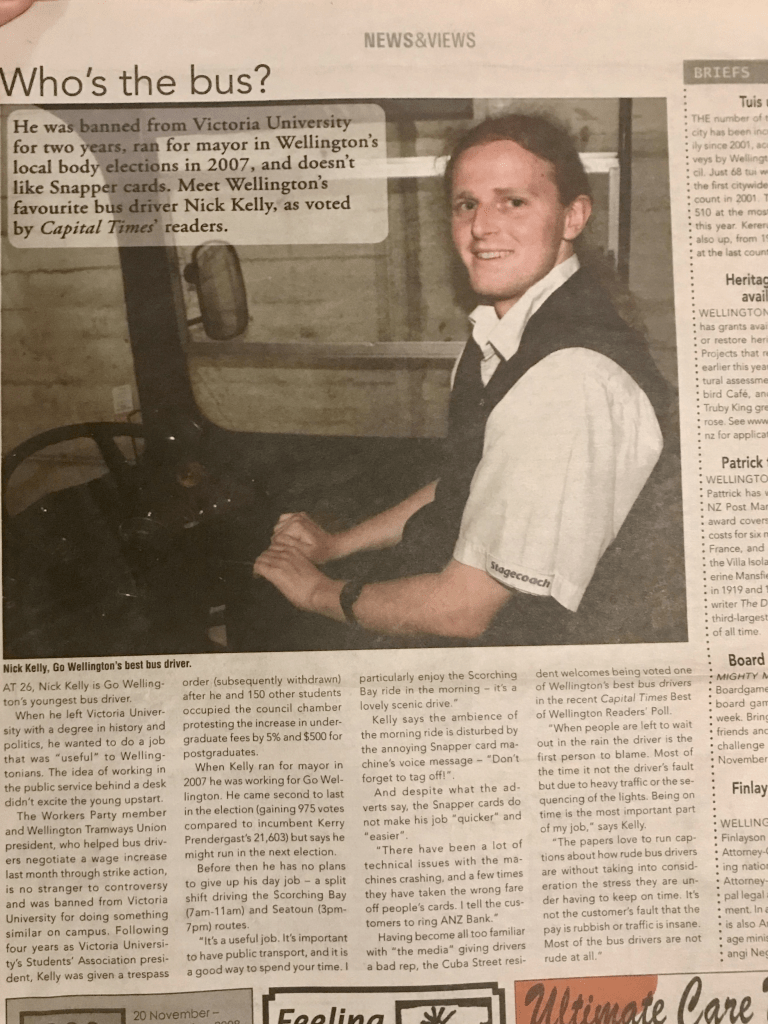
Contracting out and privatisation has been a trend in New Zealand Local Government since the 1980’s. The Wellington buses I had worked on previously were until 1990 run by Wellington City Council and the drivers were council employees. Throughout the 1990’s councils contracted out many of their services to private providers. The driver for this was largely ideological and encouraged by the Central Government.
When we challenged the incoming Wellington City Council CEO about this in 2013, he responded that councils have always use the private sector as they “do not make pencils.” On one level this is correct, it would be daft to say there is no role for the private sector in local government. But the issue was services being contracted out to the private sector, without a business case demonstrating efficiency or where it would save the community money. Worse, too often the contracts were awarded to the company who put in the lowest tender, then subsequently failed to deliver the service they were contracted to, resulting in increased costs to the council.
For council employees, promises of transferring to a new employer on no loss of pay and conditions were great words, but all too often nothing more. In many cases, workers were simply made redundant after decades of service and given little to no compensation.
One example of this was Wellington City Council contracting out their Citi Operations business unit by stealth. In the mid-1990s, the elected councillors had voted down a proposal to privatise the council’s public works unit. The argument then was that the council should continue to do maintenance of the city’s roads, footpaths parks, drains, rubbish collection and the rest. Having lost the political battle, council senior management began a nearly two-decade campaign to outsource all the council operations jobs. This went largely unnoticed by the elected councillors.
This article I wrote for The Standard in 2013 gives a bit more context.
By March 2013 Citi Operations was almost gone and outgoing CEO Garry Poole was just getting rid of the final bit when I started organising WCC. The team of about 50 were all that was left of the once 1000 strong Citi Operations group. When I contacted local councillors about this none of them knew of the proposal and were very annoyed. In particular Labour Councillor and now MP for Rongatai Paul Eagle was outraged. He and I met with the workers several times in the first few weeks of 2013. Various other councillors also got on board and we mounted a campaign to save the 50 remaining Citi Ops jobs.

On the day of the council vote, we organised for the effected Citi-Ops workers to sit in the public gallery in the Council rooms wearing their High Viz’s and work gear. I was one of three speakers for the union, expressing opposition to axing these jobs. The Council debated the issue for about 30 minutes. Those councillors in favour of making the workers redundant argued that they should not interfere with management decisions. Those against the decision felt that management did not have the mandate to make this decision. The vote ended up being 7-7, so Green Party Mayor Celia Wade-Brown used her casting vote to uphold management’s decision to outsource these workers jobs. The Citi Operations staff were sitting in the room, so Celia and the councillors were looking at these workers as they made them redundant.

Saving Public Libraries and the Living Wage
Privatisation was not the only thing Wellington City Council management was trying to do by stealth. We discovered through our members in the Library that WCC was planning on cutting over $1 million from the Library budget and had in previous years made even bigger budget cuts to the library operating budget. The details of this can be seen in Gordon Campbell’s article from the time.
The PSA had strong membership in Libraries, who were very vocal against cuts to the service and library branch closures. The PSA helped form a community coalition of Library users to campaign against branch closures and cuts to the services.
Like the gradual privatisation of Citi Operations, elected councillors had no idea that library budgets had been cut. None of the documents that senior management had presented to council pointed this out. When we produced the actual budget documents that Council Senior Management had presented to Library management and staff, it became clear that there were to be cuts to the Library budget. Library staff were told they were not allowed to talk to elected councillors about this as that would breach the council code of conduct. When I discovered this had been happening, I worked with colleagues to ensure the alarm was raised.
2013 was a council election year, so cutting library budgets was not a popular move. Councillors were quick to call for the cuts to be reversed. With public pressure from the Library’s Coalition, we were able not just to stop the cuts but secure a modest funding increase for the city libraries that year.
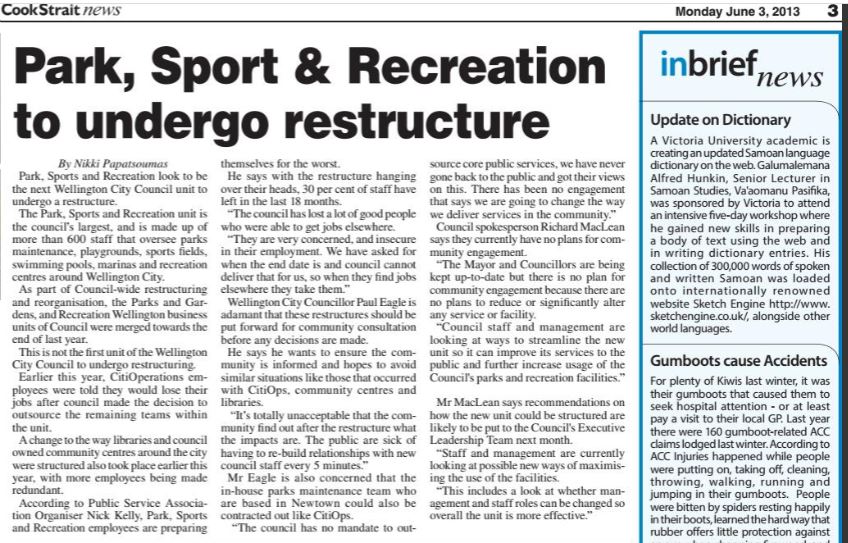
Above: One issue at Wellington City Council was they were constantly restructuring and forcing staff to reapply for their jobs. Over time this is very damaging to staff morale in any organisation.
The other significant campaign that started in 2013 was the Wellington Living Wage campaign. Based largely on similar campaigns in London and San Francisco, the aim was to get all wages in the city up to a rate that was calculated to be liveable – as in a worker could provide the basics for themselves and their family.
Mayor Celia Wade-Brown was quick to sign up to this campaign in an election year, and the then Service and Food Workers Union were happy to get the Mayor of NZ’s capital city on board. The campaign rather than being union led, was a coalition of faith and other community groups, political parties, and unions.
This was a positive campaign and did get some early victories with the council voting to adopt the living wage rate for all those employed by the council. By employed, they meant directly employed – not the many workers whose jobs had been outsourced to private companies. This meant many of the lowest-paid workers such as the cleaners, the parking wardens and the council security guards missed out.
For those who got it, there were issues too. Most of the directly employed council staff were in the PSA if they were in a union so I ended up representing them during the implementation phase. Pool lifeguards were told they would get the new living wage rate, but only once they had completed training which would take three to six months. Our argument was that if it is a living wage and what someone needs to survive, then the living wage should be the starting rate and training should just be happening anyway. The other issue was the small issue of inflation. In 2014 when the living wage campaign announced the new rate, I wrote to the councillors as the union organiser asking them if they would be paying the inflation adjustment. Several councillors panicked, not realising that the living wage would increase each year (because presumably, they had never heard of inflation before) and got cold feet. The council management tried to get around this by calling it the Wellington wage – which would increase each year but not as quickly as the living wage.
Collective Bargaining:
The real goal for the PSA was to get bargaining sorted across the Wellington Councils. The employment conditions varied wildly across the different councils just in the Wellington region, and even more so nationally. One of the issues was that each council bargained separately and often at different times. Our goal was to line up bargaining dates across councils in the region so we could bargain, and if needed take industrial action across the region at the same time.
The best of the Agreements was the Wellington Regional Council unitary authority, where we were constantly playing a game of defence against HR who were doing their absolute best to claw back employment conditions. This was not an easy task when other council workers in the region had inferior terms of employment.
At Wellington City Council (WCC) there was a significant gap between those who were in the PSA and covered by a Collective Agreement and those who were not. In 2014 we had our first attempt to do a single collective agreement to cover all WCC employees. At those negotiations, we succeeded only in combining the two existing agreements in the Libraries and Building Consents. Under NZ employment law, any workplace with two or more union members is entitled to be covered by a collective employment agreement. As the council were trying to treat each department as a separate business unit, I responded by initiating bargaining for each one. After a heated email exchange between the HR team and I (much to the entertainment of council members I bcc-ed into the exchange), the council finally decided that negotiating 15 separate contracts was not how they wanted to spend the next year. It took us another 18 months, by 2016 we had successfully negotiated an agreement that covered all business units in the council meaning there was a consistency of, and improvement to employment conditions.
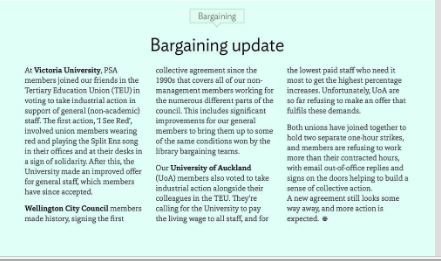
Above: The PSA Journal reporting on the historical collective agreement signing in December 2016.
During this time, my colleague George successfully negotiated the first Agreement at Porirua City Council in twenty years. By the end of our time working in Local Government all but one council had a collective agreement. Though the bargaining continued separately for each council, we were achieving greater consistency of conditions across the region.
The goal could not just be to improve the working conditions for those directly employed by council. Large swathes of council workers have had their jobs outsourced to the private sector. The challenge for the Living Wage campaign was to get councils to make their contractors pay this rate when private sector companies would argue that the council should not be stipulating terms of employment. Also, councils like having the excuse of not paying the difference saying it was up to the private company to find the money. Generally, workers employed in these private companies were on worse conditions, as the council would go with the lowest tender when outsourcing work.
In 2013 we picked up a group of road and footpath maintenance workers who had just been transferred from one company to another. The union that had been organising them had failed to do anything during this transfer, resulting in the workers losing all their conditions of employment. This workforce had been without active union representation for some time, despite their depot being located next to a large private-sector union office. A PSA colleague Melissa Woolley put me in touch with these workers after talking to a few of them at her local pub. From there we were able to sign up most workers on-site and negotiate a collective agreement. Unfortunately, about 18 months later the company lost the contract and all these workers got made redundant. Wellington City Council’s response was that they were not responsible for employment matters with their contractors.
Shortly after this, the council started bringing certain services back in-house. The council parking wardens had been outsourced for a couple of years. The decision was made to employ the parking wardens directly and increase their pay to the living wage.
Local Government – National Strategy
As well as doing local work, I was responsible for coordinating the Local Government Sector Committee. These committees sat under the board, the governance structure body of the PSA and were responsible for the sector nationally. I was also one of three national organisers who had oversight of the PSA’s organising strategy at a national level. During this time, the PSA merged with the Southern Local Government Officers Union, so I was part of the committee when this integration took place.
The big national issues at the time were proposals to amalgamate councils, which had started off with the Auckland region where the councils had all been merged into one larger entity. Attempts to do this throughout the rest of the country had met with resistance, including in Wellington. The PSA took no formal position on council amalgamations, though many officials were in favour of mergers based on the Auckland experience. The PSA had increased its membership during the Auckland process by being proactive and ensuring council workers concerns were raised during the process. Outside of Auckland, PSA members were wary of mergers and were pushing the organisation to oppose any change. The Government eventually walked away from council merger plans when it was clear there was growing public opposition.
In 2015 I moved from local government, instead working with government departments. The time working with local authorities taught me that these are crucial branches of government that have considerable power. While people tend not to engage on local council matters, when services are at risk of being cut, they will get involved. Often people are simply unaware of what local government does or how to influence it. When people do get involved in local government politics there is the potential to make real and significant changes to the lives of many in our communities.
Earlier posts in this series:
Tramways Union: From new driver to union president in 18 months
Go Wellington bus driver lockout 2008
Buses, bikes and pedestrians collide: Unions supporting health and safety
Tramways Union: Strikes, sex scandals and solidarity
Wellington buses now: how a local authority harmed public transport
NZ Public Service Association & the Soviet Union partnership plot
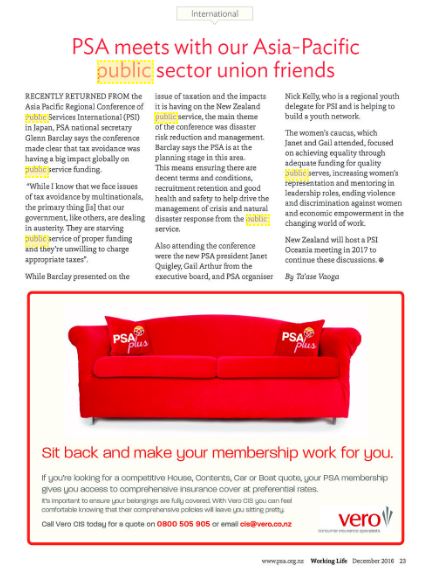
Public Service International – global unionism
Earlier Blog posts about Nick:
School uniforms and the young Nick Kelly
University and Student Politics
Blogs and the Political Establishment