Labour candidate in the Ladywell Ward of the London Borough of Lewisham. Promoted by John Paschoud, Thomas Carter and Will Cooper on behalf of Lewisham Labour, all at 43 Sunderland Road, London, SE23 2PS.
You probably will not remember me. I was the campaign manager for Andrew Little when he ran for Labour Leader back in 2014. The last time we met was in Burger Fuel on Cuba Street the day after you took over as Labour Leader in 2017. I was with my colleague from Piko and we were both covered in paint after doing work at our Trades Hall office. We certainly weren’t expecting to meet the future Prime Minister that evening.
I am emailing to say thank you for all that you have done, both in New Zealand and internationally since becoming Prime Minister. I now work as a Researcher in Westminster and I can say that you have earned the respect and admiration of politicians from all sides of the political divide over here in the last five years.
In particular, I wish to acknowledge the strong compassionate leadership you took after the Christchurch Mosque attack. Your simple statement “they are us” regarding Muslims living in Aotearoa had a profound impact and broke down barriers of hate and ignorance at a time when tensions were so high. I still tear up thinking about how important your showing humanity and compassion was at that dark time. Thank you.
Your government’s response to the coronavirus in 2020 was the right one and undoubtedly saved thousands of lives. Again, having lived through the UK response to this crisis, I and many others living here looked to the NZ response with considerable admiration.
The last couple of years has been difficult for governments throughout the world. The Ukraine invasion on the back of a global pandemic has seen inflation skyrocket everywhere. People understandably look to their elected representatives in difficult economic times and we know that the actions of the government can help or hinder economic recovery. But there is also much that is out of the hands of the nation-state. Where governments can have the most impact is on policies that help in the medium to long term. In the short term, options are quite limited and it is easy for our leaders to take the blame for things that are largely out of their control. The New Zealand government has managed this crisis better than many in the last 18 months. In years to come I hope this is recognised.
Your legacy as Prime Minister will be as someone who showed both strength and compassion in some of the most challenging times faced by any leader in modern times. On the world stage, you are rightly held up as a model of progressive political leadership, and I am certain this will continue into the future in whatever role you take on next.
Finally on a personal note, due to the coronavirus, I was only able to spend two weeks in Aotearoa during your time as Prime Minister. But as a Kiwi in London, I was proud of your leadership both of our party and of the country.
The demise of Boris Johnson’s premiership in 2022 was both a surprising political upset and entirely predictable at the same time.
It was a political upset when considering the large majority the Conservative Party won in 2019 under his leadership, the best result of any political party since Thatcher’s 1979 election victory. Yet, after months of reports about Party Gate and scandal after scandal involving both Boris Johnson and various other MPs, his eventual resignation in June 2022 became inevitable. Indeed back in February last year my blog post questioned how he was still in post and argued that his brand was damaged. Five months later, after yet another scandal involving Deputy Chief Whip Chris Pincher, he was forced to resign.
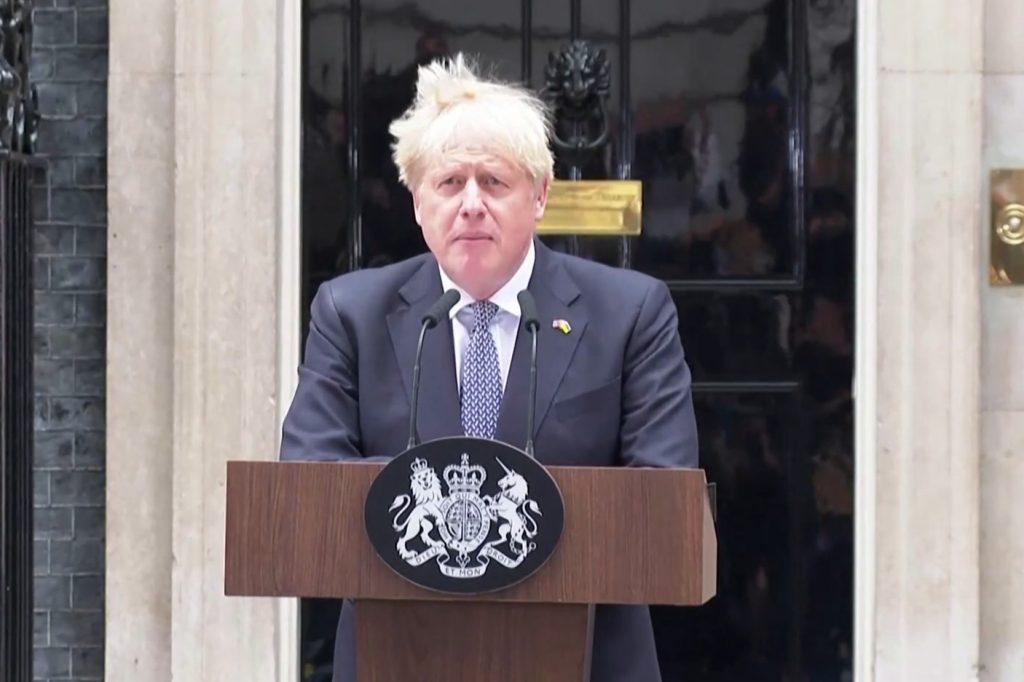
Boris Johnson resigned as PM in June 2022.
It is still too soon to say how history will judge Boris Johnson, not least because there is still the possibility that he may return as Tory Leader someday. Few can deny that his ascent to the role of Conservative Party Leader and Prime Minister in 2019 profoundly impacted British politics for many years to come. In 2019 I said that one of Boris’s strengths as a politician was that he could tap into people’s hopes and fears. He would have been a formidable Leader of the Opposition, and if the Conservative Party do not win the next election this theory may be put to the test.
Yet, Boris Johnson is a deeply flawed character whose political ambition has and continues to come first. What little political or policy conviction he held was primarily about staying on brand and winning votes. This in itself is not unusual and in modern politics, one can have quite a successful career by being transactional and self-promotional.
Boris Johnson was ultimately undone by both his own character flaws and by the direction of the Conservative Party, the latter being seriously out of touch with the mood of the British public.
Plenty has already been said about Johnson’s character flaws, which were well-known long before he became Prime Minister. For those who backed him, there was plenty of evidence that things would turn out as they did. The fact is that like Johnson, his backers promoted him for short-term gain. Specifically to break the political deadlock caused by Brexit and to win an election largely on that issue. It worked.
But the fixes the Johnson leadership provided, under the guidance of Dominic Cummins and others, were largely short-term. His oven-ready Brexit deal may have won the election in 2019, but has resulted in a long-term stand-off over the Northern Ireland Protocol causing ongoing problems. The bold assertion during his resignation speech that his government had fixed social care is simply not true, with the system overwhelmed and the system still facing serious workforce shortages and lacking proper integration with the NHS.
The three years of Johnson’s premiership will be largely remembered for the Government’s management of the coronavirus pandemic. As I have addressed in earlier posts, the Government failed in its response to the pandemic. Yes, the rollout of the vaccine was a success, in no small part because this task was administered by the NHS, one of the most trusted British institutions, rather than being contracted out to businesses with close association with the Conservative Party. Examples of favourable business deals, such as those given to Dido Harding or Michelle Mone, whose companies were awarded lucrative government contracts and failed miserably in delivering have left a sour taste in voters’ mouths.
This all happened under Johnson’s watch and he was simply not fit to lead the country during this crisis. But he did not act alone. It was a failure not only of the Conservative Government but also of the British state. The crisis highlighted the country was not prepared for a pandemic, and longstanding underfunding of the NHS made this much worse.
A month before Boris Johnson’s resignation at PM, I argued that during the current time when inflation has increased globally, national governments are limited by what they can do, in the short term at least. Incumbent governments of all political persuasions have struggled in the last year, so it is not surprising that the Conservative’s polling numbers have been poor during this crisis. But in the same way that the Tories blamed Labour’s spending levels for the 2008 financial crisis, despite strong evidence that this was not the case, they cannot now claim economic problems are beyond the control of the nation-state without looking like hypocrites. Again, the short-term electoral gain in 2010 has now made a rod for their backs a decade on.
Yet he retains core support within the Conservative Party, and with a group of Tory MPs. He also enjoys a surprising level of support still with the British public, though nowhere near the level he enjoyed in December 2019. His two months as caretaker Prime Minister in July and August 2022 during a cost of living crisis certainly did not help matters, where he partied in the Cotswalds and took holidays in Greece while many voters struggled to pay their bills. Meanwhile, the Tory Party spent the summer holding a leadership election, where, as the next post will discuss, the least competent candidate was elected by Tory members.
Boris Johnson believes that like his hero Winston Churchill, he can return to power one day. He probably believes that he fixed social care, did a good job during the pandemic and did a good job with his Brexit deal. Or he knows that if you repeat a lie often enough people start to believe it. When you have a legacy to protect and want a future in politics, you say what you need to say and do what you need to do. And the Tory Party? Would they put him in power again? If they thought it would increase their vote, yes they would. That he is not suitable or trustworthy is no matter, when the motivation is power at all costs.
Were Johnson to return as Tory Leader for the 2024 election, he would almost certainly lose. However, he may motivate a section of the Tory base and Brexit supporters, possibly mitigating the losses. On the other hand, this might spur on a wave of tactical voting by Labour, Lib-Dem and Green voters to punish the Tories for putting Johnson back after all that has happened.
It is risky to make predictions, but it is safe to assume we have not heard the last of Boris Johnson. And much like Berlusconi in Italy, the results will undoubtedly be bad both for politics and the country.
As the world currently goes through a post-pandemic and Russian invasion of Ukraine fuelled economic crisis, it is interesting to reflect on the economic crisis of over a decade ago and how the public responded at that time.
After the 2008 financial crisis, despite predictions to the contrary at the time, there was a global shift to the right in the years that followed. Examples of this include the fall of the Brown Government to the Tory/Lib-Dem Coalition in the UK in 2010 or the Clark Labour Government being voted out in 2008. After some initial excitement about Obama’s election in 2008, the Republicans easily won the 2010 mid-terms. There were plenty of other examples across Europe, South Asia and South America of progressive or centre/centre-left governments falling.
Given the financial crisis exposed the failings of the banking sector and free market economics, it would seem strange at first that it was the political right who were the primary beneficiaries of this. In certain countries, incumbency was the issue where rightly or wrongly the party in power were blamed. The late 1990s and early 2000s were the height of the Third Way era, meaning many progressive governments had accepted and made little attempt to reverse the free market reforms of the 1980s. Whilst this position was electorally popular up to this point, by 2008 this position was not tenable. Meanwhile, the right was much quicker to pivot away from Laissez-faire to a more traditionally conservative position, raising concerns about immigration whilst claiming to be prudent economic managers. The politics of austerity were never popular where they were implemented. Yet, the argument that national debt is like household private debt where you just have to tighten your belt to get out of the red was not adequately challenged. That cutting social spending, holding down wages and other earnings and other such measures resulted in less money in the economy thus making the crisis worse became obvious, eventually. Yet in the early 2010s, many European Governments were implementing these sorts of policies.
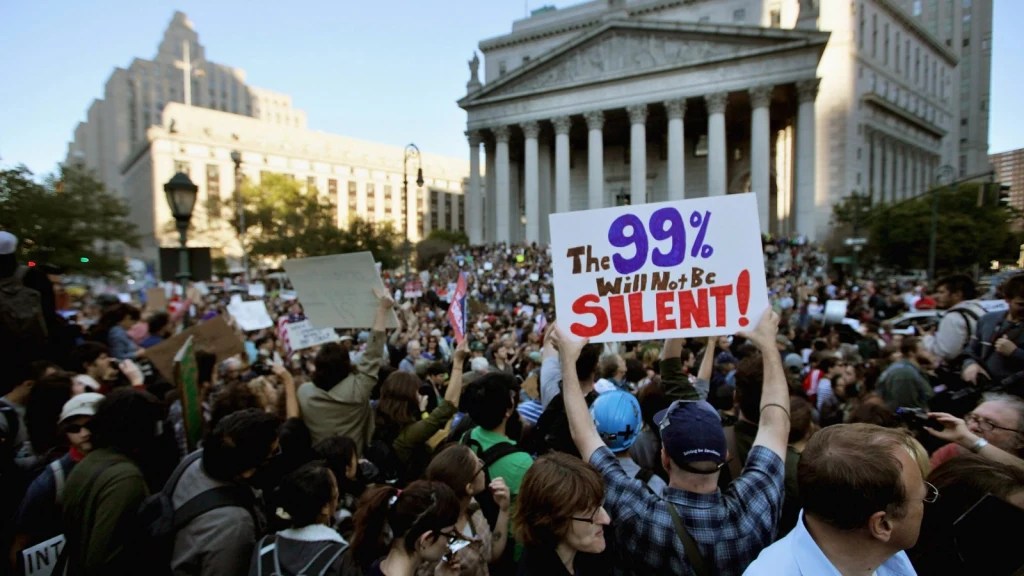
Above: Protesters in the Occupy Wall Street protests of 2011. One of the lasting legacies of this movement is the political slogan “we are the 99%” which continues to resonate with millions around the globe.
It was in this context that ‘Occupy Wall Street’, which quickly grew into the international Occupy Movement was born. Anger at banks being bailed out in the US whilst people’s homes were being repossessed and a feeling that the elected politicians had failed to stand up to Wall Street sparked this protest movement. The protests took inspiration from the Arab Spring protests in early 2011 which successfully brought down a handful of corrupt rulers in the region such as Muammar Gaddafi of Libya and Hosni Mubarak of Egypt amongst others.
Although there was some involvement of organised labour and other elements of the traditional left was involved, many more were not. In part, this was due to the reluctance of the main social democratic parties to be involved with such a movement, especially in the US when there was a Democrat in the White House. For many in the movement, there was a level of antipathy towards members of the political establishment, including those on the left.
As a friend of mine said to me a few times during the 2003 Iraq War protests “mass movements shoot up like a rocket, and subsequently fall like a stick.” Within a few months, the initial movement had dissipated. This was very similar to the late 1990s early 2000s anti-globalisation movement, the difference being that Occupy was responding to a serious financial crisis and failure of the global banking system. By contrast, anti-globalisation was reacting to the moral shortcomings of institutions such as the IMF or the World Bank and accused multi-national corporations of undermining democracy and self-determination, especially for those in less well-off nations.
It is interesting to look back now to see how both the anti-globalisation and the Occupy Wall Street movements influenced policy over the coming decade. Both were clear attempts to forge a new left in the post cold war era in response to the new right. On the surface, neither made any direct impact, with the free trade and the IMF agenda still rumbling on after the anti-globalisation protests in Seattle, Genoa and elsewhere. Likewise, the banking sector after 2008, took the government bailouts, the executives paid themselves bonuses and people paid the price, including mortgage foreclosures in the US. This contributed to the backlash against Obama during his presidency, as mentioned in an earlier blog post.
Ironically, the 2008 financial crisis saw the right move away from free market deregulation policies, in no small part as they had just failed on such a spectacular and global scale. The right became much more concerned with reducing debt through reducing government spending and other austerity policies. This is not inconsistent with free market ideology, more radical deregulation policies were not pursued with such vigour. With both the Brexit referendum in the UK and the rise of Trump in the US, the right began moving away from international trading blocks such as the EU or NAFTA. The claim by the anti-globalisation movement in the early 2000s was that the Neo-Liberal agenda wanted the free movement of capital, but not people. Certainly, in the case of Brexit, this was to see greater restrictions on both.
Not for the first time in history, the right took the sentiment of the anti-globalisation campaign and used it to pursue what is now termed a more ‘populist’ agenda. The UK Conservative Party winning “Red Wall”s seats in 2019 or Trump winning in the “rust belt” in 2016 were all in part due to this more ‘anti globalist’ agenda by the right. It also reflected that trying to openly pursue free market policies post-2008 was not going to work. Unlike the left, the right was as always quick to adapt to the changing environment.
The Occupy movement’s influence over politics in the 2010s is less obvious. Whilst the larger protests soon became much smaller, this movement did help shape the narrative of the left in the coming decade. The slogan “we are the 99%” stuck as did accusations of politicians serving the 1%. The surprising levels of support for Jeremy Corbyn’s Labour Party in 2017 and the rise of Bernie Sanders in the 2016 Democratic Primary owed something to this anti-corporate, anti-banking campaign of a few years earlier. More significantly, as the left needed to reinvent and reposition in the 2010s, this movement at least in part helped shift the centre-left parties towards a stronger anti-austerity and pro-public services position. The austerity light ‘moderate’ position some social democrats espoused in response to the financial crisis was never going to gain public support, especially when austerity was soon shown to have deepened rather than halted the economic crisis of the time.
Sudden mass movements may not instantly change the world. My friend’s analogy of the rocket becoming a falling stick may have been a good comparison. But maybe the falling stick in a small way did help change the course of history at least a little bit.
Throughout my time being active in politics, people have discussed the rise of Neo-Liberalism and the free market that occurred throughout much of the world from the late 1970s onwards. Yet few seem to really understand the reasons for this significant shift in economic policy at that time, which continues to shape our society today.
Those less familiar with the works of Karl Marx may not be familiar with the concept of the tendency for the rate of profit to fall. One does not need to be a Marxist nor socialistically inclined to believe or understand this law of economics, which explains what has happened in the last half-century of economics. As Wikipedia explains:
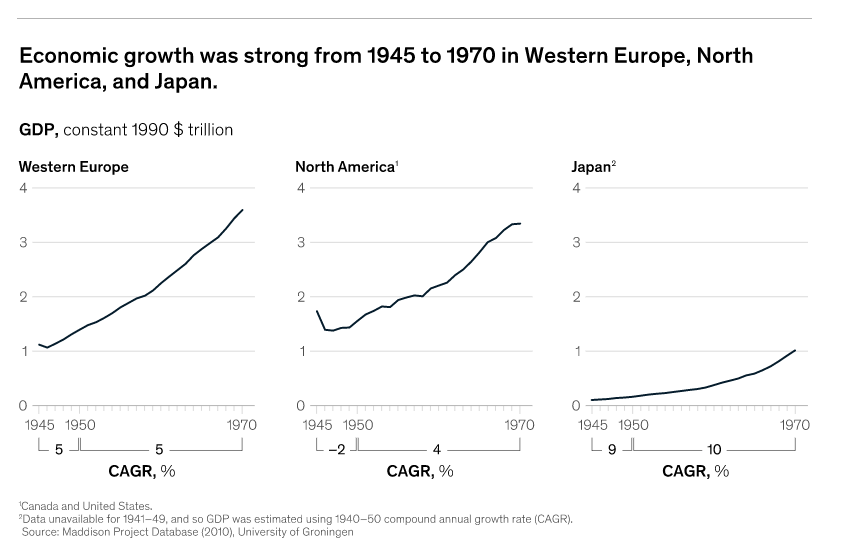
The above graph shows the strong level of growth in Western Europe, North America, and Japan between 1945 and 1970. The economic decline that followed would result in the new right revolution of the 1980s and 1990s.
To simplify this concept in explaining what happened in the late twentieth century we simply need to understand that in response to the 1930s depression many nations and particularly developed nations invested in infrastructure to stimulate their economies and create employment. This was followed shortly by the Second World War where investment in industry was required. Then after the war, the Marshall Plan rebuilt Europe, whilst similar investment and rebuilding occurred throughout the late 1940s. This period of investment in response to the depression and war created the post-war boom resulting in significant economic growth.
Keynesian economics whereby government policy and intervention in the economy and significant levels of government spending are required to stimulate the economy and prevent depressions. This theory dominated government policy in economically well-off nations from Great Depression until the mid-1970s, when the post-war boom came to an end. The thing Keynesian economics was meant to prevent happening, did happen. So in 1979, Margaret Thatcher came to power in the UK, and the following year Ronald Reagan in the US, and with them came a sea change in economic policies not just in their own countries but internationally.
The Neo-Liberal project essentially was to move away from state intervention and allow the invisible hand to do its dirty work. Privatisation of state infrastructure such as rail or power companies, reducing spending on public services and increased user pay charges, and generally reducing the size of the state to try and stimulate the private sector. Part of this also included reducing employment rights including laws protecting the right to collectively organise, ultimately resulting in reduced earnings for most people. As my series of blog posts about the trade union movement suggested, the job of those wishing to attack union rights was often made much easier by the fact that most union leaders and a poor understanding of economics or how to respond to the end of the post-war boom.
New Zealand was peculiar in its transition to Neo-Liberalism in that it was the Labour Government of 1984 to 1990 that first introduced and championed these right-wing economic policies. At the time the big political issue in New Zealand was the Nuclear Free movement which successfully stopped US Nuclear ships from visiting New Zealand. Whilst this was a worthy campaign, it is strange to think that a government selling off state assets (often for less than their market price) and putting thousands out of work managed to win support based on a Nuclear shipping policy when their economic decisions were hurting so many.
Neo-Liberalism and reducing the size and expenditure of the state were meant to stimulate the economy. For whatever short-term gains were made in the 1980s and 1990s, which generally only benefited the 1% wealthy elite, it soon became clear that the fundamental problems in the economy still remained. Unregulated or self-regulating markets resulted in terrible outcomes including the Pike River mining disaster in New Zealand, the Grenfell Tower fire in London, and the levee failures in New Orleans during Hurricane Katrina all from lack of regulation and investment by the Government.
The 2008 crash ended the widely held belief that the market could correct itself or that wealth would trickle down. This crisis was due to a lack of financial regulation and was then made much worse by those countries who insisted on implementing austerity measures to restore public finances, instead of making the economic situation worse. Neo-Liberalism now is discredited and few governments either on the left or right really have an appetite for the types of policies Thatcher and Reagan promoted 40 years ago. As I will discuss in another blog post on Liz Truss’s brief time as Prime Minister, attempts to follow such a path now generally end in disaster very quickly.
After the fall of the Eastern Block Communist/Marxism ideology has been largely discredited. The end of the post-war boom saw an end to Keynesian economics and a shift to Neo-Liberalism, which is now also largely discredited. In 2021 economic policy is largely populist and a weird mix of Keynsian/Keynesian-lite interventionism with a sprinkling of laissez-faire rhetoric. So far in the 21st century, Capitalism has lacked any serious rivalry from any other theory or system. But capitalism has also run out of ideas. This is not just an abstract notion as the political upheavals in recent years stem from people feeling let down and angry by an economy that has not delivered. Yet, there is no clear alternative to the status quo. People were shocked in 2016 when the UK voted for Brexit and the US voted for Donald Trump as President. The increasingly polarised and challenging political world we live in can be blamed on many different factors. But at its core, I believe much of the trouble is caused by the lack of economic policy ideas that can address some of the great challenges we face.
We can learn much from mid-20th century Keynesian economics, but we also need to understand the limits of this theory and what caused the shift away from them from the late 1970s. Whilst the Neo-Liberal experiment also failed, we should also understand that bureaucratic and cumbersome regulation must have a purpose, and whilst state investment in public services can have real benefits we must be clear about what these actually are when this money is spent. Whilst I subscribed to socialist ideas in the past, it is clear that attempts to implement such a system to date have all ended in failure. However, we can still take Marx’s economic analysis (if not subscribing fully to his proposed remedy), specifically what he had to say about the tendency of the rate of profit to fall. Before we decide whether the current economic system can be reformed or needs to be completely replaced, we first need to improve the general understanding of how our economic system works.