Walk 10 in from the 1980s AA guide book was titled City Streets and Alleys. This was was done on Friday 27 July 2018.
From the 1980s AA guide book of London
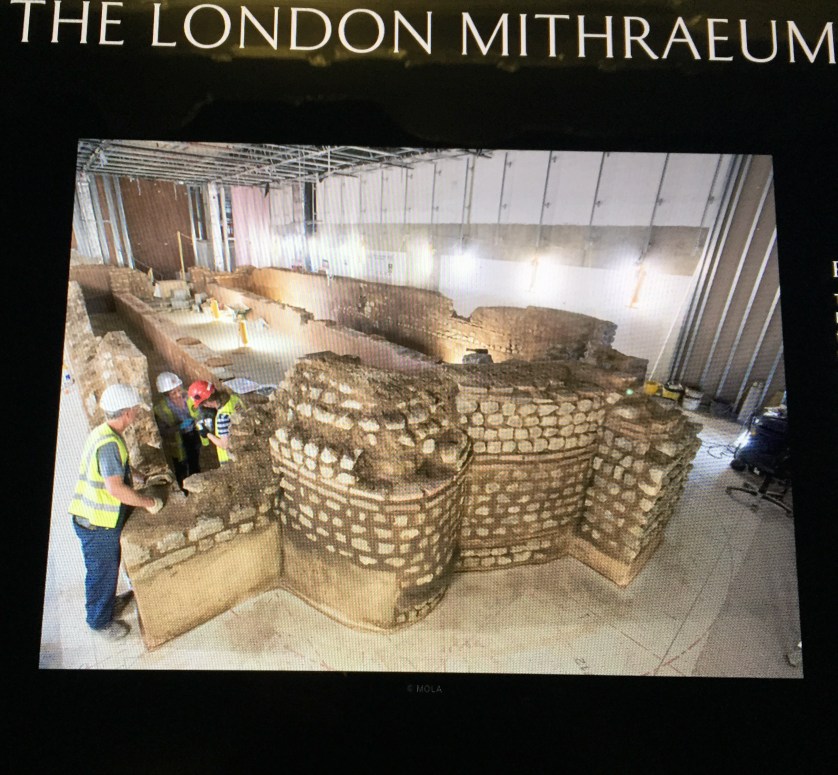
The first landmark to see on this walking tour was The Temple of Mithras. These remains were discovered in 1954. For many years the temple foundations were viewable at street level.
I got a bit lost finding the Mithras, as they weren’t located at the place the guidebook stated. After wandering about for awhile I eventually asked for directions, and was sent to the Bloomburg building.
Artefacts found near the temple
Artefacts found near the temple
Artefacts found near the temple
Artefacts found near the temple
The site after being found in 1954, had in fact been moved from the location it was found. The remains having been moved to their Victoria Street site, had the middle bit filled in with concrete. A campaign started to have these ruins moved back to their original site nearby, and to have the 1950s concrete removed.
The Temple is now in the basement of the Bloomberg entry, and is free entry to see.
View of the temple ruins at its old location
After a good look at the temple ruins, I continued up Watling Street towards St Pauls.
Ye Olde Watling – Where Christopher Wren stopped for a Pint while Building St Paul’s Cathedral.
From here I continued up the street to St Paul’s Gardens and then through Paternoster Row.
Having past around the outside of St Pauls, the walk took me up Giltspur Street to Pye Corner – said to be the mark where the Great Fire of London was finally put out.
Following this the walk took me to Bartholomew’s Hospital, the oldest hospital in London and St Bartholomew’s Church which is the oldest church in the city.
From here the walk headed past Smithfield market through to Roman Wall.
Smithfield Market
Small park near Smithfield market
Little Britain was the street to Roman Wall, part of it was closed
William Wallace
Little Britain – street, also classic TV show
The Roman Wall is the site of an old Roman Fort. Next to this is the Museum of London.
From here the tour took me onto Cheapside, the high street of medieval London. It was called Chepe – from the Anglo-Saxon word for Barter.
St Peter Cheap, the small church yard.
Cheapside
Guildhall Buildings
Guildhall Buildings
Guildhall Buildings
The tour ended back at Bank Station. IT passed the Old Grocers Hall, a casualty of a 1944 German bombing raid. It was rebuilt only to be guttered by fire in 1965. The grocers company dates back to 1428.
The political Establishment need to show leadership and stand up to racism.
The media has been reporting both antisemitism in Labour and Islamophobia in the Conservatives all year. Some journalists and commentators have speculated as to which of the two major parties is worse for their bigotry. The simple answer is that both are an absolute disgrace, and these sorts of discriminatory and xenophobic prejudices should have no place in modern politics. But sadly it does.
Racism is nothing new, it has existed throughout human history. And racism is out there in society. Politicians are elected by the people, and yes there is a market for racist politics. The rise of the far right throughout much of Europe globally is evidence of this. But this doesn’t make it inevitable. The two main political parties in the UK need to show leadership and stand up to racism. Both May and Corbyn have come out against racist remarks made by party members. But in both cases, a stronger stance was needed much sooner. Not just by the leaders, but by all MPs and people in leadership roles. And most importantly by party members.
The UK is far from alone from having problems of racism in politics. But in the UK this issue has come to ahead in 2018. There is nothing good in what has come out, but this can be an opportunity for the political establishment in the UK to draw a line in the sand. If from this Labour and the Conservative’s to vow to take a much stronger stand against racism and bigotry within their parties, this would be a very positive development. Whether this happens remains to be seen…
In 2010 the ACT Party with the help of National managed to pass a piece of legislation that damaged student democracy, and blatantly ignored public opinion. Voluntary Student Membership or VSM sounds like a horrendous STI, and its impact has been to screw student democracy.
Prior to 2010 students had a choice as to whether membership of their students’ associations at tertiary institutions would be universal or voluntary. This was due to New Zealand First who in coalition with National in 1998, could see the contribution democratically elected students’ associations make. In 1999 all campuses had a vote on whether students’ association membership should be universal or voluntary. In the University sector all but Auckland and Waikato voted to retain universal membership, and Waikato voted to return to universal membership shortly.
Students’ Associations provided democratic representation at all levels of tertiary institutions. They represented students who faced difficulties with the institution and provided support for dealing with agencies like Studylink. They lobbied institutions for welfare services like foodbanks and hardship grants, and in many cases helped provide these services directly.
When ACT put forward the bill to make all students’ associations voluntary, the National Party said it would listen to submission at select committee and then make a decision. Over 90% of submissions were against this bill sponsored by Roger Douglas. Students from around the country highlighting importance of democratic representation.
Roger Douglas did the same to Students’ Associations in 2010 as he did to the NZ economy in the 1980s. In both cases his polices have done lasting damage.
Recently on my blog I have been talking about my time on the students’ association exec. Looking back much was achieved. Students’ Associations provide strong representation on campus and valuable services to students. The student movement struggled for nearly 30 years to end crippling student fees, and in 2017 a Labour led government was elected on the promise they would do just this. Students’ associations continue to play an important role. Sadly after half a decade of VSM many of them are now struggling to survive.
The legislation NZ First got National to pass in 1998 putting the question of membership of Students’ Associations to a democratic vote of all students work well. NZ First, now in coalition with Labour and the Greens should unlike national, listen to the 90% of submissions on the current law and repeal Roger Douglas’s 2010 VSM legislation.
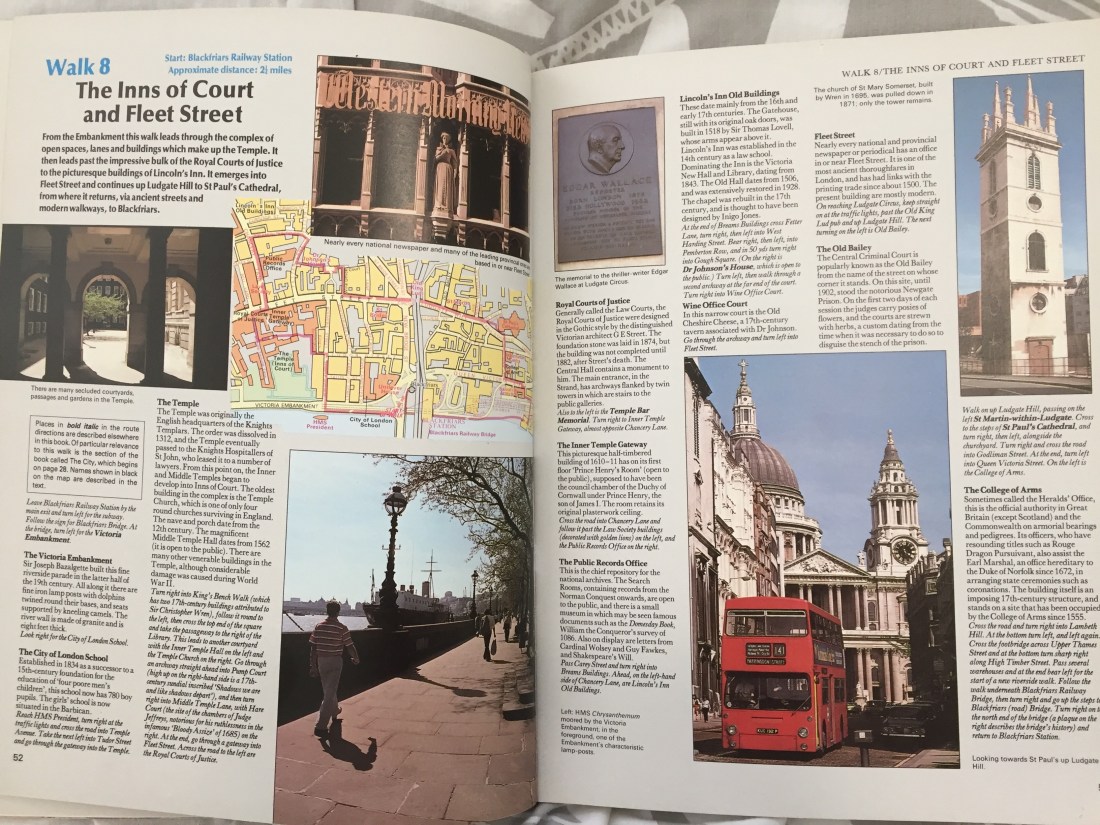
Walk number 8 in the 1980s AA guidebook was of the Inns of Court and Fleet Street. I completed this walk on Sunday 24 June 2018.
The outline of Walk 8.
The walk commenced at Blackfriars Station. For some reason it didn’t mention the Blackfriars pub as part of this tour. Though the pub does get a mention at the back of the book in a section titled ‘London’s Pub’s’ – where it claims:
“Occupying a sharpley-angled corner site, this wedge-shaped building is a splendid example of a Victorian Pub, with wrought-ion balustrades on the upper stories and a large Black Friar perched on the corner above the entrance. A nearby Dominican Priory founded in the 13th century was the inspiration for this tavern’s name and visual theme. Hand-beaten copper murals in the bar depict jolly friars carousing, fishing and otherwise enjoying themselves. Gold leaf on the ceiling, gas lighting, open fireplaces with brass firedogs, and some good art nouveau decoration combine to make the Black Friar a most unusual and interesting pub.”
The Blackfriars Pub
The Blackfriars Pub
The Blackfriars Pub
The Blackfriars Pub
The Blackfriars Pub
The Blackfriars Pub
The Blackfriars Pub
The Blackfriars Pub
The Blackfriars Pub
Refreshments during the warm English Summer
After this rather pleasant stop over I proceeded to the walking tour.
The walk commenced along the Victoria Embankment and past The City of London School, an 19th century successor to the 15th century school for the education of ‘four poore men’s children’.
City of London School
City of London School
From here the 1980s guide book tells me to take a right at the HMS President (which was obscured by construction work, possibly now located at a different location?
This was the site of the HMS President in the 1980s
The next stop on this walking tour is The Temple. This is the site of the Knights Templars headquarters, which later developed into Inn’s of Court.
Above: The Inns of Court.
From here the walk took me to the Royal Courts of Justice on Fleet Street.
Fleet Street
Fleet Street
Fleet Street
Fleet Street
Royal Courts of Justice
Me standing outside the Royal Courts of Justice
Fleet Street
The next place in my 1980s AA guide book was the Public Records Office in Chancery Lane. However I was to discover that these offices had moved to Kew in 2003. The site is now a campus for Kings College.
The former site of the Public Records office in London
The former site of the Public Records office in London
Just up the road from this is the Lincoln’s Inn old buildings. This law school dates back to the 14th century.
Lincoln’s Inn old buildings
Lincoln’s Inn old buildings
The guide book then took me down to Gough Square, where I could see Dr Johnson’s House – now a National Trust Museum.
Hodge – Dr Johnson’s cat
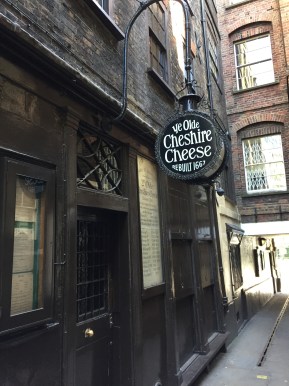
From here I walked past the famous Ye Olds Cheshire Cheese, rebuilt shortly after the Fire of London. Sadly this establishment wasn’t open when I was walking past.
Ye Olde Cheshire Cheese
The tour then took me back to Fleet Street. The 1980s AA guide book says:
Nearly every national and provincial newspaper or periodical has an office in or near Fleet Street. It is one of the most ancient thoroughfares in London, and has links with the printing trade since about 1500.
This link with the printing trade was to be abruptly broken in the 1980s, as the below from Wikipedia explains:
In 1986 News International owner Rupert Murdoch caused controversy when he moved publication of The Times and The Sun away from Fleet Street to new premises in Wapping, East London. Murdoch believed it was impossible to produce a newspaper profitably on Fleet Street and the power of the print unions, the National Graphical Association (NGA) and the Society of Graphical and Allied Trades (SOGAT), was too strong (an opinion endorsed by the Prime Minister, Margaret Thatcher). All Fleet Street print staff were sacked and new staff from the Electrical, Electronic, Telecommunications and Plumbing Union were brought in to operate the presses at Wapping using modern computer-operated technology, rendering the power of the old unions obsolete. The resulting Wapping dispute featured violent protests at Fleet Street and Wapping that lasted over a year, but ultimately other publishers followed suit and moved out of Fleet Street towards Canary Wharf or Southwark. Reuters was the last major news outlet to leave Fleet Street in 2005.[24] The same year, The Daily Telegraph and Sunday Telegraph announced they were returning to the centre of London from Canary Wharf to new premises in Victoria in 2006.[28]
Fleet Street – looking towards Saint Paul’s
From here the walking tour took me past The Old Bailey, London’s central criminal court and the site of the old New Gate Prison.
The Old Bailey
The Old Bailey
From here the tour took me up up Ludgate Hill and past Saint Paul’s Cathedral.
The steps of Saint Paul’s
The next stop was The College of Arms. This is the official authority in Great Britain (except Scotland) and the Commonwealth on armorial bearings and pedigrees. Its officers have impressive titles such as ‘Dragon Pursuivant’.
From here the tour took me back towards the Thames, past the tower remains of St Mary Somerset. This church was built in 1695 and all but the tower was pulled down in 1871.
Tower remains of St Mary Somerset Church
Tower remains of St Mary Somerset Church
The tour then concludes at The Blackfriar station.
The Millennium Bridge, an addition since the 1980s.
The Millennium Bridge, an addition since the 1980s.
Leaving university and student politics is never easy for the hardened addicts. Much worse if your departure was not voluntary. While this could be perceived as just not letting go, actually there is a good reason why a number of us ex student politicians still lend a hand to help out from time to time. The executive and staff turnover in student associations is high when compared with other member organisations, due to students only being around on average 3-5 years (often less).
One way in which exec officers remain involved, is to be on the election committee for student association elections. Your role is guide the returning officer as to how to run elections that are consistent with the constitution. This would be a relatively painless task were the constitution well written. However prior to 2012 the VUWSA constitution was an over complicated and prescriptive document that could be inadvertently breached very easily. Us seasoned VUWSA exec members had all been through this and knew its many pitfalls, so we knew when someone claimed the constitution had been breached that a) it probably had, and b) how to stop said minor breach from derailing the entire election.
The other role I played was to support candidates in both 2007 and 2008. Having won elections 4 years out of 5 on campus I was seen as someone who knew how to play that game. What I soon realised was that while I could get people elected, this would then mean I’d also be heavily relied on for support. I did find it hard seeing successors in the various roles I’d held doing things differently, or worse making the same mistakes I’d made. After a year or two I found it easier to be an ex president who was willing to help when called upon, but not involved in the actual politics on campus.
Where I still found I did need to be involved was during the Voluntary Student Membership campaign. The ACT Party had put up a private members bill to make all students’ associations voluntary. Up till that point the decision about universal or voluntary membership was decided by referendum, and the majority of students’ associations had voted to retain universal memberships. The bill had little support, and over 90% of submissions at select committee were against the change. Despite this, the National led government felt obliged to support a bill from their junior coalition partner.
The campaign for the VSM bill, involved a lot of nonsense. They’d cite examples of students’ associations wasting money. One involved a case of fraud where the police had arrested someone and the money was recovered. The others were generally examples of executives making dumb decisions, and usually those involved were voted out or left in disgrace. Contrast this with the major financial institutions who around the same time had plunged the global economy into recession due to their greed and incompetence. In this case the institutions were bailed out and their executives continued to receive bonuses. This, unlike petty issues at students’ associations, was of no concern to the National or ACT partys.
Post VSM coming into force in 2012, I along with 2004 VUWSA President Amanda Hill were part of a review of the VUWSA constitution. Now that VUWSA had voluntary membership the constitution needed amending. This also gave VUWSA the opportunity to develop a much more user friendly constitution. After about 3-4 months of regular evening meetings and rewriting clauses, we eventually made a recommendation. I helped present this to a reasonably well attended Annual General Meeting who voted for the changes.
After this my stints on election committees were significantly easier. From 2013 to 2016 I reenrolled as a post graduate student, while still working full time. Unlike at undergraduate level, for postgrad I attended classes every week and finished assignments on time. As a result my time for extra curricular activities such as student politics diminished.
I still try to keep a eye on VUWSA stuff. In 2017 I attended a VUWSA exec reunion. At some stage I’d be keen to help organise a VUWSA alumni event in London as there are a couple of us over here, and probably others who’d be prepared to travel to it.
Being involved in student politics has a significant impact on my early adult life. I loved being involved and don’t regret for a second the involvement I had. I hope that students’ associations will continue to be strong advocates for their members. Further that attacks on these institutions by short sighted political ideologues can at some point be reversed.
Governance can be a very misunderstood concept by those who aren’t familiar with it. Sadly it often isn’t that well understood by those who are serving on governance boards.
My first governance experience was as a the student representative on the Victoria University of Wellington Council in 2006. During my induction it was explained very clearly by Chancellor Tim Beaglehole that in our governance role we were not managers, and would not be involved in operations or employment matters. Further our role was to provide strategic leadership.
My time on this governance board was surprisingly enjoyable and rewarding. And judging by the job offers I got at the end of it (and declined, in retrospect probably foolishly) I managed to gain the respect of my peers.
Later in the time in the New Zealand union movement I sat on the national executives of three trade unions, the equivalent to a governance board. I also sat on the National Affiliates Council of the NZ Council of Trades Union. Also in my time in the Public Service Association I at times sat on temporary governance structures of projects or change processes. I also have been part of advisory boards or have had oversight of projects or campaigns in a governance capacity.
Governance boards serve two major purposes in my experience. One they are a check and balance on an organisations senior management team. Secondly they are there to set the overall direction for the organisation. It is very hard for people working in an organisation to do either of these, so a governance structure is in place to ensure this happens.
So what have I learnt and observed about governance:
Yes governance is not operations. The governance structures do not need to approve every stationary order, or be across every employment arrangement. Governance groups, particularly in the community sector, who have tried this have generally found themselves entangled in a messy situations. But…
Governance boards with no idea of what is happening on the ground, can make very poor decisions. If you have a governance role, you should be getting regular updates. These don’t need micro-detail, but should give a helicopter view with an overall picture of an organisation.
Too often the information from Management to governance boards is not the full picture. Many governance boards suffer from senior mangers or other influencers swaying decisions. This can be just as damaging as the problem highlighted in point 1.
A governance board’s size does not in itself correlate to how effective its output is. While a large group can be more challenging to handle, a small group who lack the relevant skills, experience or interest is frankly pointless
Having the right mix of people is crucial. Having lots of technical experts from your industry in governance roles may add value to understand the products or services delivered. But if thats all you have your governance board could lose sight of other issues – specifically product or service demand.
Also on the choice of team, having people with experience in a variety of sectors is good. But they need to a) understand and b) not only have an interest but a believe in the thing they are on the governance board for. People who turn up to some meetings and contribute little are not adding value, whatever their background.
Having stakeholder representatives can be valuable in my view. This view is certainly not shared by many. The reality is that having input specifically from the users (the customer, the student or whoever uses the product or service) and from the producers (the workers) can really help. Depending on the organisations there will be other stakeholders who could (should?) be included. If the users and producers input is ignored by a governance board, the quality of decision making will likely decline.
Governance boards often are made up with people who have been successful in business. Also they need to be people who have time to contribute. Middle age and retired white men, in my experience, tend to be heavily represented on governance boards. Some governance boards are paid, but many are not. So financial and time constraints limit involvement of those in full time work, or who have dependants. This is not me saying old white guys don’t add value, they do. I’ve work with some brilliant people on governance boards who are white, male and over 55. But with diversity brings different experience and perspectives. Removing barriers to participation may help bring in the people you need.
If you are on a governance board, speak up. And tell the truth. There is no point serving on a board if you are not going to contribute. And sometimes this means opposing the CEO, or the majority view on the board. It is possible to do this without just being a naysayer or alienating your colleagues. Key to this is to remain positive and respectful, whilst also telling it how it is (this takes practice).
If you are in a leadership position, either a senior manager on a governance group, take criticism. Also respect differing opinions, and foster an environment where people can question and challenge. Do not respond to disagreement by trying to remove the person who raises the issue. Most leaders would read this and think ‘of course.’ In reality many leaders struggle with criticism and disagreements (its not easy), and an automatic response is to try and silence the views you don’t want to hear.
In conclusion, no governance structure is perfect. No business or organisation is perfect. We should always try to improve things, but don’t pretend there is some magic formula for governance to run perfectly. The above considerations I believe will help make a governance board more effective. I have identified some of the most common mistakes or problems with governance structures. If your board is at least aware and taking some measures to help with the above, you’ll be much better off.
I was elected Victoria University of Wellington Students’ Association (VUWSA) President at the end of 2005. This was two days before the New Zealand General Election where the 5th Labour Government were elected for the third and final time. Students had played an important role in this election, with Labour promising interest free students loans which in a close election helped them across the line. Student fees were still going up each year, and student debt was nearing $10 Billion NZ. The promise was a start, but fundamentally user pays were still in place.
Coming in as a student president the year after a general election, and after a modest win, it was always going to be a challenge. My attention as student leader quickly turned to internal matters both within the University, and within the students’ association.
A major win was resolving a 40+ year ownership dispute of the student union building. From this VUWSA became a central player in the university redevelopment where over the following half a decade the campus hub was significantly developed and improved.
I sat on the University Council, the governance board of Victoria University as one of the two student representatives. My earlier interactions with the University Council had mostly been when disrupting fee setting meetings or other similarly heated situations. Despite the many misgivings of the University Council members, I soon established a positive and constructive relationship with all members of the Council. As a result we were able to advance a number of issues affecting students ranging from academic issues through to student welfare.
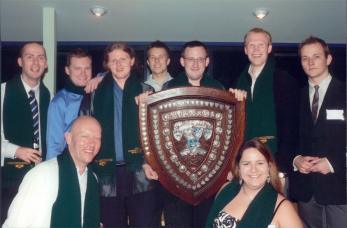
The 2006 University Sports awards. In 2006 Vic won the University Games. Photo taken with the University Shield, October 2006.
The biggest challenge I faced however was internally. The executive were quite young and generally inexperienced, even by student association standards. Further the internal issues of the association really came to the fore that year. The Student Association levy had remained at the same level for nearly 2 decades. In that time Victoria University had expanded from 1 campus to 4. Further the Students’ Association had increased the welfare and advocacy services it provided to students, as user pays had meant there was greater need than in the past.
In addition to this the students’ associations budget setting process was inadequate. A zero budget system had been established a few years earlier, whereby elected representatives would built the whole budget from scratch each year. Nice idea, but when 2/3 of the cost were fixed and when the exec turnover was high this meant budgets often weren’t set in a timely manner meaning control of spending was a challenge.
2006 NZUSA co-president Connor Roberts speaking at protest opposing international fee increases
VUWSA International Officer Fiona Shi challenging Vice Chancellor Pat Walsh on International Student Fee increases.
Me speaking as VUWSA President at the protest against International Student Fees. Next to me Vice Chancellor Pat Walsh
In September 2006 I launched a financial review of the students’ association. As part of this I got a motion through a general meeting (on the 2nd attempt) to increase the membership levy, and for it to be inflation adjusted from then on after. I also got in a auditing firm to do a financial review of the organisation. Thirdly I started the process of having a proper management structure within the association – something that wasn’t completed until 2009. Up till then the Student President had been the employer, the financial leader and general manager of the Students’s Association. They also had to represent 20,000 students and be the student rep on the University Council. Looking back I didn’t do too badly given I was 23. But the reality was it was too much, and the association needed proper management.
2006 wasn’t an easy year, and I had been forced to make some difficult decisions. The longstanding tension between myself and Labour and its activists continued to be an issue. This came to a head at the end of 2006 when I ran for re-election as Vic Labour ran a candidate against me, and won. I felt I had done my best, and believed what Labour did was align with the right to score a political point. Maybe they did? But the reality was I lost that election.
Losing an election hurt. And it did knock me for awhile. But in time I came to accept the result. One of the things I do look back on with pride is that after losing I kept working really hard till the end of the year. While at the time the animosity between myself my successor was fairly high, a few years later we were to become friends and of course both members of the Labour Party. Further I look back at the year that Geoff Hayward had as VUWSA President and saw he faced many difficulties of his own. Geoff also failed to win a second term at the end of 2007, and I suspect like me he grateful of when looking back later.
I loved my time on the student executive. I am proud of what I and the people I served with achieved, and what my successors continue to achieve today. The skills I learnt as a student representative have served me well in the roles that have followed. And I made a number of life long friends from across the political spectrum, including those who at the time I considered adversaries. I didn’t want to leave at the end of 2006. But it was time. And there were new challenges awaiting…
One of the things that make for strong students’ association is the services they provide. Specifically things like clubs and on campus events throughout the year which contribute to the student culture.
The heart of the student culture is and should be the student union buildings and facilities. These will generally include student bar and cafes, the common room and club spaces, gymnasiums and sports fields and various other social spaces.
Not all these services are necessarily owned by students associations. Quite often the institution and the student association will do joint ventures and share the cost of building and maintaining these services. This is great. However when you do business there is one important thing to remember – sign contracts and keep records.
The Victoria University Student Union Building opened in 1961. Victoria University contributed about a quarter of the costs, the Students’ Association contributed about 1/3, and the rest came from alumni and other community investment. These figures are rough, as records were not kept. Further no deed or agreement about ownership was signed. The assumption at the time was that the students’ association would manage most of the day to day operations, but this was vague and not written down. Before long disagreements started…
By the late 1990s things had really become ugly. With treats of Voluntary Student Membership (VSM) from the government, the university started asserting it should have full control of the student union complex and services. This resulted in the students association losing control of the bar and beer prices soaring, an ugly tug of war between the university as the students’ association over control of clubs and countless other disputes.
When I was elected to the student exec in late 2002, I saw this as one of the key issues facing the students’ association. Most of my colleagues felt the same way. In 2004 VUWSA President Amanda Hill really brought things to the fore during her term by threatening to take legal action against the university. In 2005 there was a change of Vice Chancellor, who started an informal dialogue with VUWSA about trying to find a resolution. In early 2006 a negotiating team of myself as VUWSA President, Dave Guerin (1993 VUWSA President) and Mark Thomas (former exec member and 1996 National Party candidate for Wellington Central ) were on the VUWSA negotiating team. On the university side Jenny Bentley the Campus Facilities Manager and Victoria Healy the university lawyer. These negotiations were very professional and I still believe the compromise we came to has served students well in the years that followed. Personally I learnt a great deal from these negotiations, something that was to become very useful in later life.
The solution was a Deed of Strategic Partnership set up a governance structure between VUWSA and VUW, where the university and the students’ association had two representatives – and a chair agreed by both parties would be appointed.
As a result of this the VUWSA and the VUWSA Trust, were able to support the University in its plans to revive the campus facilities. A few years later when I returned to campus to complete my postgraduate degree, I enjoyed a campus with far nicer facilities and better protected from the Wellington southerlies than those we endured a few years earlier.
There were many people involved bringing an end to that 45 year ownership and governance dispute. I was certainly pleased to have played a part in helping bring it to an end.
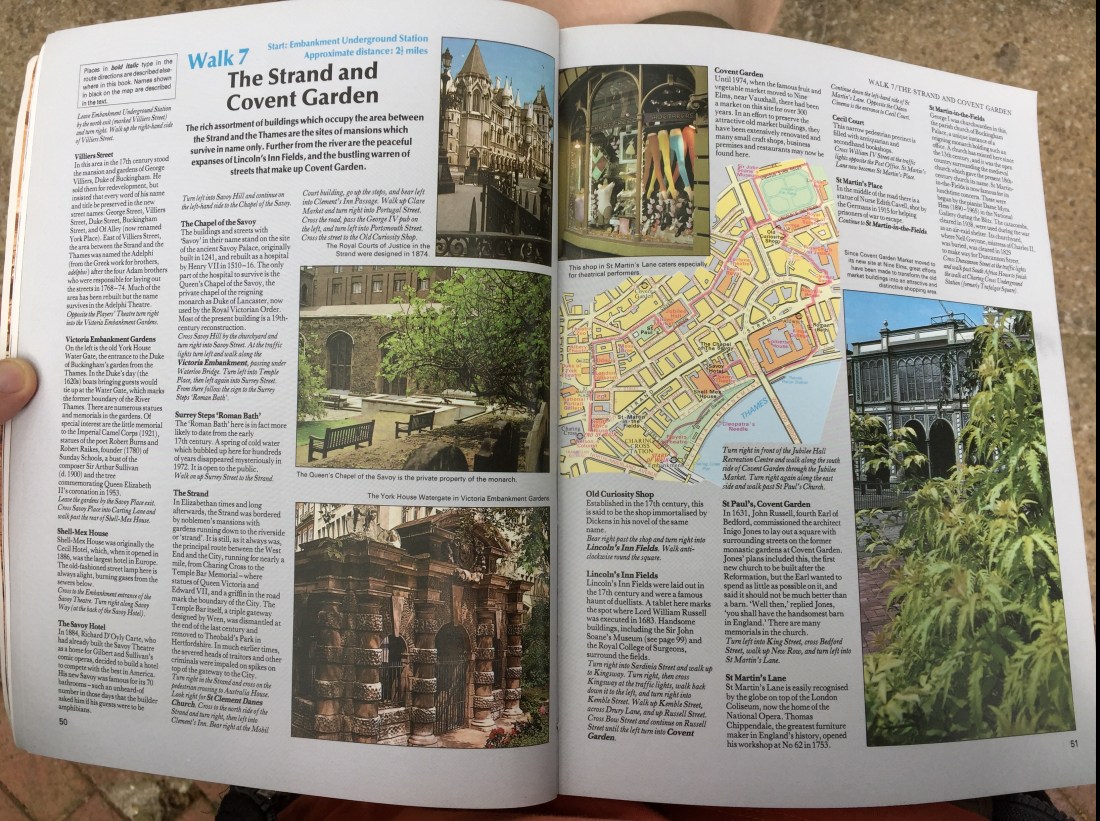
Walk number 7 in the 1980s AA guide book took me to Covent Garden and the Strand. I did this walk on the afternoon of Sunday 13 May, 2018.
The Strand and Covent Garden
The walk commences at Embankment Underground Station. From there I walked up VIlliers Street names after George Villeiers the Duke of Buckingham. From here I turned right into the Victoria Embankment Gardens.
Embankment Station – with the London Eye behind (new since the 1980s)
The entrance to Victoria Embankment Gardens
This garden located on the north bank of the Thames is a great place for a stroll on a warm spring afternoon. Full of old statues and well arranged gardens, lots of people come here to sit outside and enjoy the sun (tis a rear thing in London, especially during those winter months.
After a wander through the house the walk took me past the Shell-Mex House. From here we headed past the Savoy Hotel, famous as the home for Gilbert and Sullivan’s comic operas.
And its elegant surroundings
From here the walk took me past the Chapel of Savoy, the site of the ancient Savoy Palace. Rebuilt by Henry VII in 1510-16 as a hospital, now the only part that survives is the Queens Chapel.
Queens Chapel of the Savoy.
From here I walked up to the Roman Baths, which according to the book more likely date from the early 17th century. Unfortunately they were closed at the time I walked past.
Roman Bath on Surrey Street. Unfortunately the National Trust locked the gate.
From here the walk took me to The Strand and then past St Clement Dames Church.
St Clement Danes Church
The next landmark on the walk is the Old Curiosity Shop, immortalised by the Charles Dickens Novel of the same name.
Old Curiosity Shop
Old Curiosity Shop
From here I proceeded to Lincoln’s Inn Fields, laid out in the 17th century and according to the guide book a famous haunt for duellists (I saw none during my walk). This is also the spot where Lord William Russell was executed in 1683.
Lincoln’s Inn Fields
After this the walk took me to Covent Garden. According to the 80s guide book, until 1974 this had been a famous fruit and vegetable market for over 300 years. The book talked about how the old buildings had been renovated and were then filled with craft shops and restaurants. In 2018 it is one of the main tourist craft markets and restaurant areas in London.
Punch and Judy Bar, Covent Gardent
Covent Garden
St Paul’s, Covent Garden
After stopping for a coffee and a bite to eat, I headed down St Martin’s Lane. This took my past the National Opera and the London Coliseum with the globe on top.
London Coliseum with the globe on top
The walk then took me down St Martins Lane and past the famous St Martins in the Fields opposite Trafalgar Square. St Martins is now no longer near any fields, but when first build in the 13th century it was in open country surrounds.
The walk then took me to Charring Cross, and this is where walk 7 ended.
Above: statue for Nurse Edith Cavell in St Martin’s Place. Cavell in during the First World War for helping prisoners of war escape. Bottom right: a child attempting planking.
Being in the thick of student politics in the mid 2000s, I was around just at the very beginning of social media. From about 2003-2004 onwards, the big trend was the emergency of blogs. Ironically I wasn’t a great fan of them as my Presidents Column in Salient of 7/8/2006 outlined.
On reflection my distain wasn’t in fact for blogs. My weekly presidents’ column was published online in a blog format, thus I was using the medium to attack the medium. My distain came from operating in Wellington, New Zealand’s capital city, where the political establishment operated in an isolated bubble. In student politics, I loved being in a position where I could be a voice for change or do good. What I despised was the irrelevant gossip and manoeuvring that inevitably follows when you are near the seat of power, ie parliament.
It wasn’t that I had a particular thin skin. Having had the record for being called a c%#t in the Salient’s letters to the editor one year, to then go on and get re-elected to the executive showed me that the (usually unanimous) comments from random dickheads mattered little. What annoyed me was the time wasted when others indulged them, or made random attention seeking idiots feature writers or gave them some other platform. If this were just student politics then fine. But I could tell then and still see today, that much of the political debate in Wellington supposedly at a national political level is little more than the gossip and nonsense of a club. This sadly, sums up much of the political journalism, social media and blogging from Wellington.
This is by no means unique to Wellington. I very clearly see similar such bubbles exist in London, Canberra, Washington, Paris, Ottawa and in most capital cities in democracies. And worse, people know this. They’ve known for years that politics is an elite club.
One of the reasons that the people in these clubs are still struggling to understand Trump, Brexit or even the relative rise of Corbyn and Bernie Saunders is that many people outside the bubble are sick of the bubble. In fact there are people who are quite happy to vote for extremes on either side of politics, just to wipe the smug look off people the smug establishment.
The fact is people who don’t live in the world of the political chit chat, or endlessly read the inane political blogs like this one may view the world differently. The world views of people outside the bubble are not only valid, they actually are often more informed than those in it. People in the bubble to will claim to know what is happening “on the ground.” Yet something like Brexit or the Trump election hits, and those in the bubble are shocked.
My experience during my student politics years was to be labelled mad, looney, extremist, idealistic and unrealistic. Many of those positions I took at the time such as free tertiary education are now government policy in New Zealand. Democracies work well when voters are given a genuine choices and can be part of serious debates about the future of our society. When this reverts to name calling and pettiness by those who would rather protect their position in the club, this undermines democracy.
















 Nick Kelly