The US has had a longstanding beef with the Iranian regime. I’m not going to try and defend what is a brutal and repressive theocratic regime in Iran. And no doubt US intelligence had evidence of Qasem Soleimani plans to undermine the US and its allies in the Middle East. But let’s be clear, Qasem was a senior official in the Iranian Government on an official state visit to Iran. The United States military chose this window of opportunity to launch an air attack and murder Soleimani.
Qasem Soleimani’s motorcade attacked my the US government, murdering Qasem 3 January 2020
In 2015 US President Obama negotiated the Iranian Nuclear deal. At the time this was seen as a significant turning point in the Middle East. Whilst not ending longstanding tensions between Iran and the US, it at least brought the world one step back from nuclear disaster in the region. Further it opened the door for further dialogue. Trump on coming to power in 2017 tore up this Nuclear Deal as promised during his cynical but successful election campaign of 2016 which I’ve blogged about before.
The actions of the US have of course been condemned by Iran. Chants of Death to Americawere made by Iranian law makers in parliament. They have compared this act to the 1953 coup. In 1953 the US and its allies overthrew a democratically elected government and installed a regime that would be sympathetic western interests. Specifically western oil company interests.
In the UK, the Conservative Government who were supported by President Trump in the UK General Election were not given a heads up by the US prior to the attack. Dominic Raab Secretary of State for Foreign and Common Wealth Affairs has come out supporting the actions of the US Government but has also called for diplomacy going forwards. The Prime Minister has had little to say on the matter to date.
Qasem Soleimani, while no ally of the west and considered one of the hard liners in the Iranian regime, was also a key player in fighting and eventually defeating Isis in Iraq. The Iraqi government has called for all US troops to be expelled responded to the assassination of Qasem on their soil. Across the Middle East there has been similar condemnation of the US assassination.
So one week into 2020, a Hawkish US President focussed primarily on re-election and playing to his conservative base has authorised the Murder of a senior Iranian Government figure. The world now stands on the brink of another bloody conflict and heightened security threats everywhere.
But the world doesn’t need to be like this. The Iranian regime is brutal and repressive, and the recent protests within Iran demanding change are to be commended. So too are those protesters in 70 cities throughout the USA have come out in opposition to their governments assassination of Qasem. It is time for regime change in North America and the Middle East, and to build where diplomacy, peace and prosperity can replace war, violence and injustice.
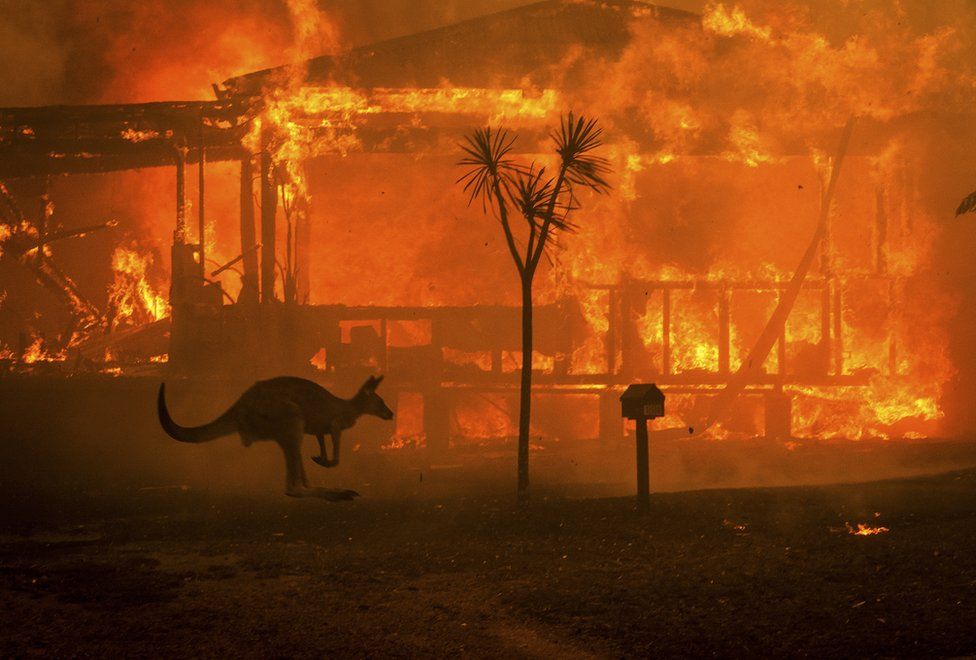
The start of 2020 has been a truely horrible one for Australia. The fires that are sweeping the country have been wreaking havoc. Currently more than 20 people have lost their lives and hundreds more have lost their homes and possessions. In the state of New South Wales its estimated that over half a billion animals have perished in the blaze.
Fires across Australia have caused over $4 billion Australian dollars in damage.
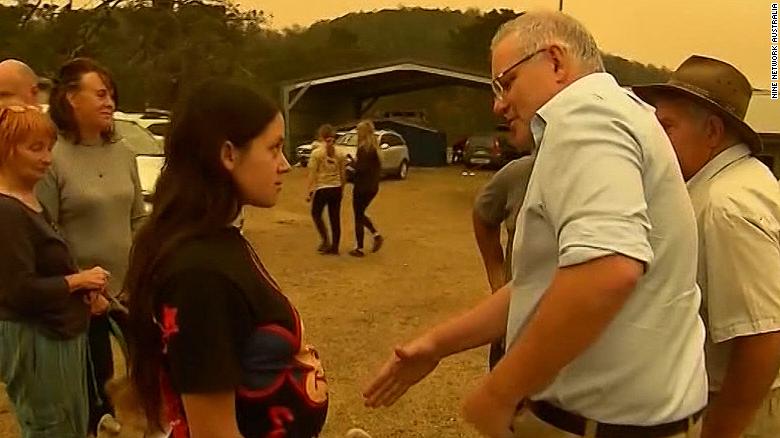
Australian Prime Minister Scott Morrison has come under considerable fire over his response to this national emergency. He has been criticised for being slow to return from his family vacation in Hawaii, and generally for his government not showing adequate support to those impacted by the fire. The below clip shows the PM getting a particularly frosty reception from bush fire victims.
There is no question that Scott Morrison’s response and leadership during this national emergency has been weak. But the abysmal response of the Australian Government to this issue predates Morrison’s leadership of the country.
Few sane people would dispute that climate change is a significant factor for the fires in Australia. Those who have warned about the consequences of human created climate change have warned for many years that events like this will be the result. Yet Australia has had a long history of denying the looming climate catastrophe. Scott Morrison’s government was re-elected in May 2019 with a very weak climate change policy. With some parallels to the recent UK General election, where I blogged about Boris Johnson’s weak leadership on the Climate Crisis, Scott Morrison and his government has been poor on this issue. But this is nothing new.
Back in the late 1990s, the Liberal Government led by John Howard refused to ratify the Kyoto Protocol, a global treaty aiming to reduce carbon emissions. In 2007 there was a glimpse of hope that Australia would start to take this issue seriously. That year Australia elected Kevin Rudd’s Australian Labor Party (ALP) in the federal government elections. The ALP stood on a policy of tackling climate change. The situation seemed even more hopeful when in 2009 the Liberal opposition leader Malcolm Turnbull came out in support of the ALP’s proposed Mining tax.
But then came Tony Abbott. Tony has been a longstanding climate change denier. He recently made a speech in Israel claiming the world was in the “grip of a climate cult”, while his country burns. Tony successfully rolled Turnbull as Opposition Leader, and changed the Liberal Party policy to oppose the governments mining tax. The Liberals shot up in the polls, the ALP got the spooked and abandoned the policy. Shortly after Rudd was replaced by Julia Gillard, Australia’s first and only women PM. Gillard was very narrowly reelected in 2010 but relied on independent MPs in parliament for numbers. In 2013 Kevin Rudd once again became PM, briefly, before losing the election to Tony Abbott.
Abbott only served two years as PM, before he was rolled by Malcom Turnbull. As PM Turnbull was more moderate in some policy areas than the rabid Tony Abbott. But on climate change he knew he didn’t have the numbers in his party to push for any significant policy change. By 2018, having only narrowly won the 2016 election and consistently polled badly thereafter, Turnbull was replaced by Scott Morrison. Scott’s backers were the same people who’d backed Abbott, thus action on climate change was out of the question.
Mining companies have considerable power in Australia. They also have a truck tonne of money. According to Forbes Magazine Australia richest person, mining magnate Gina Rinehart is worth $15.5 Billion US. According to the Minerals Council of Australia mining is worth 198 billion to the Australian economy and accounts for 54% of the country’s GDP. Thousands in Australia depend on mining jobs for their livelihood. Many more live in communities that rely on the mining industry.
Mining companies put considerable time and resource into lobbying the Australian Government on policies that impact on their industry. They spent millions and worked overtime to oppose the mining tax in 2009. Politicians are scared of the mining sector. And recent history shows that those who serve their interests fare well in Australian politics. Also the voting public are influenced by what the mining sector say. Specifically they get concerned when mining companies and their political representatives say there could be job losses if mining companies are taxed or regulated. These messages impact how people think, and how they vote.
Most Australians and their politicians realise the climate change is real. But it’s been easier and more convenient to face up to the reality of the climate crisis. It’s easier to believe that the environmentalists are exaggerating. It’s convenient to believe scientific evidence is not conclusive regarding human activity causing climate change, when actually the evidence overwhelmingly concludes that it is. So Australia continues to do nothing about climate change. And now the country is going up in flames.
The fall out of these fires will be significant for Australia. For a number of communities their lives are now turned upside down, and many have lost everything. The fires will take weeks if not months to put out. The rebuild and recovery will take could take years. The environmental impacts of these fires will be devastating. Many animal habitats and forests may never recover. Politically, Scott Morrison and his government has taken a big hit over the fires. He may survive, he may not. But ultimately thats not important. What is important is that climate change has caused this crisis. And unless Australia and other developed nations take action on this issue – events like the Australian fires will become more and more common.
Generally it is safer not to pick elections. Increasingly polling seems to be unreliable, and growing numbers of undecided voters make their minds up on polling day. I would certainly not put a prediction in writing prior to an election. That said, on the eve of the UK general election when I wrote my blog post about Brexit, when going through the numbers it was hard not to draw certain conclusions.
The election was about Brexit. The reason the election was called was because parliament had been stuck for over 2 years in Brexit paralysis. It feels like Brexit has been the only thing on the agenda in Westminster for the entire term of the last parliament – meaning governments have no time to get anything done. But why did Brexit help the Tories?
Britain, and in particular England is a conservative (small c) country. The UK Conservative Party have spent 68 of the last 100 years in government. As the worlds 6th largest economy, it is logical that a conservative message of keeping things as they are tends to resonate.
But 2019 was no ordinary election. And Boris Johnson is not leading an ordinary Conservative Party.
After a decade in office the Party started 2019 in a pretty bad state. The Tories record in office left a lot to be desired, and voters were clearly fed up. In EU elections in 2019 saw the Conservative vote dip below 10%. How on earth did the Party go from that, to their best result in a general election since 1987 in 6 months?
On the eve of the election when I was writing about the Brexit referendum, some numbers really stuck out for me. Firstly, 84% of UK voters live in England. In the main, England is where elections and referendums are won or lost. In the 2016 referendum, the strongest support for Brexit was in England. When you look at the map of how people voted in 2016, England outside of London voted overwhelmingly to leave the European Union. While this included traditional Tory strongholds in rural England, it also included traditionally Labour voting areas in the Midlands and The North of England. When you look at the total UK voting stats 52% of voters opted to leave the EU compared with 48% voting to remain in 2016. Unless there had been a radical shift in public opinion, it was hard to see how a Remain Alliance would succeed.
Boris Johnson from the day he announced he would run for the Tory leadership said getting Brexit done was his top priority. But he faced the same issue that Theresa May faced before him. The Conservatives did not have a majority so relied on the DUP, who would not agree to any withdrawal agreement. Further, many Tory MPs did all they could to block a no deal Brexit. Boris himself of course had voted against Theresa May’s withdrawal deal, and resigned as Foreign Secretary in 2018 so he could publicly oppose it. As PM, he now faced the same threat of Tory MPs rebelling against him on Brexit.
One of the defining moments of Boris Johnson’s premiership to-date was when he removed the whip from 21 Conservative MPs. These MPs had supported a bill in parliament making a no deal Brexit it illegal. These MPs included then Father of the House and former Cabinet Minister Kenneth Clarke, Former Chancellor of the Exchequer Phillip Hammond and Winston Churchill’s Grandson Sir Nicholas Soames. Shortly after these MPs lost the whip, Amber Rudd quit the cabinet and resigned the Tory Whip in protest.
This move by Boris Johnson was seen by many as callous, brutal and utterly mad. In retrospect, this now can be seen as a decisive act which strengthened Boris Johnson’s leadership considerably. In doing this, Boris Johnson showed that the Conservatives had become the Party of Brexit. Remain Tories like Ken Clarke represented who had been the mainstream of the Party from the 1970s through to 2016. In one fell swoop Boris Johnson has cut that wing of the party loose.
Boris Johnson could now go to the country and say if you give us a majority, we’ll get Brexit done. Whereas in 2017 both the Tories and Labour were divided on the Brexit issue, now Boris could say with authority that the Conservatives were the Party of Brexit. In a country that had been stuck in Brexit paralysis since 2016, he could go into an election promising to get it done and enact the 2016 referendum result.
UK PM Boris John, Next to him left Lord Buckethead and right Elmo – both ran against him in the constituency of Uxbridge.
There were of course other issues and factors that played into this election. My next post will look at why Labour lost and some of the issues around that. But again, much of this was to do with Brexit. The overwhelming majority of constituencies that switched from Labour to Conservatives were leave voting ones. The Conservative Party campaign deliberately targeted the North of England and the Midlands during the election, with the key message of getting Brexit done. It worked.
Ironically, another factors helped the Conservatives win in 2019 was Labour’s 2017 manifesto. The sudden surge in support for Labour in 2017 after its policies were released took the political establishment by surprise. Since then the Conservatives have been forced to respond to this, but increasing funding to the NHS, reversing policing cuts made by the Tories in their first two terms of office and other social spending increases.
During the election Boris Johnson promised to increase the minimum wage to £10, a promise made by Labour in the 2017 campaign. The Conservatives promised to increase police numbers by 20,000 – having cut them by 21,000 earlier. And while the Conservatives promise to build 40 new hospitals and to employ 50,000 new nurses were largely spin and don’t stand up to scrutiny, the optics worked for the Tories.
The real genius of the campaign was the way Boris Johnson managed to escape being dragged down by the Tories last decade in office. Boris played on the fact that he was a new Prime Minister and claimed that this was a new government. Given he has been a senior minister previously, how did he pull this off? His reputation for speaking his mind, and openly criticising Theresa May’s administration after resigning in 2018 had given him distance from that administration. Also, kicking out 21 remain MPs – including the former Chancellor of the Exchequer meant he could distance the government from its previous actions. That, and reading the mood of the nation correctly about Brexit, won Boris Johnson’s Conservative Party the election.
What next for the Conservatives? In the short term it will be relatively plain sailing for a bit. The Withdrawal agreement will pass. The size of the parliamentary majority will mean the government won’t have the problems both May and Cameron had of relying on other party’s for support. But as always in politics, clouds are gathering on the horizon. The government will still need to negotiate the ongoing relationship with the EU, and the 12 month deadline to do this set by the Conservatives is seen by many as unrealistic. The risk of no deal with Europe at the end of 2020 has already caused the pound to drop, reversing its rise the day after the election result.
Brexit will continue to dominate UK politics for the next 5 years. The Conservatives have MPs from poorer deprived communities in England and Wales, who have expectations that Brexit will bring positive changes. This puts pressure on the government to deliver. If things go wrong, the Conservatives won’t have anyone else to blame. And if Brexit goes ok, there are a number of domestic issues like Knife Crime, homelessness, under resourcing of the NHS, demands for increases to education funding and the need for increased financial support for services provided by local government. Not to mention the climate crisis that the whole planet faces.
The UK remains very divided. Calls for a united Ireland and an independent Scotland continue to grow and have the potential to destabilise UK politics. I will do another post about the election results in Northern Ireland and Scotland exploring these further. The government may find it challenging to hold the UK together, especially post Brexit.
This is not an easy time to be in power. For Boris Johnson and his government, the hard work is yet to come. They may have the numbers in parliament now, but as John Major learnt after winning the 1992 election, things can still go very wrong.
The 2019 British election was held a week ago today. By now there has been considerable analysis of what happened and debates about what will happen next.
Having blogged throughout the election, I made a conscious decision not to make any comment in the initial days after. Sometimes a few days perspective can help give a clearer picture. It also means you can build on or critique the analysis of others.
A bit like a broken record, throughout this election I kept returning to the theme of the electoral system. I initially blogged about it a year ago. It remains in my view one of the more relevant elements of this and previous UK elections.
Looking at the 2019 election results and then compare these to voting numbers in previous elections, it paints a weird picture.
If we look firstly at Labour’s result. Labour has had its worst result in terms of seats in the House of Commons since the 1980s, getting only 202 MPs to the Conservatives 365. In terms of votes nationally this is how 2019 compares with the previous 4 elections:
Labour’s total national vote in 2019: 10,269,076
Labour’s total national vote in 2017: 12,878,460
Labour’s total national vote in 2015: 9,347,527
Labour’s total national vote in 2010: 8,609,527
Labour’s total national vote in 2005: 9,552, 463 (Labour won a 3rd term in office this election)
So Labour, in terms of votes it received nationally had its second best election in 15 years last week. Yet the number of seats in the house of commons it won doesn’t reflect this.
Lets do the same exercise for the Conservative Party, who won this years election:
Conservatives total national vote in 2019: 13,966,565
Conservatives total national vote in 2017: 13,636,684
Conservatives total national vote in 2015: 11,334,226
Conservatives total national vote in 2010: 10,703,754
Conservatives total national vote in 2005: 8,784,915
The Conservative vote only increased by roughly 300,000 votes between 2017 and 2019, yet they gained 48 new MPs. More bizarrely, in the 2017 election the Conservatives Party increased support by over 2 million votes, yet lost their majority in the commons.
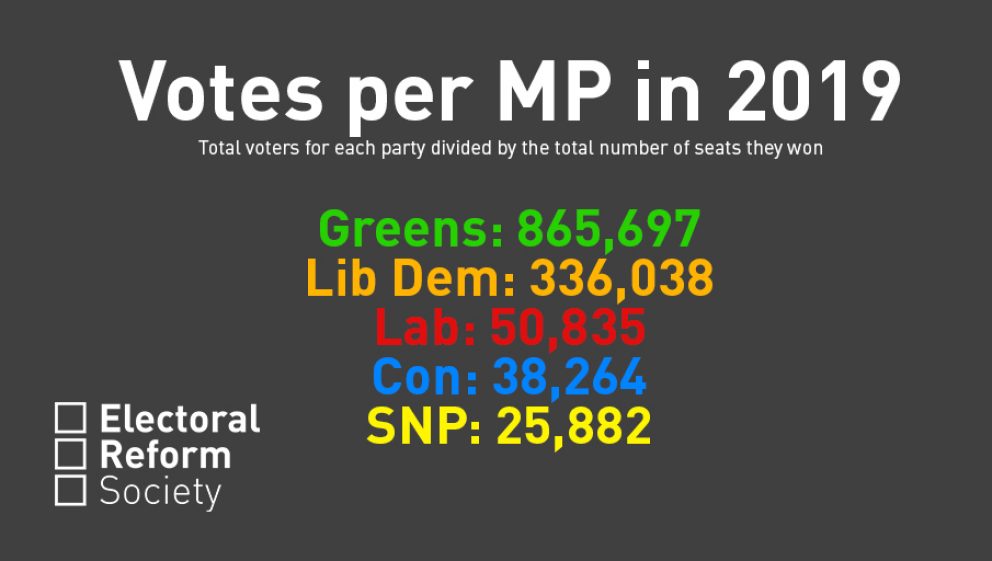
The Liberal Democrats didn’t shower themselves in glory this election, as I previously blogged. The Lib Dems won 3,696,423 votes nationally in this election, which equates to 11.6% of the vote. Yet in terms of MPs the Lib Dems now only have 11 out of 650 in the House of Commons. The Lib Dems vote increased by 4% since 2017, yet they return to parliament with fewer MPs. Contrast this the Scottish Nationalists, who won only 1,242,380 votes and 3.9%, but now have 48 MPs in the House of Commons.
The Conservative Party on 43.6% now have a strong majority in the House of Commons. In other words 56.4% of voters didn’t vote for this government, yet it has a whopping parliamentary majority. The Conservative Party got the most votes, and undoubtably won the election. But the large majority in the House of Commons they now enjoy does not reflect the true level of their support.
Poster produced by the UK Electoral Reform Society
But this is not a new phenomena in UK politics. In the 1997 general election Tony Blair’s Labour Government won 43.2% of the vote, yet got 418 MPs in the commons to the Conservatives 171 who in turn had won 30% of the vote nationally. In the following election in 2001 Labour’s lost 3 million votes, winning 10,724,953 votes compared with 13,518,167 votes four years earlier. However in the commons Labour had 413 MPs winning 40.7% of the vote to the Conservatives 166 and 31.7%.
Under proportional representation, it’s highly likely that Tony Blair’s Labour Government would have won the 1997 and 2001 General Elections, as likely would have Boris Johnson’s Conservative Government won in 2019. Point is, neither of these government deserve the majority the current voting system gave them. Further, it is difficult to morally justify a government having a strong majority when this majority does not truely reflect the votes it received.
Democracy is a precious thing, and not something that can be taken for granted. Having an electoral system where every vote matters is crucial to creating a decent society. It is time that the UK started seriously debating electoral reform and how to improve its democratic systems.
One of the more surprising policy announcements from UK Labour during this election campaign is their free broadband policy. Described by the BBC as Broadband Communism(maybe someone should point out to the BBC how they are funded) the policy certainly got discussion going.
The policy is to deliver free full-fibre broadband to all individuals and businesses by 2030. The government will own the network that is rolled out and will deliver free full-fibre broadband as the network is completed, starting with communities with the worst broadband access.
British Telecom was privatised by the Conservative Government led by Margaret Thatcher back in 1984. Rather than renationalising the whole company, Labour’s policy is just to bring the broadband part of the business into public ownership. The justification is that internet is a public good and therefore the state needs to ensure all citizens have access to it. This would put internet in the same public good basket as water, electricity and similar utilities. While consistent with Labour’s overall philosophy of bringing back these services back into full public ownership, few expected this policy before it was announced.
As a vote winner, it’s not clear whether saving 20 quid a month on broadband is going to swing that many voters. However the policy when linked with a wider economic strategy of investing in communities throughout the UK has merit. Installing ultra fast broadband in parts of the UK where internet access is poor could well encourage business investment.
While seen as a policy of the left, and decried as much by political opponents, significant investment in broadband infrastructure has considerable merit. The private sector is highly unlikely to invest in full-fibre broadband in poorer parts of the country, so it is up to the state to step in. Thus having this under public ownership is also logical.
Get Brexit done. Its all Boris Johnson says. If he is asked about the NHS, the economy, education, climate change what he ate for breakfast last night all you gets is “well, um ah, that’s a well, we a need to just get brexit done”.
From a marketing and psychology perspective its a clever strategy. The British public are utterly sick of Brexit. They are sick of hearing about it. They are sick of the country being deeply divided by it. They are sick of the fact that 3 years after the referendum virtually no progress has been made. And people are angry and upset that parliament is been so bogged down in it that it seemingly cannot get on with anything else.
Can the Conservatives get brexit done by January 31st as they are promising in the election? The short answer is no. The slogan is catchy, and taps into public sentiment. But it is also pure unadulterated bullshit. If the Conservatives do form the next government these words will haunt them, especially Boris Johnson.
So why can’t the Conservatives get Brexit done?
In a leaked recording by the EU chief negotiator Michel Barnier says The Conservatives plans to wrap up Brexit in the next 11 months is “unrealistic”. Even if the Conservatives manage to pass the withdrawal agreement in January, this is only a transition arrangement with a limited life on it. Once this expires, if no permanent arrangement has been agreed, the UK once again finds itself on the knife edge of no deal hard Brexit.
For an ongoing relationship between the EU and the UK, the EU would expect the UK to continue to comply with various EU regulations. Other states like New Zealand who trade with the EU currently have to comply with various EU regulations in order to sell to that market. Given Brexit was about giving greater independence and autonomy to the UK, this is very difficult for Boris Johnson and the Conservatives to sell to the public.
The other problem is that trade agreements take time to negotiate. The EU free trade agreement with Canada took 7 years. If the Conservatives want to try and negotiate trade deals with other countries like the United States – they’ll soon find the US play hard ball when negotiating trade. Trying to get a deal that benefits the UK won’t be easy at all, so again will likely take years.
For Labour, Brexit is no less of a headache. Initially Jeremy Corbyn, very sensibly in my view, tried after the referendum to avoid Labour being too far on either the leave or remain side, others in the Parliamentary Labour Party have pushed it towards a remain position. The wailing and whinging of former deputy leader Tom Watson, Emily Thornberry and other Labour MPs firmly enmeshed in the Westminster bubble have actively pushing for 3 years for Labour to support a second referendum and campaign for remain. Effectively these so-called moderates thought Labour’s path to government was to tell 52% of voters they were wrong in 2016.
Many friends and former colleagues on the left in New Zealand when they talk to me seem surprised that Labour didn’t jump straight on the second referendum campaign bandwagon after 2016. Anyone who has visited or worked in the Midlands, the North or indeed most places in England outside of Greater London will realise that taking such a stance would not go down well. On the left, many regard the EU as an institution that for the last decade has pushed austerity, privatisation and is generally undemocratic. What happened in Greece during the 2015 bailout is often cited as a reason not to be tied to this entity. Brexit wasn’t just something supported by the political right.
The current Labour policy is the best compromise it can come up with given where it is now, which I outlined along with all other party’s Brexit positions in a post last month. But the challenge is that any deal Labour does with the EU will likely see the UK stay in the customs union. A second referendum where this and remain are the options, will not please many Brexit supporters who see the being in the common market as the problem.
The Liberal Democrats anti democratic position of ignoring the referendum result and revoking article 50 went down like a cup of cold sick on the campaign trail. The Lib Dems have now had to revert back to the second referendum position. For remain voters wanting to stop the Conservatives hard Brexit, the discussion has now turned to tactical voting. However this is messy and voters are having to rely on highly dubious polling data or previous election results to make tactical calls. The situation is a bit easier on the Conservative side where the Brexit Party have stood aside in Constituencies the Tories currently hold. However for the Tories there is still concern about The Brexit Party running in key Labour marginals where vote splitting may prevent a Conservative gain.
Brexit is messy and complicated, and has contributed to making tomorrow’s election both volatile and unpredictable.
Whatever the results of this UK election, Brexit will not just get done. The division and confusion will continue for years, whoever wins and whatever policy gets implemented now. What lies behind Brexit is a more fundamental question of English national identity. I say English, not British or UK. In the 2016 election England voted 53.4% to leave and 46.6% to remain. If you take out the strong remain voting stats for London, the picture in England is very much a nation where the majority favours leaving the EU. And that has not changed.
The Map above shows the results of the 2016 Brexit referendum. Blue marks where remain won. The sea of yellow throughout England is where support for Brexit came from.
England is at a cross road with its national identity. Increasingly The Saint George Cross Flag rather than the Union Jack are flown across the country. While many still support retaining the union of the United Kingdom, increasingly there is a view that England needs to focus more on its own interests. However this is not universally shared, with many in England, and especially in London saying they identify as much if not more as European than as English.
84% of the British population live in England, so if England votes a certain way, that’s what is happening. I’ve already posted about the impact this has had on Scotland and Northern Ireland. These are very different electorates, and nations with very different view to that of England on Brexit. This is a tension that will continue whatever happens in the general election. For Wales the picture is a bit different. Wales voted to leave, though the voting margin was closer than in England, especially when you exclude the London votes. Time will tell whether similar tension starts to happen in Wales also takes a different position to England on the Brexit question.
So getting Brexit done? Sorry everyone, Brexit hasn’t event started. This was the easy bit. If the next government can survive the next 5 years, Brexit uncertainty and disruption is likely to continue.
Today Boris Johnson had a train wreck of an interview today, where he refused to look at a photo of a 4 year old with suspected pneumonia forced to lie on a pile of coats on the floor of a Leeds hospital. Rather than acknowledge the photo, the Prime Minister snatched the phone and put it in his pocket. Bizarre behaviour. And the actions of someone rattled and on the back foot.
4 year old Jack Williment-Barr with suspected pneumonia forced to lie on a pile of coats on the floor of a Leeds hospital.
Recent polling surveys have shown that the NHS has overtaken Brexit as the main election issue. This makes the terrible interview by the Prime Minister even more concerning for the Tories.
Secret documents released by Opposition Leader Jeremy Corbyn show that in talks with the US the topic of access to the NHS has come up. This is consistent with the approach taken by the US in other trade negotiations. Back in 2016 when negotiations for The Trans Pacific Partnership (TTPA) trade agreement between pacific nations were in full flight, this issue came up. In New Zealand there was concern that subsidised prescriptions would be put at risk due to conditions being pushed by the US in the trade negotiations.
Because the Conservatives have said they stand for a hard Brexit, rather than retaining a customs union with the EU, they need to find significant trading parters. The US is the obvious one. But the US don’t just give away easy trade deals. Healthcare and medicine is highly profitable, and the US would want a piece of that action in any trade deal.
The NHS is well loved by the British public. It is seen as something which makes British society decent and civilised. That the NHS is now stretched and badly underfunded is seen as a national outrage. Fears of even further privatisation of the NHS due to a US trade deal has unsurprisingly made the NHS the number one election issue.
With only 3 days to go until the election, we can expect to hear much much more about the NHS before polling opens.
On Friday, UK leader of the opposition revealed a leaked Treasury Paper which undermines the Prime Ministers claims that there will be no checks on goods moving between Northern Ireland and Great Britain. My earlier post on each of the party’s Brexit positions pointed out how critical Northern Ireland has been in the Brexit debate.
In my post about Scotland and the 2019 election I said that understanding of Scottish politics throughout the rest of the UK was poor. The situation is even worse in Northern Ireland. Northern Ireland has a fraught history of conflict and sectarian violence. Bitter divisions within the community go back generations and continue to run deep.
Since the Republic of Ireland gained independence in 1922, the six counties of Northern Ireland have been in dispute. From the late 1960s through to the Good Friday Agreement in April 1998 a bloody conflict occurred. Whilst this was often portrayed as Catholic vs Protestant (and this played a part), the real issue was whether Ireland should be part of the Irish Republic in the South or be part of the United Kingdom.
The Good Friday Agreement achieved a compromise. It was agreed that were would be power sharing between involving both communities within Northern Ireland. Stormont, the Northern Ireland parliament would have greater autonomy to make decisions in the 6 counties. Though Northern Ireland would remain part of the United Kingdom, the Republic of Ireland was also a party to this agreement. Critical to making this agreement work, was that both the UK and the Irish Republic were members of the European Union, thus were part of a common market. This made it easier to have borderless trade and free movement between Northern Ireland and the Republic.
I have been lucky enough to visit the area a couple of times. Currently when you drive from the Republic of Ireland to the North you barely notice the border. The main differences are the road signs go from kilometers to miles (very confusing at first), and the signs in the Republic say Derry and in the North say Londonderry.
For the last 21 years people have moved freely between north and south. The sectarian violence and division hasn’t completely gone away. But for the generation reaching adulthood now, they have known relative peace compared with the situation in the 1980s and early 1990s.
Brexit threw a massive spanner in the works. It seems when people voted on 23 June 2016, few outside of Northern Ireland considered the impact this would have on the Good Friday Agreement. Northern Ireland voted to remain in the EU with 55.8% voting to stay and 44.2 voting to leave.
The Good Friday Agreement was always a compromise. In each Stormont election, the margin between the Unionists and the Republicans has narrowed. Many expect that in the not too distant future Republicans will be the majority in Northern Ireland. What could have happened under the Good Friday Agreement, is a peaceful transition where hopefully both communities continued to be heard. What the Brexit result and subsequent brinkmanship and grandstanding has done, is inflame old divisions and risk the precarious peace in Northern Ireland being lost.
In the March 2017 Stormont elections, The Democratic Unionist Party (DUP) remained the largest party, but only by one seat. Sinn Fein won 27 seats and the DUP 28. Negotiations for power sharing broke down. Shortly after Theresa May called an early election and lost her majority in Westminster. For the DUP this was a golden opportunity. They no longer needed to negotiate with Sinn Fein, they could just jump into bed with the Tories in Westminster.
The DUP support Brexit, and a hard Brexit. Their position in government has been that they don’t want Northern Ireland to be treated any differently to the rest of the UK. Two problems. One, the people of Northern Ireland voted to remain, so they are not representing the views of Northern Ireland voters. Two, Geography is not on their side. Whatever your views on Northern Irish politics, the fact remains that Belfast is a 2 hour drive from Dublin. Northern Ireland is part of the Island of Ireland, and their economies are intertwined. Having had 21 years of free movement and being part of a single market, there is no way to protect this without having some sort of special arrangement for Northern Ireland.
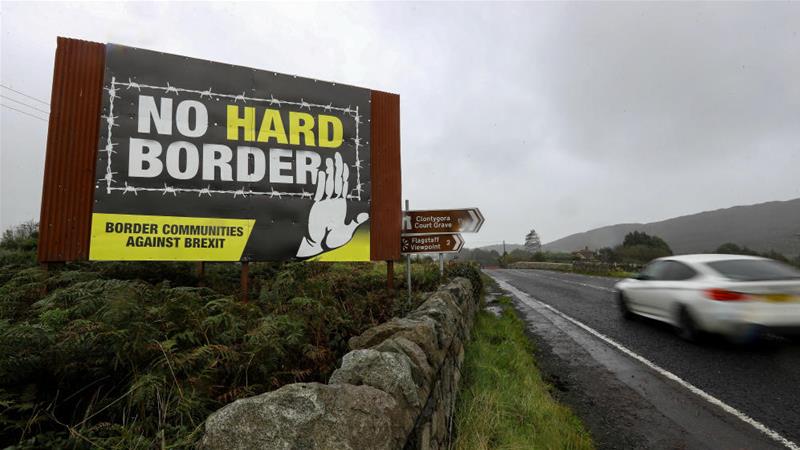
Billboard near the boarder of Northern Ireland and The Irish Republic.
Sinn Fein refuse to take their seats in Westminster, as they refuse to swear allegiance to the Queen or accept English rule over Northern Ireland. This would seem quite a principled position by Sinn Fein, however despite not taking their seats, Sinn Fein have claimed over £1 million in expenses over the last decade. Given the serious impact Brexit will have on Northern Ireland, and given the role the DUP has played in government, Sinn Fein needs to really consider whether they are representing their community well.
Boris Johnson’s promise that there would be no checks on goods between Northern Ireland and Great Britain don’t stand up to scrutiny. What is clear is that the Conservatives understand there is no way to get what the DUP want from the European Union. And the DUP don’t do compromise. At all. The tighter the margins are between the DUP and Sinn Fein, the more hard line the DUP become. They seem to have applied the same tactics with the Tories – and ended up being the coalition partners from hell.
Thursday’s general election may not be an easy one for the DUP. Having failed to form a government in Stormont, they instead formed an alliance with the Tories in Westminster and achieved very little. Like in many parts of the UK, there will be tactical voting at play. Sinn Fein has stood aside in 3 constituencies and encouraged their voters to support other remain parties. In the May 2019 EU elections the DUP lost of the two seats they previously held. They potentially may face similar loses this week.
Since the 2016 Brexit referendum, there has been a surge in Northern Irish from protestant/unionist communities applying for passports from the Republic of Ireland. We can’t assume that this means support for a united Ireland has increased, but it does indicated a shift in attitudes. For many in Northern Ireland, especially those who’ve grown up since the Good Friday Agreement, there is a desire for pragmatism and to not return to the conflict of the past. Also for Northern Ireland to have a strong and prosperous economy. The main political parties in Northern Ireland will find that if they don’t evolve, they’ll be cast aside.
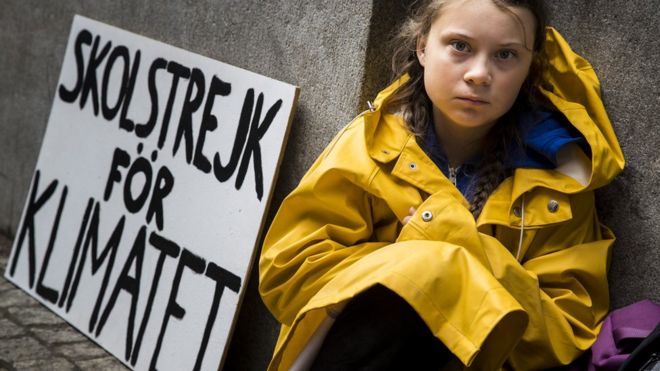
I was a bit late to the party in following the rise of Greta Thunberg. In August 2018 she began her activism by spending school days outside the Swedish parliament holding up a sign saying (in Swedish) “School strike for the climate.” This movement soon spread with high school strikes and protests happening throughout the world opposing climate change.
Greta Thunberg protesting for action on climate change.
It’s strange that media and social media create phenomena like Greta, whose name has now become synonymous for the single biggest issue facing the planet. I admire Greta, and all climate activists who have stood up and demanded that action be taken to stop the impending climate catastrophe.
But Greta was far from the first person to warn of the climate crisis and the need to take action. In 1989, then Prime Minister of Great Britain Margaret Thatcher made what I believe was one of the finest speeches of her political career to the UN general assembly. Thatcher, a Conservative Prime Minister, is far from everyone’s favourite political leader. And there are plenty of criticisms that can be made of her time in office. But on this crucial issue Thatcher acted as a real leader. She highlighted what she called the “credible” scientific evidence of environmental problems caused by the release of green house gasses, and proposed global action to counter this.
Thatcher was someone who rarely shied away from an argument. Former UK Labour Party back bencher Austin Mitchell in his book Revenge of the Rich describes this. Austin claims when hey wrote to Thatcher as a backbench MP, she would always respond, usually with 1 page justifying her government policy and 2 further pages explaining why the opposition position was wrong. Thatcher was Britains first woman prime minister and the longest serving UK PM in the 20th century. While a very polarising figure, she was a leader, and one who would stand up for what she believed in.
This is in stark contrast to the actions of current Conservative PM Boris Johnson. Last week channel 4 hosted the worlds first leaders debate on climate. Prime Minister Boris Johnson and Brexit Party leader Nigel Farage refused to attend this debate. Channel 4 responded by displaying ice sculptures on the podium where these two men should have been standing. The Tories have complained to the UK media watch dog that displaying these ice sculptures was media bias, a complaint that has been rejected by that body. The climate crisis is one of the greatest threats to life on our planet, and as Prime Minister Boris Johnson should have fronted this debate. By failing to do so, he has shown himself to be a weak and feeble leader. By not engaging on the critical issue of climate change, Boris Johnson has shown not only UK electors, but the world that he is a fool.
The melting ice sculpture on the podium where Boris Johnson should have been during the Channel 4 climate debate.
The increased occurrence of extreme weather patterns, like the flooding in the north of England a month ago are becoming more common. The slow and disinterested response from the current government is consistent with not attending the climate debate. Internationally we have seen climate change deniers like Donald Trump come to power. There are also a number of governments around the world who pay lip service to the climate emergency but continue to take little action. Unless this changes very quickly, it may be too late to stop the climate crisis.
In anearlier blog postI mentioned the increased number of young people enrolling to vote in the 2019 election. Climate change is a massive issue for young voters, who are very aware that during their lifetimes the impacts of the climate crisis will hit. Globally we have seen youth leaders like Greta Thunberg stand up and demand action. It’s time the world listened to these young leaders, and Margaret Thatcher’s UN address back in 1989, and take real action to prevent a climate crisis.
Scotland matters in the 2019 UK general election. Yet much of the electorate have little understanding of the place, it’s politics or what could happen after the December 12 election. Scotland could well decide the outcome of the 2019 UK Election. It did in 2017.
At the last election fierce electoral competition between Labour and the Scottish Nationalist Party (SNP) split the vote and allowed 13 Conservative MPs to win Scottish Constituencies. In the 2015 election the Tories only won 1 constituency in Scotland. Without these 13 Scottish Tories, Theresa May would not have been able to form government in 2017.
After Boris was elected leader of the Conservative Party in July 2019, Scottish Conservative Leader Ruth Davidson announced she was standing down from parliament. It was clear that Ruth, and many others in the Scottish Conservatives did not like the direction Boris Johnson would take the Party and the country. Many now believe the Tories will face political annihilation in Scotland on December 12th. If this comes to pass, the Conservatives will need to win 13 other new constituencies to the south just to maintain their current numbers, and many more than that to get the majority the Conservatives seek in this election.
So what is at play in Scotland?
In 2014 a referendum was held in Scotland, asking the Scots if they wanted to become an independent state rather that stay part of the United Kingdom. Scotland voted to stay in the UK with 55% voting No to independence and 44% voting Yes. Case closed, Scotland voted to stay. So thats it right?
After the 2016 Brexit result, the SNP wasted no time pointing out that when Scots voted to stay in the UK in 2014, they did so thinking they would be remain a member of the EU. Now that the UK has voted to leave, the SNP claim a second referendum on Scottish independence is now needed.
Since 2007 the SNP have been in government in Scotland. During this period the SNP have actively pushed the independence agenda. While 2014 referendum result was a set back for them, overall the SNP has performed well electorally and built support for Scottish independence.
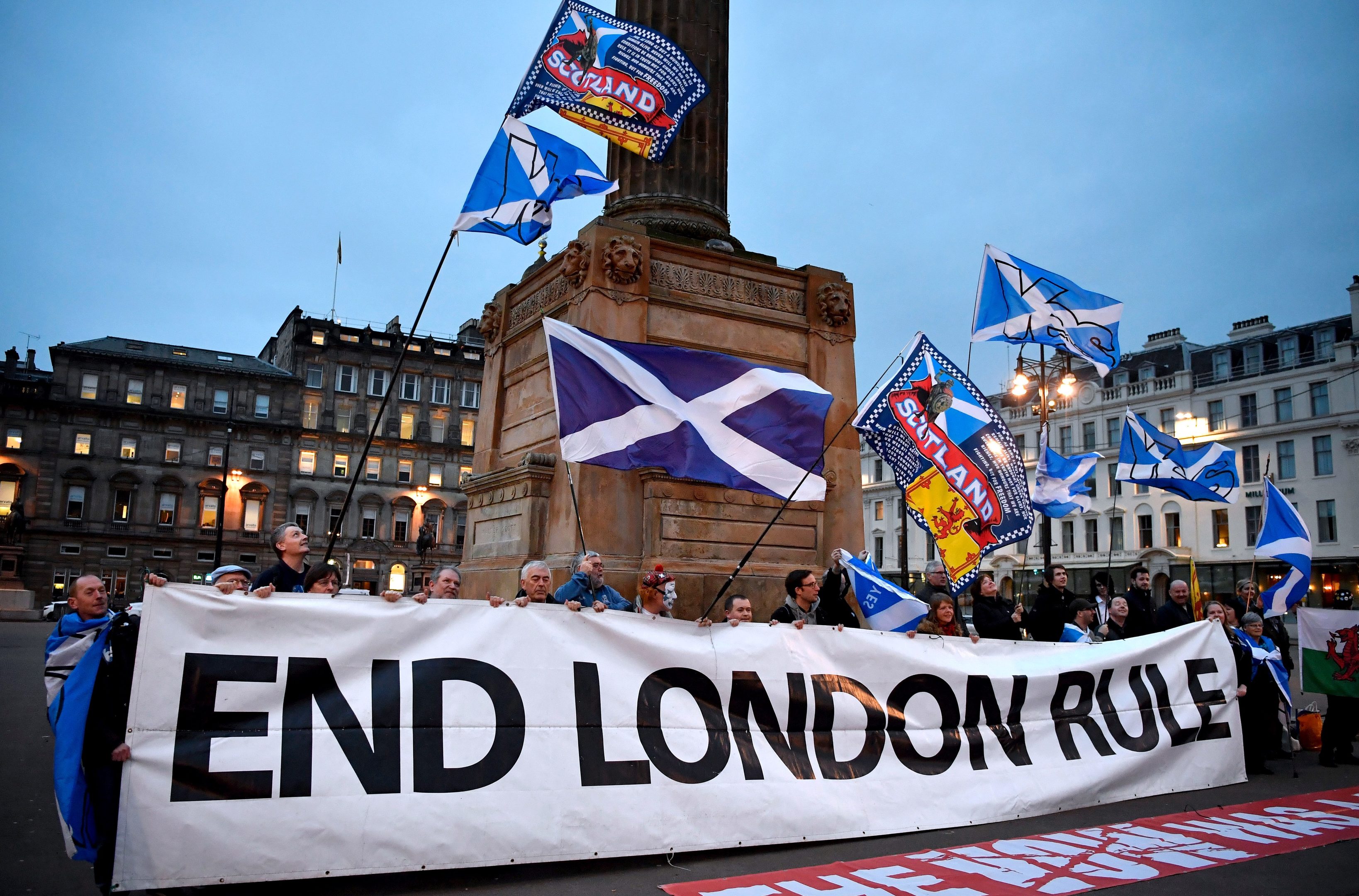
Pro Scottish independence rally 2014
For all that Boris Johnson, and many others in the Westminster establishment may whinge that Scotland has already had a referendum, the objective fact is that things have changed since 2014. Scotland wanted to remain in the EU, and now is being taken out against its will. Since the Brexit referendum the European Union has now indicated that they would now be much more open to an independent Scotland joining the EU. So in 2014 if you were Scottish and wanted to stay in the EU, your best bet was to vote No to Scottish independence. In 2019, Scottish independence now offers Scots a way to stay in the EU if the rest of Britain leaves.
The Orange Lodge (usually associated with Northern Ireland Protestants) March against Scottish independence in Edinburgh in 2014
Labour initially opposed another referendum, but has more recently softened their position saying they would respect a vote of Scots to leave the UK. In turn SNP leader Nicola Sturgeon has said her party would back a Labour Government if they agreed to a second referendum. Nicola would like an independence referendum within a year of forming government. Whereas Jeremy Corbyn has indicated he’d like such a referendum, if it were to happen at all, to occur after the next Scottish Parliament elections in 2021.
The Conservatives in the 2019 election have been saying that electing a Labour government would put at risk the Union of Great Britain.
First point: there is no guarantee a second Scottish referendum would result in Scotland voting to leave the UK.
Second point: if the Conservatives win the coming election, the SNP who are in government in Scotland, could still call an independence referendum. In October 2017 the Catalonia state government in Spain called a referendum on Catalonian independence, and 90% of those that voted supported independence. The Spanish government didn’t recognise the referendum and civil unrest and political instability ensued. The SNP have already indicated they would consider holding a similar referendum, even if not recognised by Westminster after Britain leaves the EU.
Forcing Scots to stay part of the UK against their will would do nothing to “defend the precious union” as Boris Johnson waxes lyrical about on the campaign trail. Many in the UK may not want Scottish independence to happen. But it needs to be accepted that the situation has changed significantly since 2014. If people in Scotland don’t want to be part of Brexit Britain, then this needs to be democratically tested and the result respected.
Whatever happens in next weeks general election – the issue of Scottish independence is not going to go away.








 Nick Kelly