Lies, damn lies, and unemployment figures

Last week there were reports by the BBC that unemployment rates in the UK had hit a record low. Back when I arrived in the UK in September 2017 there were newspaper reports that unemployment in London was at it lowest since the 1970s.

At a time when the government in Westminster lurch from crisis to crisis during brexit negotiations, and while the 2017 election wounds are still fresh, these statistics are welcomed news for the Conservative Government. Unfortunately for them, few are terribly excited, nor convinced by the statistics.

Anyone who works even an hour a week is deemed to be employed in these statistics. This means if you pick up a couple of one off cleaning jobs, do a few hours driving for uber, have a zero hours contract with McDonalds or are employed for only a few hours on minimum wage at the local supermarket you count as employed. How many people are currently seeking to increase their work hours and are still aspiring to receive an income to cover basic costs like food, rent, power etc? In reality while the number of people with no work may have fallen, many remain under employed and are still not earning enough to live each week.

I remember a similar issue in New Zealand just over a decade ago. At that time Labour was in power and boasted that unemployment was at a 20 year low. Again, the statistics didn’t count underemployment and the effects of casualisation of the work force.

The reality is with unemployment, government and business have three options:

Option 1: Do nothing and accept the consequences of high unemployment.

Option 2: Public investment in infrastructure that generates jobs and economic growth. This was the strategy adopted in the USA during the 1930s depression, where President Roosevelt’s New Deal kicked started that country’s economy.

Option 3: Fudge the statistics.

Politically, option 3 often proves to be the easiest.

The International Labour Organisation have a decent work agenda. This agenda calls not just for full employment, but for meaningful work, where people earn enough to live and where jobs are environmentally sustainable. By this measure, most countries have a long way to go. But it can be done. Public investment in projects such as renewable energy would help reduce the planets carbon emissions, create jobs and improve our society.

In the challenges that humanity faces in the coming years, doing nothing and fudging statistics isn’t going to cut it. We need to implement the ILO decent work agenda on a global scale. This will improve peoples lives, and create an economy that doesn’t pollute and destroy the environment. For all governments, this needs to be top of the agenda in 2018.


Work and Pensions respond

Some people say its not worth complaining as it doesn’t change anything. I couldn’t disagree more. In an earlier blog post I published my letter to the Secretary of Work and Pensions. I have now received a response:

Maybe they will now review and improve their phone systems. Maybe they won’t. But at least I forced the departments complaints team to look at the issue, and agree that the phone system was “frustrating.”

So my advise – when something isn’t right you should always complain. Its the only way things might get better.

Genius Trump

On the 1 year anniversary of Trumps inauguration quite a few commentators are giving their assessment of his first year as president. Not surprisingly, much of the commentary is less than flattering and the list of achievements fairly small.

Recently author Michael Wolff released his book Fire and Fury. This painted a picture of a white house staggering from crisis to crisis and a president who was unstable and not fit to lead. Trumps response to this was unsurprisingly to attack Wolff. Further Trump defended his mental fitness and claimed to be a genius.

Trump

It gives me no pleasure to do so but I am forced to agree, President Donald Trump is a genius. Don’t get me wrong, I utterly despise his policies and actions. His anti muslim immigration ban, his executive “gagging” order cutting funding to health groups that advise on contraception, his atrocious and inconsistent position on gun control in the US, his support on twitter of far right Britain First, describing third world countries as “shit holes”  and countless other utterly despicable statements. His actions both before inauguration and since have been  deplorable. But there is no denying the man is very smart.

When Trump first announced his candidacy for Presidency in 2015 he was largely written off as a joke. The political establishment were quick to pronounce “oh that will that will never happen.” 18 months later he’d beaten both the Bush’s and the Clinton’s, the families who’d won 5 out of the previous 8 elections. He was able to win rust belt states like Michigan that previously were considered ‘safe’ Democrat states. The reality is that Trump defied the odds, and he was able to harness the support of enough angry, alienated hope deprived American voters to install himself into the white house.

American politics has many flaws. All democracies have flaws, some more so than others. In the US, the system is based on a 200 year old constitution thats difficult to change. Difficult both in terms of the actual process, and culturally difficult due to the narrative that the constitution is some sort of sacred document that mustn’t be changed. Constitutions and rules are great, but they work best as living documents that evolve and change with the times. If they don’t change, they hold everyone back. So it is that a US President can be deemed to have won an election when they actually got 2.8 million fewer votes than his opponent. This is the second time this century that this has happened,  the other being in 2000 when Bush received 540,000 fewer votes than Al Gore. Despite losing two key elections where through this system, few Democrats have called for this system to be changed.

But Trumps success can’t be solely put down to a broken electoral system. For Trump, Hilary Clinton was the ideal candidate to go up against. Former First Lady, senator who voted for the invasion of Iraq (something Trump claimed to oppose during the Republican Primary Campaign in 2016) and part of the Washington Political establishment. Beaten in the Democrat Primary in 2008 by Obama, the Democratic Party leadership were seriously mistaken in thinking running Hilary would be a good move. And not its not because she was a women, I think had Bill Clinton run in the 2016 election he would have done even worse against Trump.

Hilary was considered the favourite at the start of the 2016 Primary, just as she had been in 2008. Out of nowhere, Bernie Sanders came on the scene and started winning considerable support. Politically you couldn’t get a more different candidate to Trump. What they had in common was they successfully tapped into growing alienation and discontentment in the political and economic system. I’m not saying that a Sanders vs Trump election would have produced a different outcome, though polls suggest otherwise. But once Hilary got the Democrat nomination, and she selected another establishment Democrat Tim Kaine, it was clear that the political establishment were still arrogant and not listening.

On the night of Trumps election I wasn’t surprised. Globally people are fed up with a political elite that don’t listen. The political bubbles that exist in Washington, Westminster, Wellington etc have ignored large sections of society for years. Until recently it worked for them. But Brexit, Trump and a number of upset elections recently in France, New Zealand, Germany and significantly in Alabama show when people have a chance to give the establishment a kick in the pants, they give it to them. There hasn’t been a clear ideological shift globally, but a growing resentment towards the political elites. Trump got this. He didn’t need to be consistent. He didn’t need to be honest. What he needed was to tap into feelings of resentment, sadly using the age old tools of Misogyny, xenophobia and general fear to do so. And yes some help from the Russian Government may have aided his cause.

A year later Trump continues to send late night tweets. The commentators and the establishment respond every time. “This shows Trump isn’t experienced as presidents don’t do this” they always respond. Global outrage and condemnation always follows when an outrageous comment is made. Yet he still tweets. Why? Simple, it fits with his brand. It connects him with his base. His voters wanted someone who wouldn’t just play the Washington game the Washington way. And the tweets prove it. He sends an outrageous tweet and the world responds. Like it or not he is setting the narrative. Its horrible, but he is a genius.

Fire and Fury no doubt sold well. It confirmed for those who oppose his presidency that he is not fit to hold office. Yet hold office he still does. I agree, he shouldn’t. I applaud those who in the US and around the world stand against his policies. But to stop the destructive Trump political agenda, we first need to understand why he come to power.

Compassion Fatigue

Sad Nurse

Last year I managed a project with health professionals. During this project I talked to a number of people who work in the health sector, who talked about how difficult their job had become. After years of austerity and underfunding, being told to do ‘more with less’ (one of the most idiotic HR/Management speak cliches) many health professionals are tired. They spoke of people who’d being in the profession a long time and were suffering from ‘compassion fatigue.’

In an earlier blog post I discussed why too much reliance on specialisation can have detrimental effects on individuals and the economy. In a profession like nursing, people working in the sector can easily find themselves trapped in jobs they no longer enjoy. Further they feel their contribution is not adequately remunerated or even properly acknowledged.

Generally people go into a profession like nursing as they want to help people. They get a buzz from helping someone in need and assisting them in their recovery. But do the same job day in day out, month after month, year after year…the buzz soon goes. As the decades roll by you increasingly find yourself cynical, and even slightly nauseated when the exited young nursing graduates are running around the hospital. All you can think is, you won’t be this happy in 20 years.

Sadly this happens to many people in caring professions. Professions that are often underpaid and undervalued. They find that they have been pigeon holed into these roles and struggle to get out. When looking for other work, friends and colleagues will just suggest jobs in the same field, and you increasingly feel trapped. Its not that you don’t care, its not that you don’t still want to help people. But you are tired, and its hard to keep looking after others when you feel nobody is there to help you.

This can quickly turn ugly. The person feeling unhappy and trapped becomes increasingly unhappy. One day they snap and tell their boss that they are an idiotic f#@k wit. They end up in a disciplinary meeting with the manager and HR. A union rep or some other employment advocate will be called in to represent them. This will be the one of 7-8 such cases said advocate will be dealing with that week, and you can be certain they too are becoming heartily sick of their job. Swearing at your boss is a sackable offence, but it will become clear that the manager didn’t follow the proper procedure, as they are in fact an idiotic f#@k wit. A confidential settlement will be reached and the employee is paid a couple of months salary. If the person is lucky this will be the opportunity they needed to change careers. Usually however this is the beginning of a long period of unemployment, and eventually a move into a lower paid role in the same profession.

For most people it doesn’t end up like this. Most people just struggle on and try and find ways to cope with being in a role they are over doing but can’t get out of. But in roles that require compassion this is a challenge. Compassion and empathy are not easy things to fake. And often you do still care, but you its hard not maintain the same level of energy that you had when you started in the role.

Health care professionals and other caring professions such as social workers or people who work in other social services do such an important role. So why do we work these people to exhaustion and suck all the energy out of them? Why do we trap people in roles for years that require a high level of emotional energy? People in these roles should be properly paid and valued. Also they should be given opportunities to train and transition to other roles if/when they feel the need to move on. After a break doing something else they may later want to return to their caring role, and they will do so with replenished energy and renewed passion.

People who care and help others are gems. We need to look after these people.

Positive thinking?

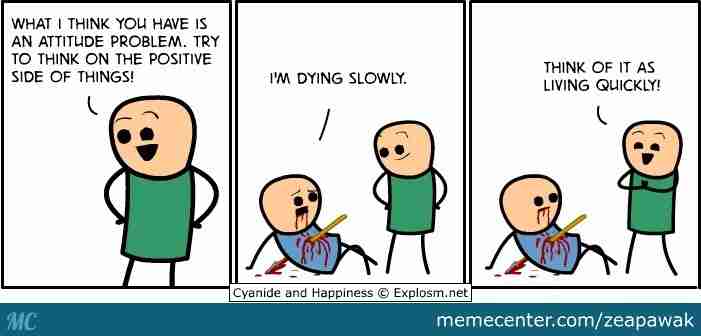
Is always being positive actually a good thing? Motivational speakers will often talk about picking your attitude or making sure you always have a positive outlook to life? On the surface is sounds like some fairly harmless possibly slightly hippie-ish ramblings. In corporate world talk of positive outlooks is a popular mantra, often linked to improving the companies performance or lifting sales. Again is this really that bad?

It is possible to be too negative. People who have suffered many knock backs or disappointments in life can easily became stuck in a mindset where nothing good can happen. Often this is used as a resistance to change, as you know whats the point nothing is going to make things better.

positive-thinking-meme

But frankly, always being positive is not the best thing. Its false. If something bad happens in your life such as you lose your job, a relationship ends or a loved one dies – is being positive that helpful? Or are you just repressing the emotions that you actually feel, and whats more should feel. Those of feelings of sadness, anger, regret, disappointment, frustration and grief. Telling people to just put those aside and be positive is frankly just nonsence.

When I lost my mother to cancer a few years ago, people at the time would try to comfort me and say things like “you will grow stronger from this.” A work colleague at the time came up to me shortly after mum died and said “those who say you are stronger for this are talking crap, its a shit thing that happened and there is nothing good about it.” This was the single best thing anyone said to me during that time, it validated how I actually felt. Sadly the colleague who said this to me, died suddenly of a heart attack two years later.

The above is an extreme example. We also face disappointment in day to day working life. You have been working on a project that didn’t come through or a funding request was denied. No, the answer isn’t just to give up. But being all new aged and zen and loving the enriching experience of a knock back  is not helpful. And telling a colleague to be certainly is not.

My experience has been that it is important to have goals or a desired outcomes to work towards. In doing so you hope to make progress as quickly or pain free as possible. As my previous post related to setting up a UK bank account explains, this isn’t always the case. Were those phone calls to the Department of Work and Pensions positive or life enriching? Like hell they were. They were very frustrating. It wasn’t a positive attitude that eventually got me through to set up a bank account, it was determination and persistence. Was it fun? No. Did I learn anything? That bureaucracy is a pain in the arse (something I was already well aware of).  But I didn’t give up, and that eventually got me through.

There are times when you can pick your attitude, and where stubbornly wallowing in the negative can be utterly destructive. But so too is stubbornly fixating on everything being positive. Its false, and actually very draining to force yourself to feel a certain way when it doesn’t come naturally. And sometimes “shit things” happen, and you should just allow yourself to accept how you feel rather than force something thats not real.

Letter to the Secretary of State for Work and Pensions

The Rt Hon David Gauke MP

Secretary of State for Work and Pensions 

House of Commons United Kingdom

SW1A 0AA

Rt Hon David Gauke,

In September 2017 I moved to the UK to expand my business Piko Consulting, a communications and research company into the UK market. One of the first things I did was to get myself a National Insurance Number.

In late October when still trying to set up a bank account in the UK, the bank asked me for proof of address. It was suggested to me by the bank that I called the Department for Work and Pensions and get them to send a letter with my National Insurance number on it to my home address.

On 24 October 2017 I called the Department of Work and Pensions help line. Firstly I was told that this was not the correct number and that for National Insurance queries I should call a different number. I then called this number. I was given a series of options; eventually I was put through to a pre-recorded message and then hung up on. My issue still wasn’t resolved so I called back. Once again, I after selecting a series of options I was hung up on. The third time I was slightly more cunning. I called back the helpline, and manipulated the answers in a way that I thought may get me put through to an actual human being. I had been at it for 20 minutes by this stage. I was successful. I spoke to someone, explained that I needed my National Insurance number posted on letterhead to my home address. The person on the phone agreed and said it would be on its way.

A few days later I got an email from my accountant. A letter had been sent to my accountants address with my National Insurance number on it, not to my home address as requested.

Having wasted over an hour of my life on a fruitless quest to get what I wanted out of the Department of Work and Pensions I elected not to put myself through this again.

A few months earlier I had seen the Ken Loach film I, Daniel Blake. At the start of the film there is this guy who recently suffered a heart attack trying to get information about his benefit out of the Department of Work and Pensions. He becomes highly frustrated with the long waiting times, and the circular conversations where he can get no answers to his questions. When I first saw this film I thought this scene was exaggerated for artistic effect. I now realise that this is an accurate display of a typical call to the Department of Work and Pensions.

My case ended up ok. I found another letter which the bank accepted as proof of address. What I was appalled by was that a government department could show such contempt for the UK tax payer by hanging up on them when they were seeking advice or help. That a pensioner who has paid tax all their lives, possibly a veteran even, could be treated with such contempt was very saddening. I understand the desire for government departments to save money and rationalise resources. And I accept that call centres will often get any number of nuisance callers or people who have questions they could easily find out online. But for some people using the internet is a struggle. And sometimes, people have complicated requests, and need to talk to someone rather than listen to a robot. It shouldn’t be a struggle for tax payers to get the help they require.

The UK is a great country, and I really love that I have the opportunity to live work and contribute here. But I do think its citizens deserve their government and in particular its government departments’ to treat its citizens with greater respect than the Department of Work and Pensions help line currently does.

Yours Sincerely,

Nick Signature

Nick Kelly

The folly of specialisation

Don’t misunderstand what I’m trying to say. Specialisation is a great thing. Modern society has evolved due to the specialisation of labour. People live longer as doctors and scientists have specialised in areas such as cardiology or neuroscience. It is a good thing to have a workforce where people’s particular skill sets are recognised and they can be their most productive.

But it is always possible to have too much of a good thing.

One of the things I have found moving from Wellington to London is the degree of specialisation is far greater in the UK. For example in a typical New Zealand communications team, there often are social media specialist roles. But people in these roles are likely to be expected to do other roles within the communications team, such as being the media contact or working on an organisations annual report. Far less likely (though it does happen) is it that a New Zealand organisations will have a team just dedicated to social media where the team members specialise in specific platforms such as Twitter or Instagram.

The personal struggle for me is that my CV and previous work experience includes a number of different roles. I have worked as an advocate and a representative. I have done research and analysis. I have set up and maintained social media campaigns or pages for organisations. I have been responsible for media campaigns dealing on a daily basis with journalists. I have worked the education, transport, trade union, government, private and NGO sector. I have been a member of governance boards. I have managed people and budgets. And I even use to drive a bus.

While I have been able to pick up contracts in London in my first 3 months here, the process of securing contracts can be slow. One of the challenges is that in London organisations rate specialist skills. So someone with 10 years specialist experience in social media is seen as an ideal candidate. Someone who has used social media in previous role, but also has wider experience  in managing the other functions of running a campaign or project may not be viewed as so qualified. I believe having that broader experience is incredibly valuable. Having someone who can see the bigger picture, or knows how their piece of the project interacts with the other departments or functions is vital.

Globally the trend is has significantly moved away from people remaining in the same job throughout their working lives. According to the Financial Times people in the workforce today should expect to change careers 5 times in their lifetimes. This isn’t a trend that workers in the UK are necessarily wanting to resist with nearly half of UK employees wanting a career change a 2015 study showed.

Changes to the world economy are going to perpetuate trends of people changing careers. In the UK clearly the changing economy when the country leaves the European Union will force businesses to change strategy, in a as yet  uncertain direction. But bigger shocks are on the way to the world economy than this. The development of driver less cars will result of millions of workers being forced to change careers in coming years. Responses to climate change, weather voluntary or reactively to climate disasters, will also cause massive changes to the workforce.

Significant changes to the workforce and people having multiple careers will not mean the end of specialisation. But people who display the skills of agility, adaptability and who can transfer specialist skills from one sector or role to another are very valuable to any organisation. Increasingly transferable skills and adaptability could will become just as important as having specialist knowledge.

Why Piko?

The second in my ‘Why’ series is about my company Piko. A group of us formed Piko in early 2016 in Aotearoa/New Zealand. In September 2017 I expanded Piko into London.

So why the name?

Piko is a Māori word which means to bend or curve.Piko was a road address for one of our directors at the time we formed the company. Much of our work is about helping our clients run campaigns for change, or to refocus clients strategic aims. Thus the name seemed appropriate.

But why did we form Piko?

The founding directors had worked in political parties, government departments, trade unions, Iwi organisations and private sector companies. One of the issues we had found in running campaigns is that often knowledge from successful projects or campaigns weren’t shared. We had run successful political campaigns within our various organisations. We wanted to build a company that helped organisations develop their capability so they can achieve their strategic goals or campaign outcomes.

Piko provides an opportunity for individuals to broaden their experiences and develop in their careers. It is very easy to end up in a certain sector or organisation, and soon find you only get opportunities to work in that area. Piko offers the opportunity to work across the public and private sector. To run campaigns for unions, charities, NGO’s and other not for profits, but also for political parties or businesses. We want people to develop their skills and capability, and not be limited by siloed organisation or sector thinking.

Much of our work has involved helping organisations run successful social media and digital campaigns. We are not a digital or social media company. We are a company that helps organisations run successful campaigns or promotions, and social media is one of the tools in the kit.

Why expand the business form New Zealand to London?

This why is addressed in the previous post. In the context of Piko’s overall business strategy campaigns and projects are often run across national boundaries. The UK retains strong connections with New Zealand, but also is a larger and more complex market in many ways. Both countries have much they can learn from each other, and Piko’s expansion in the UK can help facilitate this.


Why London?

Recently someone recommended I look into Simon Sinek’s Start With Why. I’m not usually one to get over excited by the latest motivational speaker or concept. But this one spoke to me. It spoke to me as it was so simple, so obvious, yet often the very question that businesses and organisations ignore. Why?

So my first blog posts are going to be dedicated to this theme.

Why London?

The UK and particularly London is about to go through the most significant period of uncertainty and change since the end of the second world war. Brexit will fundamentally change the economic, political and cultural landscape of the country. Commentators and pundits can try and pick what will happen over the coming months and years (and I’ll inevitably do the same). But in reality there are so many variables that at this stage it is anyone’s guess as to how things will play out. Last nights upset vote in the House of Commons being just the latest sign of turmoil.

Uncertainty, change, turmoil. These don’t sound like reasons why do they? Or are they?

When there is a risk, often there also is an opportunity. Since 1973 Britain has been part of the common market. In March 2019 that will come to an end. All of the UK’s trading arrangements will need to be revisited. EU regulations will no longer automatically apply and parliament will need to pass a considerable amount of legislation. The politics of Northern Ireland have already been brought to the fore, with concerns that a soft border may not be retained with the Irish Republic. This was further complicated in the 2017 general election when the Conservative Government were forced to go into Coalition with the DUP. Likewise the issue of Scottish Independence looms in the background, as like Northern Ireland the majority of voters in Scotland voted to remain in the EU.

The above may not look like opportunities for positive change. But in times of change comes and opportunity to fundamentally revisit the political and economic structures of the United Kingdom.

Coming from New Zealand, I have grown up in a country that was never part of the EU. New Zealand has been forced to make its own trading relationships. As a small country in the South Pacific we have had to develop relationships with superpowers like the US and China. We hold our own on the world stage despite having a population of just over 4 million people. I don’t mean to put NZ up on a pedestal, and future posts may address some of the challenges that country faces. However coming to London from New Zealand, Piko Consulting comes to the UK with fresh eyes and a different perspective. This fresh perspective and openness to change is something that would greatly benefit many organisations in the UK.

So why London? For me and my company Piko, London at this time offers exciting challenges. There are opportunities for Piko to make a positive contribution to the UK at a time of significant change. For me it is an opportunity to move into new areas of work in a different economy. The city of London is full of many opportunities for me to expand my company at this time. And for London I offer a skills, experience and a fresh perspective that will be incredibly valuable, especially during this time of change.

I am excited to be here, and I can’t wait to make a positive contribution in London.