Why the Labour Party?

In November I attended a screening at Cambridge University of My Year with Helen, the documentary about former NZ Prime Minister Helen Clark running unsuccessfully for Secretary-General of the United Nations. I briefly spoke to Helen after the screening. She appeared not to remember me, it was probably easier for us both.

I joined the NZ Labour Party in January 1997 at the age of 14. Within a year I had become very active in the party and spent many hours campaigning in the 1999 election when Labour came to power. New Zealand had since 1984 been a world leader at implementing a hard Neo-Liberal economic agenda. Privatisation, user-pays and free-market deregulation were all the rage. As a teenager, it became apparent that a widening gap between rich and poor was the inevitable result of this agenda. I decided the thing to do was join Labour and help change the country’s direction.

By 17 I had been elected chair of the Rimutaka Labour Electorate Committee. By 18 I was the Young Labour Wellington Representative. I was regularly attending meetings with MPs and was building a reputation as an up and coming Labour Party activist in Wellington.

But in 2001, things changed. After a year of Labour being in office, I started to become critical of the 3rd way and specifically the governments continued support for trade liberalisation. The conflict quickly ensued:

Read the story of how I publicly fell out with Labour here.

Sacked as the chair of the electorate committee and soon after from the Young Labour exec for opposing free trade deals that put 20,000 jobs at risk. Then 9/11 happened and the US led war on terror commences. I got dragged out of the 2001 Labour conference for interrupting Prime Minister Helen Clarks Speech opposing NZ troops being sent to Afghanistan.

Labour fires teenaged rebel

Above: Photo on the front page of the Wellington Evening Post under the headline “Labour fires teenage rebel”

Eventually, I got expelled from the NZ Labour Party in 2002 for running against sitting Labour MP and Cabinet Minister Paul Swain in the Rimutaka Electorate. I got 376 votes, and Paul got significantly more.

Looking back, I managed quite successfully to gain the attention of the national media. Specifically, my initial media release about free trade was 14 pages long, that it still got reported is quite a feat. Amusingly when a Dominion post reporter rang my home my mother answered. The reporter explained that I’d put out a media release attacking the government’s stance on free trade and was scathing about government economic policy. Mums reply was “typical, mothers are always the last to know.”

Getting turfed out of Labour didn’t harm my prospects, in fact, my lifted profile probably helped me get elected to student politics shortly after. Further, in the short term it did help create some debate about both free trade and globalisation, and the connection between that and NZ aligning with the US to send troops to Afghanistan.

I don’t regret what I did, and on issues like sending troops to Afghanistan, I still think the west’s intervention in that country was short sighted. But tactically I would take a different approach today. NZ Labour remained in government for 6 years after my expulsion and attempts to build new political organisations in opposition to Labour on the left failed. Further, the relationship between myself and Labour members in the following years remained quite strained, and there were faults on both sides. In student politics and in other campaigns certain opportunities were missed as a result. It wasn’t until 2008 that this started to change. Even today there are those who remember the events of 2001 and remain suspicious.

I remain critical of placing any party/tribal allegiances over policy. Political parties and organisations are a tool. Parliamentary Parties like Labour can help achieve significant social change. But they are only one way. Community campaigns, unions, lobby and other pressure groups are just as important in achieving social change.

Back in 2002, I was often dismissed a nutty or far left. Policies like free tertiary education, opposing sending troops to Afghanistan and ending youth rates for young workers are all policies of the current NZ Labour led Government. In 2001 these things were considered insane. Labour MP Trevor Mallard suggested I “lay off the hallucinogens, or take them, whichever is appropriate” in response to voicing such opinions.

Did getting kicked out help make things change? Or would I have been better off staying inside? It possibly made life easier for 3rd way Blairite types not having to face dissenting views internally? But possibly making noise on the outside was effective?

Fast forward 11 years to 2013. At a Mayday function, I was asked if I would re-join Labour. My reply (after a few drinks) was that Paul Tolich who had helped drag me out of the 2001 Party Conference would have to come to sign me up. The next day Paul Tolich turns up at the Public Service Association where I worked and signed me up. Unlike my 2002 expulsion, my 2013 re-joining of Labour was a low-key affair. My aim was to quietly slip back unnoticed, and avoid picking up any roles or responsibilities.

This wasn’t to last long…

In 2014 Labour suffered one of its worst election defeats in the Party’s history. A leadership election was held after former leader David Cunliffe resigned. Former trade union and student leader Andrew Little put his hat in the ring. Labour leaders in NZ are elected by party members, trade union affiliates as well as by MPs. Andrew had only just made it back into parliament in 2014 and was far from being the front runner for the leader. I was asked to be his Campaign Manager, which I agreed to.

Andrew 1

Above: Campaign image used during the 2014 campaign to elect Andrew Little NZ Labour Leader.

Andrew narrowly won the leadership contest becoming Labour Leader and Leader of the Opposition. One of the reasons I supported Andrew’s Campaign was having worked with him before I’d seen he was a leader unafraid of making hard decisions. I also liked that he opposed raising the retirement age from 65 to 67, whereas previously the party had supported raising the age and alienated a number of voters.

After getting Andrew elected my involvement decreased. I went back to my work at the Public Service Association and concentrated on other things like finishing my Post Graduate degree. While far from perfect under Andrew’s leadership, some important things were achieved. Labour managed to ban zero hours contracts from the opposition benches with the help of a strong campaign by unions and social justice groups. In 2017 Andrew stepped down as leader and was replaced by Jacinda Ardern who shortly afterwards became NZ Prime Minister. The work Andrew and his team did from 2014 to 2017 helped Labour get into government, even if he wasn’t leader during the election. Andrew is now Minister of Justice. He also is doing good work supporting the families of the Pike River Mining Disaster as the minister with responsibility for this.

So from young up and coming Labour member, to kicked out and expelled, then returning and running a successful campaign for the Party leadership, my history with the NZ Labour Party has been eventful. Over the last 20 years, I have certainly grown and changed, as too has NZ Labour. Now back in government, Labour has an opportunity to make a real difference both at home and internationally. I now watch with interest from London.

 

Cryptocurrency and the nation-state

This is a topic I make no pretence at being an expert in. It has only been recently that I have started learning about Bitcoin and other cryptocurrency. However in the short time I have been educating myself about this issue, I have made some fairly obvious but also quite profound observations. The rise in cryptocurrency occurred after the 2008 financial crisis, and in part was a response to a loss in confidence in traditional banking. Secondly as cryptocurrency increasingly enters the main stream, this poses a significant challenge to the nation state.

For those who like me are still new to the concept of cryptocurrency, below is a brief definition:

a digital currency in which encryption techniques are used to regulate the generation of units of currency and verify the transfer of funds, operating independently of a central bank.
“decentralized cryptocurrencies such as bitcoin now provide an outlet for personal wealth that is beyond restriction and confiscation.
In an era where people can buy and sell all over the world from their smart phones, the internet has increased global transactions at a phenomenal rate. Cryptocurrency is the logical next step. Bitcoin has played a similar role in cryptocurrency to that which Napster played in the music industry in the late 1990s. Being the first out the gate Napster got bashed by the establishment. Ultimately however the music industry was never the same again.
Other cryptocurrencies such as Ethereum may well surpass Bitcoin, as I gather builds in a programming language on top of the blockchain, allowing for far greater functionality, and the creation of executable ‘smart contracts.’ If one is looking for the best big investment, the time for Bitcoin has possibly been and gone. But other cryptocurrencies will likely rise in its place.
For libertarians, cryptocurrency is a wonderful development. An encrypted currency the state cannot regulate or track. While currency and banking regulation is not the only significant thing the state does, its certainly one of its major functions.
There has been attempts in the US and elsewhere to regulate cryptocurrency and in particular Bitcoin. The concern being that if all transactions are encrypted and cannot be traced, this technology can be used for illegal activity. While this is true, the same argument can be made for someone taking money out of an ATM machine. But the fundamental problem is regulating a currency that operates outside of the nation state.
The monetary system that we use today replaced barter just over two thousand years ago. Currency as we know it today was developed much later. For example the British pound was first established in the year 760. Cryptocurrency has the potential to be the biggest change to the way we use money in over 1000 years. The impact this could have on the nation state should not be underestimated. How do governments set monetary policy for cryptocurrency? What does the future hold for existing currencies? Will cryptocurrency replace them? Again, I am no expert at all. But its clear that these are huge questions. Its not clear that governments, or global governance organisations are yet seriously facing up to this challenge.
Predicting how things will turn out is always risky. Too many variables are at play, especially when it comes to technological developments. But as disruptive technologies go, cryptocurrency is likely to be one of the biggest in the next decade. If the nation state tries to resist or control this force with 20th century methods, it may come off second best.

Guns

Mexico has a reputation for being a dangerous place, especially when you talk to people living in the United States. It has a reputation for violent crime and drug trafficking and illegal migrants. A couple of years ago I travelled south across the border to the Baja Peninsular in Mexico. Below was the warning we were given as we headed south:

Guns in MexicoAbove: Advise given to Americans crossing the border to Mexico

While Mexico does have a reputation as being dangerous, for many Mexicans they equally have fears about their northern neighbour. Specifically they are concerned that the United States Government has failed to pass adequate gun control laws, and consider this to be very dangerous. The Mexican Government in the interest of public safety of heavily police the US border for guns. As the above shows, it severely punishes those who try to bring weapons into Mexico.

Today the news reported that 17 high school students have been killed in a mass shooting in Parkland Florida. There have been 291 school shootings in the United States since 2013. Today’s shooting is the 8th school shooting resulting in injury or death in 2018, 7 weeks into the school year.

Calls for US gun control laws are nothing new. After former Beatle John Lennon was murdered in New York in 1980 there was calls for tighter gun control. But the 1776 US Constitution second amendment protects the rights of gun owners:

“A well regulated Militia, being necessary to the security of a free State, the right of the people to keep and bear Arms, shall not be infringed.”

This constitutional freedom apparently extends to semi automatic weapons designed solely for the purpose of mass killing. The fact that such weapons were invented long after the second amendment was written is irrelevant, apparently. That the perpetrator of this horrendous killing in Floria was not part of a ‘well regulated Militia’ again is apparently irrelevant. This individual had the constitutional right to own the weapon he used.

This highlights yet again the folly of having a constitution that fails to adapt and grow with the times. Specifically it has failed to protect American citizens from gun violence. The US could implement gun control. It isn’t an easy process, but it could repeal the second amendment. There is growing public support for tighter gun control in the USA. But weak political leadership has failed to put the US gun lobby in its place – that place being prison for aiding mass murder.

I don’t have much positive to say about the John Howard Liberal Government of Australia from 1996 to 2007. However the gun control laws this government implemented after the Port Arthur massacre in 1996 are a model for the rest of the world. These laws require all guns in Australia to be registered to an owner. Gun owners are heavily vetted and any breach of the law will see all guns confiscated. When gun owners wish to get rid of their weapons, the state will buy them back at market value. The result has been a sharp decline in gun violence in Australia.

The counter argument to stronger gun control is that guns don’t kill people, people kill people. I can’t disagree with this. While strong gun controls laws are needed, we also need to look at why people commit these horrific mass murders. While stopping perpetrators gaining access to these weapons may reduce the number of fatalities, these people can still harm people with other weapons such as knives. We need to understand why people become so alienated and full of anger and hate that they would do these terrible things. The US need tighter gun control laws. But this is only part of the solution.


Ideology

Ideas are great things. Having thoughts, opinions and analysing the world is very important. Having a set of theories or ideas based on material analysis, studying discourse or generally trying to interpret the world we live in is fantastic.

I would encourage anyone to read about philosophy, economics, politics, religion, sex (there is plenty of societal analysis rather than just hands on practical guides), class, race, gender or any other discipline or idea. People should read Adam Smith, Karl Marx, Friedrich Nietzscher, Ayn Rand, John Maynard Keynes, Michel Foucault, Emma Goldman, Vladamir Lenin, Francis Fukuyama, Rosa Luxemburg, Anthony Giddens….or whoever else.

Read, critique, question, analysis, compare and generally allow your mind to be open to new ideas. Don’t just read authors from your side of politics. Don’t just read from specialists in the area you are interested or work in. Read widely and broadly and open your mind. But whatever you do, don’t read these people like they have written some blueprint for life. Wealth of Nations is not an instruction manual on how to build society. There isn’t some pure interpretation of Das Capital that if everyone follows poverty will end. Reading and (attempting to) understand Foucault’s history of sexuality is great, but please don’t then reject all materialist analysis of economics out of hand (but don’t think everything is pure materialism either).

Reading works that have shaped human history is important. Understanding how and why these ideas shaped our world is essential. In doing so, also remember these works or ideas are placed within a time or place. Calling yourself a ‘Marxist’, ‘Keynesian’ or ‘Darwinist’ is just daft. These people were human beings who had ideas at a certain time. Here’s a thought, if the ideas you are taken by were written prior to the internet being invented, or the atom being split, then you might want to place them in their historical context. Further even if the ideas haven’t dated that much (some don’t), they still are just the idea of one human – and all humans get things wrong.

I write this because I find in politics, in academia and in many walks of life people get trapped into ism’s. Worse they put themselves into these boxes and subscribe to ideas uncritically. This is a theme I will return to in later posts, but its a trap I’ve fallen into myself. Very few people who’ve engaged in politics haven’t. Much of politics in the 21st century is still based on ideology and ideas, which were not intended to analyse the realities of the 21st century. I can hear the response now “oh yes the left do that” to be countered by “no the right are even worse”. Actually it happens across the spectrum. The spectrum itself is a construct of ideology. Dated, flawed, blinkered and narrow ideology.

We need ideas. What the humanity needs considerably more of is people who think, and think outside of the old boxes.

School uniforms and young Nick Kelly

I’m going to return to the earlier theme of this blog, the theme of why. Why Nick Kelly? Thats a fairly major existential question. I want to talk about about my background, and why I am the person I am today.

So we head to the year 1998. I’m a 5th former (Year 11) at Heretaunga College in Upper Hutt New Zealand. This is what I am up to:

Nick school uniformsAbove: Taken May 1998

I still admire 15 year old Nick Kelly. The world was trying to socially condition him, and he wasn’t putting up with it.

I had long hair, and when people mocked or told me to get a haircut I’d tell them where to get off. I questioned authority, and if it didn’t have a good answer I would give it hell.

At 15 I decided I was going to campaign against School Uniforms. I started a petition which in a few weeks over half the school had signed. Within a few months a number of parents had signed it. I built a website, got a couple of news paper reports and generally built a campaign. At 15 I was still new to running political campaigns. But I knew getting numbers mattered. And I got them. From this it gave the campaign a platform that the school authority had to respond to. The initial response was the principal telling the newspaper I should go to another school (nice). But when more parents and even some teachers signed, the Board of Trustees agreed to meet with me.

I remember at the time the arguments were that uniforms were cheaper. So I did a costing and found uniforms were double the price of equivalent clothing sold in town. Apparently it taught kids discipline – which teachers who’d taught at schools with no uniform thought was utter nonsense, so I quoted them. I was told this wasn’t an important campaign, “what about the starving children in Africa?” Hey great, you want to start a campaign about that go ahead, I’ll support you. But I’m running a campaign about this issue, if you don’t like this debate taking place thats your issue, don’t tell me I should do something else.

I also had an issue with the way gendered nature of uniforms. Girls forced to wear skirts, boys in trousers. At 15 I was fast becoming aware that society and in particular the school system tried to put people in boxes. Being made to dress a certain way because of your genitals is a prime example of this. I decided to turn up to school in a kilt one day, and another time in a skirt. The reaction this got from 1990s New Zealand teenagers wasn’t entirely open minded or progressive. School teachers had the good sense not to get involved. These actions inevitably led to questions about my sexuality and gender identity. Whereas the point I was trying to make was that clothing is just material. Society give these things social meaning, but we can chose not to view things in this way. At 15 I was yet to come across post modernist theories and idea of social construction, but was clearly exploring these ideas in my own way. Again, not all of my school mates were quite on the same page, but I had a car so kids still hung out with me.

My early campaign didn’t change the school uniform policy. Sadly a few year later the school scraped 7th form mufti, in a reactionary move in my view.

I still don’t support school uniforms. I no longer have long hair, but if I hear some old fart telling some kid to get a hair cut – I still think they should jump in a lake. 15 year old Nick Kelly was naive in some ways (I was only 15), but he fought for what he believed in. He also had learnt some valuable skills about running campaigns, which would serve him well in the future.

Last day 7th form

Above: Last day of 7th form (Year 13), our year might have gone a bit crazy 😉


Stop using the ‘F’ word

Fairness. How often to you hear people grizzling how ‘unfair’ something is. You hear a child tell their parents that its unfair they won’t buy them lollies. Its not ‘fair’ that your older sibling cheated at a card game. Maybe its not fair that your lottery numbers never get drawn, or that it only rains on the weekend. Fairness is a nebulous cliche far too overused in our society. What is and isn’t fair is entirely subjective. So why on earth do people still run political or social movement campaigns calling for fairness?

In the past I have complained about using fairness in campaign slogans. Many in the trade union movement love to call for “fair pay.” When questioning the wisdom of this in trade union circles I have been accused of being heartless and right wing. Incidentally that notorious right wing theorist Fredrick Engels had similar criticisms of  calls for Fair Pay

In 2011 when I was president of the Wellington Tramways Union in NZ I attended a Council of Trade Unions meeting where plans to campaign against changes to employment law were being made. 4 years earlier the Australian Union movement had run a successful ‘your rights at work’ campaign against attacks defending workers rights against Government attacks.  At the NZ CTU meeting in 2011 we were told that focus group finding were that people responded positively to the the campaign name ‘Fairness at work’. So this slogan was adopted. For a variety of reasons the campaign didn’t fire and the changes went through.* Not helping I still believe, was a weak ineffective campaign slogan. Focus groups basically showed that fairness was the least polarising slogan, but as a campaign demand it proved impotent.

A far more effective campaign that I played a part in a couple of years later was the Wellington City Living Wage Campaign. This campaign replicated similar campaigns in the London, San Francisco and elsewhere. In London the campaign won the backing of Conservative London mayor Boris Johnson. The campaign calculates the cost of living in a particular city. This is the pay rate someone would need to pay rent, feed and cloth their children, cover transport costs and generally have a liveable income. Its a tangible, measurable demand that is hard to argue against.

You can’t measure a fair wage. Fairness isn’t tangible or easy to demonstrate. Calling for something like a living wage by contrast is. This is why the living wage campaign has been successful internationally.

Slogans about fairness are overused by far too many political campaigns. Nobel and important campaigns are reduced to the level of a whinging 3 year olds. Fairness campaigns are often coupled with victimhood. These poor vulnerable (insert people and cause here) just need your pity. All people have agency, and in coming together they have power and a collective voice. Instead of wasting this agency by vague calls for fairness, put down some tangible, measurable and most importantly winnable campaign asks. By doing this, things might actually change.


Continue reading “Stop using the ‘F’ word”

The Housing Crisis

People often say to me “you like politics.” By this they are referring to the fact that I have been politically active one way or another since I was 14, have run for public office, headed many campaigns and generally have opinions that I vocalise. For me politics is essential. Democracy is a fragile thing, and something we should defend. The political decisions made by our elected leaders determine the laws we live under, and decide the what infrastructure and services will be available to us as citizens. Basically democracy holds to account those who decide why people should be sent to prison or whether your local hospital should remain open. In short, politics matters and all citizens should pay attention.

But I don’t like politics. The more I have worked in political campaigns and been involved in politics the more I have grown to dislike the way politics works, or doesn’t. I dislike the elitism the exists in most nations capitals. But most of all, I dislike that short term election cycle focus limits the ability for long term decision making. Democracy is great. It forces decision makers to be accountable to the public every few years, and gives people a chance to throw out governments that aren’t performing. But election cycles encourage perverse behaviour. Specifically politicians are always thinking about the following election, and wish to take positions or pursue policies that aid them get re-elected. Often this can be a good thing, but sometimes is can be disastrous.

For the last few years in New Zealand there has been a housing crisis. The issue in a nut shell is that 30 years of deregulated free market policies have failed to deliver affordable housing to the majority of the population. Most young people are now unable to afford houses in NZ’s major cities as the value of housing sky rockets. The cost of renting has also ballooned, with a lack of controls and pure supply and demand determining the rental prices. The result, people paying an enormous percentage of their income on rents, with no chance of saving to buy their own home. Add to the problem, the government running down and selling off state housing. This crisis has caused increased homelessness, poverty and depravation.

In September I move to London. I switch on the news and what are they talking about, the UK’s housing crisis. Change the place names, different politicians but fundamentally the same problem. Fewer people able to own property, and social housing in short supply.

This crisis didn’t occur in the last term or two of government. The housing crisis in both countries (and in much of North America) comes from a lack of long term planning by successive governments and parliaments. Unregulated markets primary focus is profit. The most profitable thing for property developers to do is build high end housing, and sell it for as much as possible. Fewer people now own property, and increased numbers pay very high rents. The role of government is to step in and ensure a) there are rent controls, b) there is adequate supply of affordable housing and support for first home buyer and c) that there is adequate supply of social housing for those in need. If you don’t do this, you have homelessness, poverty and an increasingly unstable and unsafe society.

The problem is the housing crisis was created over a generation. No party can fix the housing crisis in one budget or even within one electoral cycle. There is no one simple fix to the problem. Related to increased housing costs is stagnant wages and a generally sluggish economy globally for the last 30 years. Fixing this problem requires some fundamental shifts in social and economic policy, that will take 15 to 20 years to fully implement. Further it will require decisions that will annoy vocal developers, property owners and the like. Electorally, it requires government implementing policies influential businesses and developers oppose, with benefits taking years to recognise.

I don’t claim to have all the solutions to this issue. But its clear that waiting for the political system that caused, or at least failed to prevent this crisis, to turn around and fix it is naive. Trying to find a political consensus across the main party’s in parliament would be ideal, but ideology and ambition makes this very challenging.

A radical, and by no means flawless possibility is greater direct democracy. The housing crisis reflects a fundamental breakdown of the social contract. A new contract is needed whereby everyone is guaranteed affordable housing. Everyone deserves somewhere to live. People should not pay more than 1/4 to 1/3 of their income in rent. Putting a deposit on a first home should not be totally out of reach for most low to middle income earners. One solution could be to hold a referendum where people vote for a new social contract? One that is then binding on all party’s to implement. Yes I can see issues with holding a referendum on social policy. There would need to be serious public debate and education regarding the issues. Reliable and credible information should not then be drowned out by fake news or scaremongering by those with a particular ideological bent. If later the social contract voted on doesn’t work, does another referendum need to be held to change it?

The above is not the perfect solution to a complex problem. But it is a possible alternative to the present situation where people are increasingly failed by politics. Whatever the solution to the housing crisis, the fix won’t be more of the same. Whatever the change thats needed is, something needs to change.

Exploring London in 1987 – walk # 1

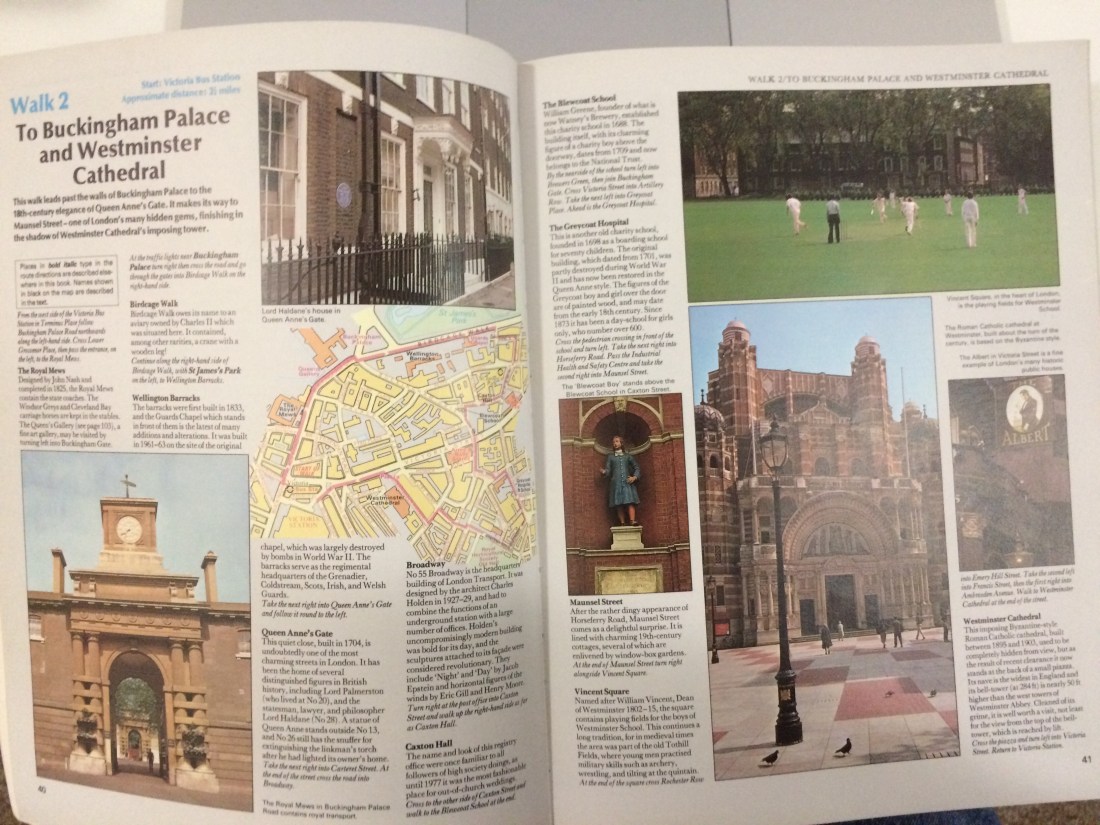
When moving to a new place, its important to have a good look around and get to know where you live. In London there is no shortage of places to explore. Having visited London prior to moving here I had a bit of an idea of things. But there is always more to see and do. Before moving here I found this wee gem:

IMG_6917

The 1980s Automobile Association Book of London.

This was purchased by my maternal grandparents when they came over to visit London in 1987. My Grandparents had both visited London during and after the second world war. My Grandad was stationed in North Africa and Italy for much of the war. My Nana was a Sargent at Trentham Army camp in Upper Hutt. After the war she visited London for the Victory Parade:

Above Left The London Victory Parades 1946, Right my Nana Pat Oram (nee Darroch) in her Army Sargent’s Uniform while in London.

40 years later my grandparents decided to come back to the the UK. This would be their last visit as they both died a few years later. I was 5 years old at the time and vaguely remember them being away.

Nana and Hilda 1987

Above, My Nana Pat Oram with her pen friend Hilda in Halifax in 1987

So 30 years later I was curious to see how accurate the The Book of London of the 1980s still was. There was no London Eye, no Shard, and no Walkie Talkie building. The Jubilee line stopped at Westminster and Surrey Quays station was still called Surrey Docks (should have kept that name according to the locals). Coventry City F.C were the FA cup victors and Sananda Maitreya’s Wishing Well was top of the pops. Much had changed in 30 years, but just how much?

Walk 1 in the 1980s book was of Westminster and Millbank. The walk commenced at Westminster Station and headed to the Cenotaph. The book advised the following:

In the centre of Parliament Street is the Cenotaph, a simple yet moving pillar of Portland stone, that was designed by Sir Edwin Lutyens and unveiled in 1920 on the anniversary of Armistice Day. It was originally built to the memory of the men who lost their lives in World War 1. Now memorial service for the dead of both world wars are held here in every year on the second Sunday in November.

IMG_6652

Above: The Cenotaph, Parliament Street London. Photo taken 6/1/2018

30 years later it would be great to report that this monument was to a time when humanity fought and killed each other. That his practice has now ceased and that humanity has learned to live together in peace and harmony. Iraq, Afghanistan, Kosovo, Rwanda, Croatia, Bosnia, Kosovo, Sierra Leone, Algeria, Somalia, Yeman, Israel/Palestine, Congo, Chechenia, Macedonia…I could keep going

The next stop was Downing Street:

This world famous street was built by Sir George Downing, a secretary to the Treasury, in about 1680. At first it was an unimportant residential street with a pub – the Cat and Bagpipes – on the corner. In 1732 Gorge II offered No 10 to Sir Robert Walpole as a town house and since then it has been the official residence of the

British Prime Minister. No 11 is the official residence of the Chancellor of the Exchequer. The buildings themselves have unpretentious Georgian facades, but have been extensively modified inside.

Above: Downing Street 6/1/2018. Neither Theresa May nor Philip Hammond invited me in for a cup of tea – rude!

Next stop was the Government Offices:

Sir George Gilbert Scott, the distinguished Victorian architect designed this imposing building. His first designs were in the Gothic style and Lord Palmerston rejected them all. He insisted on something Italian, so Scott bought some books on Italian architecture and ‘set vigorously to work to rub on up it,’ with the results that can be seen today.

IMG_6656

Above: Scott vigorously rubbed on up the Italian style – this was the result. 

Next is Parliament Square:

In and around Parliament Square there are many statues of British Politicians. Foreign statements men are also represented, and include Field-Marshal Smuts by Jacob Epstein, and (outside the old Middlesex Guildhall) a rumpled figure of Abraham Lincoln. The latter is a copy of the statue by Augustus Saint-Gaudens in Chicago.

Above – Parliament Square 6/1/2018. Today Nelson Mandela, Gandhi and Winston Churchill stand tall in the square. What happened to Smuts? Is he now in storage somewhere? Or was he melted down to make frying pans and sold at Tesco’s? 

Next the Middlesex Guildhall:

This Renaissance-style building was opened in 1913, and stands on the site of an earlier guildhall. It once functioned as the administrative centre for the old country of Middlesex. The friezes on the facade depict Magna Carta, Henry II granting charter to Westminster, and Lady Jane Grey accepting the crown from the Duke of Northumberland.

IMG_6658

Above: Middlesex Guildhall 6/1/2018

Next the Methodist Central Hall:

Built in 1849-51, the Methodist Central Hall stands across the road in Storey’s Gate. It was once a meeting place for the infant United Nations Organisation.

IMG_6663

Above: The Methodist Hall

Next, Little Dean’s School Yard and Westminster School

Westminster Abbey probably had its own school before 1200. When the abbey became a cathedral in 1540, the school became the King’s Grammer School, with 40 scholars. It was re-founded by Queen Elizabeth I in 1560. The custom known as Pancake Greeze is observed here every Shrove Tuesday. The cook, dressed in a cap and apron, comes in with a frying-pan and has to toss a pancake over the 16-ft high iron bar which separates the old Upper and Lower Schools. As it falls, representatives from each form scramble for it, and the boy who gets the biggest piece get a guinea from the Dean. On the north side of Little Dean’s Yard is Ashburnham House, built shortly after 1662, and the best example in London of a stately mid-17th century house.

IMG_6664

Above:  Me and Julio down by the (Little Dean’s) school yard. 

Next Barton Street:

Barton Street contains some exceptionally well-preserved Georgian houses. Nos 1-14 (except for Nos 2 and 8) are original and carry a tablet dating them to 1722. T E Lawrence (‘Lawrence of Arabia’) lived at No 14. An inscription on the wall of No 2 reads ‘Peace on Thy House O Passer-by.’

Above: Barton Street, and Lawrence of Arabia’s old digs. 

Next, Smiths Square:

This square is named after Sir John Smith, who owned and developed the land. Some of the houses were rebuilt after World War II, but NO 5 dates from 1726. In the centre of the square is Thomas Archer’s fine church of St John. Concerts are often broadcast from the church, which has been specially adapted for the purpose. St John’s also has its own orchestra, now of international repute. Other buildings in teh square include the headquarters of both the Labour Party (Transport House, in the south-east corner of the square) and the Conservative Party (No 32).

Above: Left – The church of St John. Right- Building in South East corner of Smith Square, was the Headquarters of the British Labour Party in the 1980s. In 2018 it is now Europe House, London Headquarters for the European Union. This building appears to the the patron saint of lost causes. 

Next, Vauxhall Bridge Garden

A large bollard here marks the approximate site of Millbank Penitentiary from which, between 1816 and 1867, convicts sentenced to transportation embarked on their journey. The garden also contains a sculpture by Henry Moore, foundations and seats.

Above: Left – view of Vauxhall Bridge from Vauxhall Bridge Garden, Right Henry Moore’s sculpture. This Garden no longer contains a fountain and the seating looks uncomfortable – the results of austerity no doubt. 

Next, Lambeth Palace:

Much of this historic structure, which has been the London residence of the Archbishop of Canterbury for 700 years, was rebuilt during the 19th century. Extensive damage was caused by bombs during World War II. Of the old place, the most interesting parts are the Lollards Tower and the Gatehouse, both of the 15th century, and the 13th-century Chapel Crypt. Parts of the palace, and its grounds, are open to the public. Adjourning the south gateway of the palace is the former church of St Mary, now being restored as Museum of Garden History in memory of John Tradescant, Charles I’s gardener. Captain William Bligh, of the Bounty, is buried here.

Above: Lambeth Palace

Next, Victoria Tower Gardens

In the thin Triangle of Victoria Tower Gardens are the Buxton Drinking Fountain, Commemorating the emancipation of slaves in the British Empire in 1834, a statue of the Suffragette Mrs Emmeline Pankhurst (1858-1928); and a copy of the famouse statue by Auguste Rodin (1840-1917) called ‘The Burghers of Calais,’

Above: The Buxton Memorial, Victoria Tower Gardens.

Next, the Jewel Tower

This inconspicuous moated tower is in fact a survival of the medieval Palace of Westminster. It was built in 1365 to house the monarch’s personal treasure, and this remained its function until the death of Henry VIII. It now houses a collection of pottery and other items found during the excavations in the area, and is open to the public.

Above: The Jewel Tower, very inconspicuous. 

On conclusion of this walk, I was freezing cold. I caught a tube home on a line that wasn’t build until 1999. Some things had changed in 30 years, but overall walk 1 was pretty close to how it would have been in the 1980s. Would the other walks be the same?