2024 UK Election – the Tories finally lose power

Welcome to my 200th blog post, the first since the 2024 UK General Election.

In what came as a shock to absolutely no one, the Conservatives lost. Badly.

Today the corridors of Westminster felt like the first day of school. 334 new MPs have come in to get their passes working, set up their email and find a desk. A couple of freshers nervously asked if they were allowed on the red carpet/ the House of Lords end (they are). Many were walking around steering in awe at the statues and artwork and excitedly looking around the Commons.

The election result was a massive swing against the Tories. 121 MPs will be the lowest number of Conservative MPs elected in the party’s history. Labour is by far the largest party and will govern with a majority of 172. Below are the full results showing the results for all MPs and parties elected:

PartySeatsSeats (change) Total VotesShare of the Vote
Labour412+2119,704,65533.7%
Conservatives121-2516,827,31123.7%
Liberal Democrats72+643,519,19912.2%
SNP9-39724,7582.5%
Sinn Fein70210,8910.7%
Independent6+6564,2432.0%
Reform UK5+54,117,22114.3%
Green4+31,943,2656.7%
Plaid Cymru4+2194,8110.7%
DUP5-3172,0580.6%
SDLP2086,8610.3%
Alliance Party10117,1910.4%
UUP1+194,7790.3%
TUV1+148,6850.2%
The 2024 UK General Election results

In 2019, Labour received 10,269,051 votes and won just 202 seats. In 2024, Labour received 9,704,655 votes but won 412 seats. In 2017, Labour won 12,877,918 or 40% of the vote, compared with 33.7% of the vote in 2024.

I will come back to the elephant in the room, the lack of proportionality in the First Past the post-electoral system.

The feedback on the doorstep is reflected in the numbers above. Many voters were undecided leading up to the election and unenthusiastic about either main party. When pressed, it became clear many former Conservative voters would not be supporting that party again. 2024 was the election that the Tories lost, and badly.

On the surface, 33.7% may not seem like a strong result for Labour, in terms of overall support. We need to consider some of the following factors:

  1. Tactical voting played a significant role in this election. Many would-be Labour voters living in places like Devon voted Liberal Democrat to stop the Tories. Curiously, the Liberal Democrats went from 3,696,419 votes, equating to 11.6% in 2019, whereas on Thursday their total votes went down to 3,519,199, but due to lower turnout, this equates to 12.2% of the vote. The Lib Dems now have 71 MPs, instead of the 8 they got in 2019.
  2. The voter coalition built by Jeremy Corbyn’s Labour in the 2017 election of younger progressive voters, has now moved to the Greens. On Thursday the Greens received 1,943,265 votes equating to 6.7% of votes cast. In 2019, the Greens received 865,715 votes or 1.1% of the vote.
  3. In New Zealand or other countries with more proportional voting systems, it is common to look at the centre-left and centre-right bloc rather than just what the parties received. Labour and the Greens together received 40.4% of the vote compared with the Conservatives and Reform who received 38%. The Liberal Democrats were largely targeting Tory seats this election. They stood on a broadly social democratic platform and made it clear that unlike 2010 they would not support a Conservative Government after the election. So adding their 12.2% to the Centre-left bloc we get to 52.6%.
  4. So while First Past the Post has produced a result that is not proportional, and in my view is an appalling voting system, a different voting system like the one used in Germany and New Zealand would have still resulted in a Labour Government (though almost certainly in coalition) and a crushing defeat for the Tories.

The UK Electoral Reform Society have put together modle showing what the result would have looked like using the Additional Member System used in Scotland and Wales:
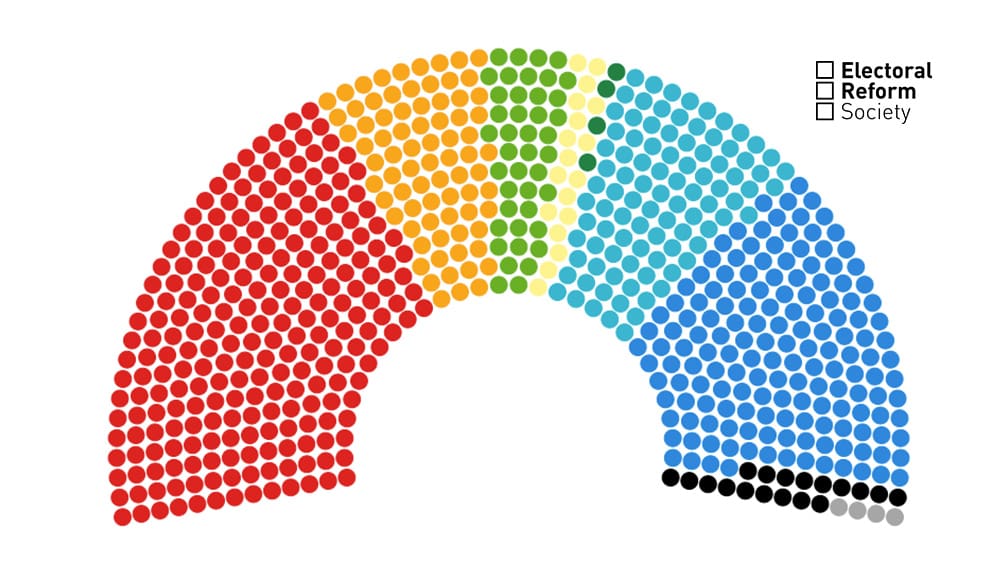
https://www.electoral-reform.org.uk/how-the-2024-election-could-have-looked-with-proportional-representation/

The problem with this is that if there were a different voting system, people would likely not vote the same way.

The broader problem with the proportional representation debate in the UK is they tend to advocate only specific alternative voting systems like AMS or AV. This election result will rightly see more people call for proportional representation. Just as New Zealand did before changing voting systems in 1993, UK voters need the opportunity to explore all viable alternatives to First Past the Post.

Those who blame the rise in Reform for the Tory Party’s misfortune need to look at the bigger picture. In 2015 UKIP, Farage’s old party, received 3.8 million votes compared with Reform’s 4.1 million last week. While Farage’s new political vehicle certainly cost the Tories votes in key marginals, there is evidence of former Labour voters also switching to Reform.

The Conservative Party lost because their vote went from 13,966,454 votes or 43.6% in 2019 to 6,827,311 or 23.7% in 2024. The number of people who voted Tory halved in just five years. Why? Their response to the pandemic, party-gate, the Liz Truss mini-budget and their failure to manage the small boats crisis in the channel. They were terrible at managing the economy allowed public services to decline.

In terms of the two major party’s vote share, in 2019 the Labour and the Conservatives together received 75.% of the vote, and in 2017 82.3%. Last week the two combined received 57.4% of the vote.

One feature in this election is the 6 independent candidates, many of whom ran on the issue of Gaza. In one case it caused former Labour front-bencher Jonathan Ashworth to lose his Leicester South seat. Other senior Labour MPs such as Wes Streeting or Jess Phillips saw their majorities reduced drastically as many Muslim voters abandoned Labour for Independent candidates, or refused to vote. Starmer’s Labour Party was initially reluctant to call for a ceasefire in Gaza. Had there not been a significant swing against the Conservatives, Labour losing support from large sections of the British Muslim community could have been very damaging.

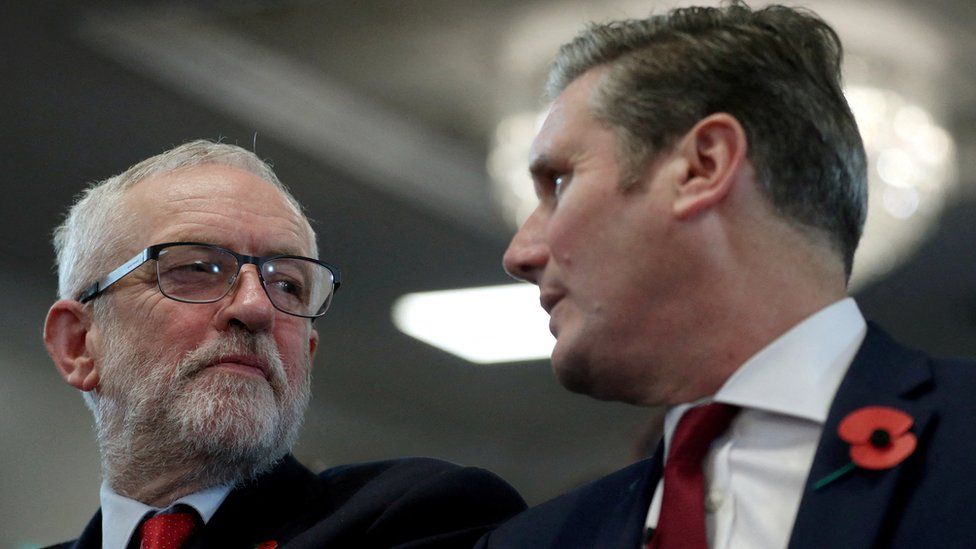
Former Labour Leader Jeremy Corbyn was also elected as an Independent MP in Islington North. Again, his position on Gaza was a factor in Corbyn’s success.

In Scotland, support for the embattled Scottish Nationalist Party (SNP) collapsed. Labour now has 37 of Scotland’s 57 seats, compared with one seat in 2019. It would be a mistake to view this as a collapse in support for Scottish Independence as a cause. A Norstat/Sunday Star Times poll published just a fortnight ago found that 47% of Scots still support independence, while 47% support staying in the union. Other recent polls on Scottish independence have also been quite close. The election result, rather than spelling the end for Scottish Independence, instead may result in the SNP being the main political vehicle for this cause.

In Northern Ireland, Sein Fein won the most seats. This is consistent with the most recent Stormont and local government elections in Northern Ireland. The decline of the Democratic Unionist Party post-Brexit has in part fuelled division on the Unionist side with two other rival parties challenging them.

Wales no longer has any Conservative MPs. Labour has controlled the Welsh Senedd since it was created in 1999. Despite the recent scandal surrounding Vaughan Gething the new Welsh First Minister, Labour continue to dominate politics in that nation.

This was a change election. Not only is there a new Government, but politics will be different. After this election, there are 264 women MPs, a record in Westminster. The Cabinet will also have more women than any before it. There will also be more MPs from ethnic minority backgrounds, though there is some concern that this diversity is not fully reflected in the cabinet.

Britain has been in decline in recent years. It will be difficult for the incoming government as they inherit a poor economy, crumbling public services and a country whose standing internationally has diminished considerably since Brexit. It is no wonder voters lacked enthusiasm during this election.

For Labour, the next five years will be an opportunity to show the country they can be trusted with power. Things will be tough and any honeymoon could be short-lived. That said, voters will take time to forget, let alone forgive the mess left by the previous Conservative administration. While people may not yet be enthusiastic about Labour, they can could no longer stomach the Tories.
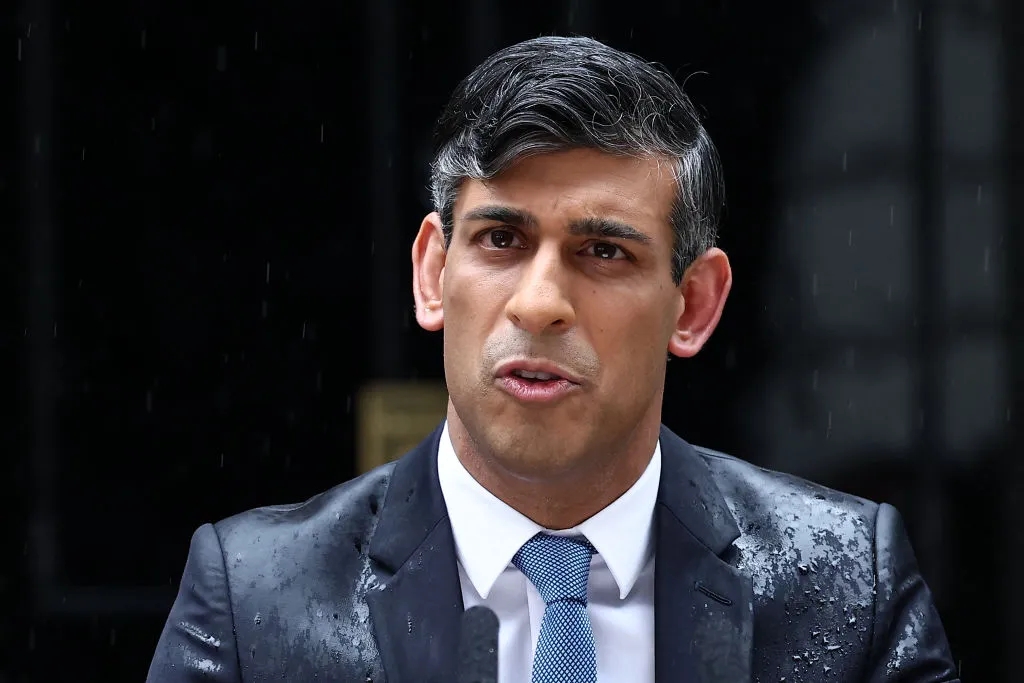
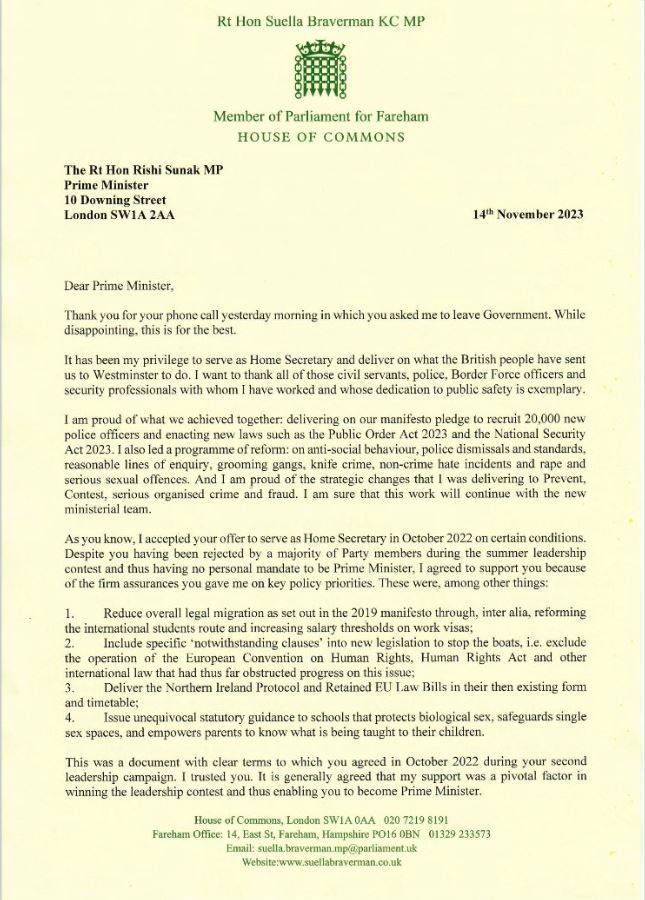
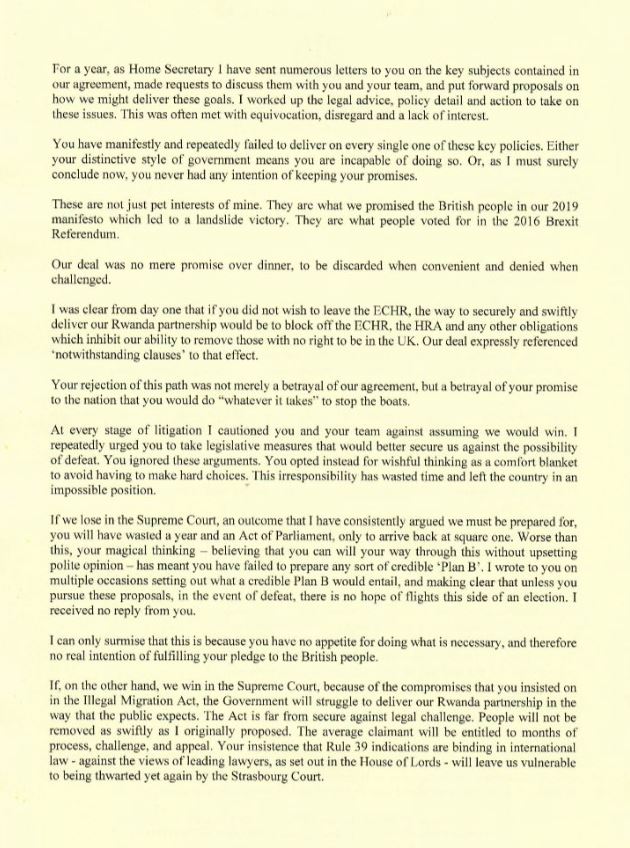
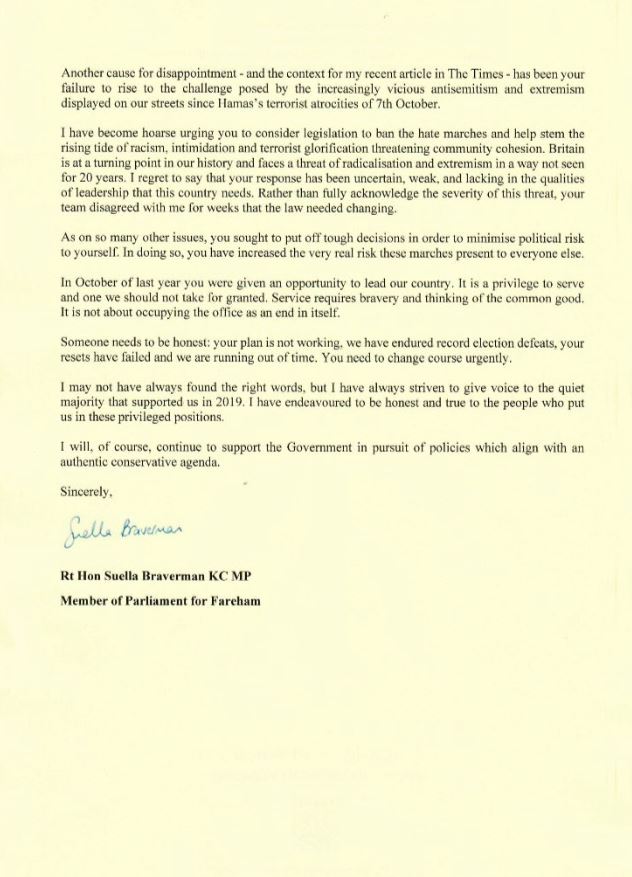
Rishi Sunak’s grubby deal with Suella Braverman

One has to really feel for those trying to write political satire these days. How can a satirist be more ridiculous than many of our political leaders they wish to lampoon? Case in point, yesterday’s “resignation letter” from sacked former Home Secretary Suella Braverman.

Just to recap. From July to September, the UK effectively had a caretaker government while the Tory Party conducted its internal leadership race. The top two candidates were Rishi Sunak and Liz Truss. Despite Sunak winning the support of more MPs, Truss won 57.4% of the party membership vote and became Prime Minister. It was a disaster.

In just 49 days as PM, Truss destroyed the myth that the Conservative Party is good at managing the economy. On 25 October 2022, Truss was forced to resign. The Conservatives were desperate not to go through another leadership ballot. Worse, there were fears Truss’s disgraced predecessor may stage a comeback. By this stage, the Tories were 30% behind in the polls.

Sunak became Prime Minister, despite losing the membership vote by being the only candidate. He did this by doing deals with the likes of Suella Braverman, who had been forced to resign as Home Secretary days earlier for breaching cabinet rules, and Dominic Raab who faced bullying accusations at the time and later was forced to resign.

Sunak did not need to do these grubby deals to stitch up support. In October 2022, Rishi Sunak was the only credible option. He did not need to do deals with people like Braverman and he would be in a much stronger position now if he had not.

Today’s decision by the Supreme Court that the Government’s Rwanda asylum policy is unlawful is the icing on the cake. Braverman is right in a sense, the government has wasted a year and an Act of Parliament on the Rwanda policy. But she is also completely wrong about the ECHR and the HRA. Instead, the UK government should have found a solution to the asylum crisis that complied with Human Rights legislation and international obligations. The response to the boat people crisis has been a failure by this government. Caused in no small part by deals done by Rishi Sunak to shore up support from the right of the Conservative Party.

For the political satirist, it is hard to come up with a more ridiculous situation. It would be all very funny were it not real, which instead is just frustrating and depressing.

Jeremy Corbyn was not fit to be Prime Minister. But is Starmer?

It is said that there is a thin line between bravery and stupidity. Posting a link to my blog post which said that Jeremy Corbyn was not fit to be Prime Minister, to the ‘Labour London Left’ WhatsApp group. I will leave it to the reader to decide which one that was.

The full quote is below:

The 2017 election proved there was significant support for social democratic policies (eg national care service, public ownership of rail, electricity, water etc, and funding public services properly). But weak leadership on Brexit, failure to respond properly on antisemitism and now his appalling position on the Russian Invasion of Ukraine have shown Corbyn was not fit to be Prime Minister. But nor was Boris Johnson, as the Privileges Committee have confirmed.

https://nickkelly.blog/2023/07/09/decoding-the-doorstep-insights-from-canvassing-uxbridge-and-south-ruislip/

Jeremy Corbyn was and still is not fit to be Prime Minister. I say that as someone who took time off work to actively campaign for Labour in 2019. I also say this as a Labour member who supported the 2017 and (with some criticisms) the 2019 Labour manifesto policies, many of which would not have been there had Corbyn not won the 2015 UK Labour leadership race.

My ‘Why Labour Lost’ series of posts published after UK Labour’s 2019 election defeat (see links below) outlined the many and varied reasons for this result. Not all of it was Corbyn’s fault, nor indeed his faction Momentum. But they made serious errors and at times simply stupid calls.

More recently, Corbyn’s position on the Russian invasion of Ukraine in the last 16 months has shown that he lacks political judgment.

Shortly after the Russian invasion of Ukraine, I wrote the following of leftists who were opposed to giving military aid to help the Ukrainian resistance:

On the left, many are still influenced by the analysis of Lenin during the First World War and just before the 1917 Russian Revolution that in an inter-imperialist conflict socialists should be standing up to their own ruling class. During the First World War, there were strong arguments for working people not to align with the Tsar in Russia or other imperialist leaders in that conflict. It is dangerous to simply apply this idea to the current conflict without understanding that the context is different. There is a strong argument that people should be holding their own government or ‘ruling class’ to account during any situation like this. Ultimately, the decision to invade Ukraine was Russia’s, but there is still a question of what the governments and in particular NATO members could have done to help prevent this and what they can do now. Sadly, some on the left and drawn both bizarre and quite dangerous conclusions based on the premise that their role is to stick it to their own ruling class. Bizarrely, some socialists still mistake Russia to be some sort of socialist/anti-imperialist power, thinking that there is some residue influence of the 1917 revolution.

https://nickkelly.blog/2022/05/03/the-russian-invasion-of-ukraine-an-act-of-aggression/

Corbyn’s position of opposing military intervention and instead trying to negotiate a peaceful settlement is at best naive and at worst giving tacit support to the Russian Government and Vladimir Putin.

Back in 2003 when I was active in opposing the invasion of Iraq, one of our key slogans in Peace Action Wellington was “peace with justice and self-determination”. Any “peace settlement” with Russia right now would involve at the very least, ceding territory taken by Russia in 2014 and probably some of the ground taken in 2022. This ‘peace’ would not involve any justice or self-determination.

What Jeremy Corbyn, the Stop the War coalition and others taking this position are doing is not progressive, left or indeed socialist. It is supporting imperialist expansion. Further, and this should be self-evident, if NATO and Western governments fail to stop the Russian invasion, this will not serve the interests of working people. That this distorted world political view still infects sections of the left is astounding. That Corbyn subscribes to it, frankly discredits him as a serious political operator.

But I can understand why people on the Labour left would not like this assessment. Even more so at a time when various left groups and individuals such as director Ken Loach have been kicked out of Labour.

And there are serious questions about Labour’s current direction. Labour, whilst winning the Selby and Ainsty by-election, narrowly lost the Uxbridge and South Ruislip byelection. Whilst most attribute this to the Labour Mayor of London extending the Ultra Low Emission Zone (ULEZ) to outer London, this was not the only reason. On the doorstep, Starmer’s Labour Party may not have been as polarising, but nor were people excited by it. In fact, many were unclear about what it stood for. Labour improved its percentage of the vote in Uxbridge and South Ruislip significantly, but it still failed to make it across the line. This should be a cautionary tale ahead of next year’s General Election.

In my blog post earlier this year on whether UK Labour can finally win, I argued that the left needs to accept that the 2019 election was a devastating loss, in no small part the result of poor decisions by Corbyn and his team. Equally, his opponents in the party have still failed to seriously reflect on why Corbyn was able to easily beat them both in 2015 and when they tried to remove him in 2016.

The 2017 Manifesto included policies such as renationalising rail and water companies. It opposed austerity and called for decent funding for the NHS, a national care service, a properly-funded national education service and stronger employment law that strengthens collective bargaining. These are mainstream social democratic policies in many other European countries.

Why did it take a member of the hard left Socialist Campaign Group becoming the leader of Labour for it to put forward a mainstream social democratic manifesto, rather than an over-triangulated, incoherent and frankly visionless positions it too often had prior to Corbyn? In a country where life expectancy is stalling, younger people are economically worse off than their parents, where over a million people are waiting for social housing and incomes have been falling for years, there is a real mood for change. Not just a change of government, but of policy. This does not mean a sudden lurch left, but a serious and costed programme that prioritises the needs of the many, not just the few.

In the UK Labour Party, people are divided into binary factional groupings of Corbynistas or Blairites. Loyalty to leaders and personalities over policy is not limited to Labour or UK politics. But it is frustrating nonetheless.

UK Labour is on course to win the next general election, whenever that may be. Its long-term success in government will, as I have argued previously, require the different factions of Labour to work together. The left need to accept that the Corbyn project failed, and move on. The right needs to accept that voices to the left of Third Way centrism have a legitimate and important place both in Labour and in political life.

Below are the links to my ‘Why UK Labour’ lost blog posts:

Why UK Labour Lost? Part 1: Historical Context

Why UK Labour lost? Part 2: UK Labour’s strange loyalty to First Past the Post

Why UK Labour lost? Part 3: Its Brexit Innit

Why UK Labour lost? Part 4: Oooo Jeremy Corbyn

Why UK Labour lost? Part 5: Antisemitism

Why UK Labour lost? Part 6: New Labour and Blairism

Why UK Labour lost? Part 7: Momentum and the Corbynistas

Why UK Labour lost? Part 8: what it takes to win?

Why UK Labour lost? Part 9: What the party needs to do now.

Decoding the Doorstep: Insights from Canvassing Uxbridge and South Ruislip

I spent the last UK General Election canvassing in Uxbridge, trying to unseat the then Prime Minister Boris Johnson. In the 25 years I’ve been politically active, this was the second most depressing canvassing session I had been to.* It was the middle of winter, the weather was awful, and it was obvious the votes were not going Labour’s way.

Last weekend I returned to Uxbridge for the first time since December 2019. The not-so-illustrious political career of Boris Johnson has ended in failure and disgrace. Johnson resigned as an MP at the conclusion of the Privileges Committee investigation. The Committee’s report found that Boris Johnson broke the COVID-19 rules, the ones his own government had set, and had misled Parliament when questioned about this.

Had Johnson not resigned, he would have been suspended from the House for 90 days. In the UK, MPs can be recalled by voters when suspended. If 10% of voters in the suspended MP’s constituency sign a recall petition a by-election must take place. Had Boris Johnson not resigned, he almost certainly would have faced a by-election. In these circumstances, he would likely have lost.

So Boris Johnson made one of the few honourable decisions of his life and resigned from parliament (though even then poo poo-ed the privileges committee report and denied fault).

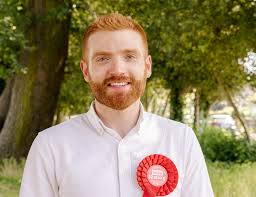
Last weekend I was out in Uxbridge canvassing for Danny Beale, Labour’s candidate in the by-election. Labour last won Uxbridge in 1966, and before that 1945. The Ruislip part of the constituency has never been held by Labour. But the demographics in the area are changing and despite a blip in 2019, overall the Tory vote has been gradually falling in the area for some time.

Above: Labour’s Uxbridge and Ruislip candidate Danny Beale

In politics, much is made of doorstep conversations. It is seen as the ultimate litmus test for how well a party, leader or set of policies are performing. Opponents of Jeremy Corbyn have often claimed that on the doorstep he was not popular. Certainly, my experience in 2019 was that Corbyn and the political project he came to represent was polarising. I found many were supportive of core Labour policy, but did not trust the party or its leadership.

The 2017 election proved there was significant support for social democratic policies (eg national care service, public ownership of rail, electricity, water etc, and funding public services properly). But weak leadership on Brexit, failure to respond properly on antisemitism and now his appalling position on the Russian Invasion of Ukraine have shown Corbyn was not fit to be Prime Minister. But nor was Boris Johnson, as the Privileges Committee have confirmed.

So what is the message on the doorstep now? When you go out you only get a small sample across a dozen or so streets. Much like opinion polling, the ‘mood on the doorstep’ is not an exact science, but gives you a general sense of the mood. Compared to 2019, overall the number saying they will vote for Labour is higher now, but only modestly.

The Conservatives won Uxbridge and South Ruislip by a majority of 7,210 in 2019. The thing that is likely to swing this Constituency to Labour on Thursday 20 July, may not be a huge swing to Labour, but former Tory voters staying at home or protest voting. On the doorstep, the anger from voters was palpable. Not all of this anger was directed at the Conservatives, but I and others had quite a few conservation with people who had previously voted Tory but would not be in the by-election.

The head-wind for Danny Beale is not coming from parliament but from the Greater London Authority (GLA). Labour’s London Mayor Sadiq Khan has decided to expand the Ultra Low Emission Zone out to all boroughs of London. This means owners of older vehicles will now pay a daily charge of £12.50.

London’s air pollution is bad and research by Imperial College London in 2019 found that it contributed 4000 premature deaths a year. Unfortunately, it is London residents who cannot afford electric vehicles who pay the price. In outer London suburbs like Uxbridge and Ruislip, car ownership is higher as public transport is generally not as frequent.

Danny Beale has called for the ULEZ expansion to be delayed, saying the cost of living crisis is the wrong time to implement this. He has also called for a better scrappage scheme to help people replace older vehicles. Unlike in other parts of the country, the Government have not helped Greater London implement a proper scrappage scheme, no doubt to put pressure on Sadiq Khan.

Did this issue come up on the doorstep? The very first door I knocked on this was their key concern. Others also mentioned it, usually in the wider context of the cost of living, and were as critical of the Government as they were of the London Mayor. But it was clear that ULEZ was a barrier to people voting Labour.

From this session and the feedback I’ve got from others who’ve canvassed, Labour can certainly win Uxbridge and Ruislip. But it will be close. The challenge will be for Sadiq Khan in next year’s London Mayoral elections. Decisions such as extending ULEZ, or increasing rail fares have been a result of the Government not supporting London. But many now blame the Mayor and the Labour London Authority Members. The Conservatives believe this will give them an advantage. The message I got on the doorstep was that anger at ULEZ did not automatically equate to voting Tory, especially given their recent track record in government.

There are two other byelections being held on 20 July: Somerton and From, and Selby and Ainsty. There is also the likelihood of a byelection in disgraced MP Chris Pincher’s constituency, and Nadine Dorries’s constituency of Mid Bedfordshire. Polls suggest that in each of these byelections, the Conservatives will struggle. Each has its own dynamic, with the Lib Dems being the serious challenger in Somerton and From, whereas in Selby and Ainsty a Labour victory is now looking likely.

Canvassing Uxbridge and Ruislip, the insight I get from canvassing is that Labour have a real chance, but should not be complacent. Support for the Conservative and Unionist Party is collapsing, but this is turning to cynicism and rage rather than enthusiastic support for a Labour Government next year.

There is a possibility that in 18 months’ time, UK Labour are in Government, but have lost the London Mayoralty. This is not inevitable, but for Sadiq Khan to win a 3rd term as Mayor, he will need to balance lowering emissions and environmental targets with helping Londoners survive the cost of living crisis. This could well turn out to be a tough campaign, which I hope does not give me a new “worst canvassing session.”

*The worst canvassing session I went on was the 2014 New Zealand General election. I was canvassing in the Wellington Ohariu electorate. It was early spring, and the rain was heavy in typical Wellington fashion. It took me hours to dry off. NZ Labour got 25% in that election, its worst result in a century. Labour did fail to win the Ohariu seat that time, though picked it up three years later when Jacinda Ardern won the 2017 election for Labour.

Previous Posts about my involvement with Labour and political campaigns. Plus other relevant posts:

Why the Labour Party

Why the Tories won the UK election

Why Labour Lost? Part 9: What the Party needs to do now?

What the recent elections tell us about British society

Tory Sleaze – sequels are often a disappointment

Can Rishi Sunak save the Conservative Government?

UK Labour – can they finally beat the Tories?

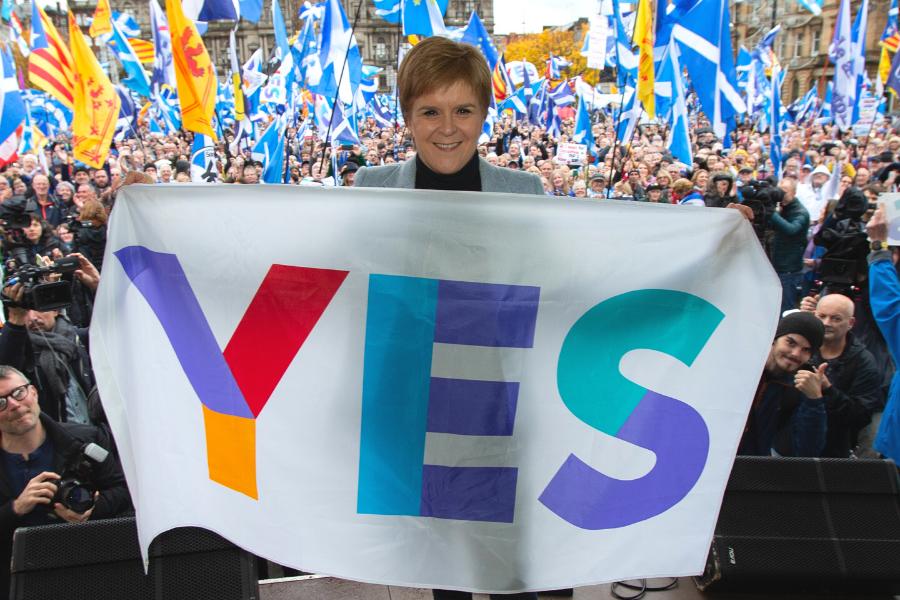
Nicola Sturgeon’s resignation and Scottish Independence.

The resignation of Scottish First Minister Nicola Sturgeon today took many by surprise. Her leadership of the Scottish National Party (SNP) and Scotland since 2014 has seen support for her party, and the cause of independence, increase significantly. Whilst recent controversies have dented her support, were an election held tomorrow the SNP would be re-elected to Holyrood and would win the most Scottish Seats in a Westminster election.

Much like the recent resignation of Jacinda Ardern in New Zealand, Sturgeon’s resignation comes after many years of hate and vitriol from political opponents. This was alluded to in her resignation announcement:

The First Minister is never off duty, particularly in this day and age. There is virtually no privacy. Even ordinary stuff that most people take for granted, like going for a coffee with friends or for a walk on your own becomes very difficult. And the nature and form of modern political discourse means that there is a much greater intensity – dare I say it? – brutality to life as a politician than in years gone by. All in all, and actually for a long time without being apparent, it takes its toll on you and on those around you. And if that is true in the best of times, it has been more so in recent years. Leading this country through the Covid pandemic is by far the toughest thing I’ve done. It may well be the toughest thing I ever do. I certainly hope so. Now by no stretch of the imagination was my job the hardest in the country during that time. But the weight of responsibility was immense, and it’s only very recently, I think, that I’ve started to comprehend, let alone process, the physical and mental impact of it on me.

https://www.bbc.co.uk/news/av/uk-scotland-64650792

In recent weeks, Sturgeon suffered political setbacks, which may have led to this decision today.

The first of these was the Supreme Court ruling in late November 2022 that a second referendum on Scottish Independence cannot be held, unless Westminster agrees to it. Controversially, Sturgeon’s response to this decision was that the next general election should be treated as a defacto referendum, something that SNP supporters are quite split on.

The second was the Gender Recognition Reform (Scotland) Bill. This Bill reduced the legal age someone could apply for a Gender Recognition Certificate. It also removed the need for a medical diagnosis and evidence of having lived for two years in their acquired gender. The response of the Conservative Government in Westminster was to make an order under the Scotland Act 1998 preventing this Bill from proceeding to Royal Ascent.

This was shortly followed by the controversy of a Transgender woman in Scotland who had been convicted of double rape being assessed for a women’s prison. Whilst this was an isolated incident that was quickly addressed by the authorities, it was quickly used as a weapon to attack Sturgeon’s “woke agenda”.

The English press, and in particular the Tory Press, has run a concerted campaign of attacking Sturgeon and the SNP for years. Pro Conservative newspaper The Telegraph have predicted doom for the Scottish Independence movement many times. For example, former SNP leader Alex Salmond formed Alba and has even gone as far as to describe Scotland as a “failed state” under Sturgeon’s leadership.

Despite investigations of breaching the Ministerial Code, which Sturgeon was cleared of, many in the media talked up her imminent political demise prior to the 2021 Holyrood elections. Others claimed that if the SNP did not win an outright majority, it showed there was not really support for independence in Scotland. That the SNP and Scottish Greens, who also support independence, did gain a majority in the 2021 Scottish election is conveniently downplayed by much of the media, especially in England.

My previous post asked whether political leadership mattered. Nicola Sturgeon as SNP leader has been a strong advocate for independence, and this will undoubtedly have contributed to increased support for this cause.

Like all leaders, she will be remembered most of all for how she responded to events. Sturgeon was an outspoken critic when the British Government struggled to get a Brexit deal through the Commons, regularly reminding the world that Scotland had voted to remain in the EU. During the coronvirus pandemic, Sturgeon was viewed by many as a strong and competent leader, in stark contrast to the incompetent actions of UK Prime Minister Boris Johnson and his Conservative Government. And in 2022, when the Truss/Kwarteng Mini Budget did enormous harm to the economy, Sturgeon was characteristically forthright in her condemnation.

While Sturgeon’s strong leadership and vision have helped build support for Scottish Independence, the Conservative and Unionist Party’s arrogance and self-serving incompetence in government have greatly aided her in this. Under the Tories, many Scots have become convinced they would be better off leaving the United Kingdom.

Polls show varying levels of support for independence. Overall, support for independence is higher than in the 2014 referendum. Further, the SNP continue to dominate Scottish politics, and a new leader is unlikely to change this. Those who believe Sturgeon’s departure spells the end for the independence movement will likely soon be disappointed.

Can Rishi Sunak save the Conservative Government?

On October 25 2022 Rishi Sunak became the fifth leader of the Conservative Party since they came to power in 2010. Having lost the membership ballot in the summer, Tory MPs having seen the polls after the Mini Budget and facing the prospect of electoral annihilation, coalesced around Rishi Sunak and ensured he was the only person on the ballot. In short, MPs no longer trusted their party membership after the Liz Truss fiasco.

Following on from Party Gate, and the troubles the Conservative Party faced in 2022, Rishi Sunak will be hoping for a scandal-free year and an economy that starts to recover. It has not got off to a very good start, with Party Chair Nadhim Zahawi facing allegations of tax issues which will be investigated by the independent ethics advisor. Meanwhile, the economic outlook for Britain is weaker than expected.

When a new Prime Minister comes in and appoints a new Cabinet it is referred to as a “new government.” This wears somewhat thin when many of the “new” Cabinet Ministers have served in previous governments, many only a few weeks earlier. The likes of Michael Gove, Dominic Raab or Penny Mordant have served under previous Prime Ministers pursuing the same Conservative Party policies in Government. The Conservative Party were elected in 2019 on a Manifesto that the public expect them to implement. The accumulative issues of the last 12 years or the last 12 months have not disappeared with a change at Number 10.

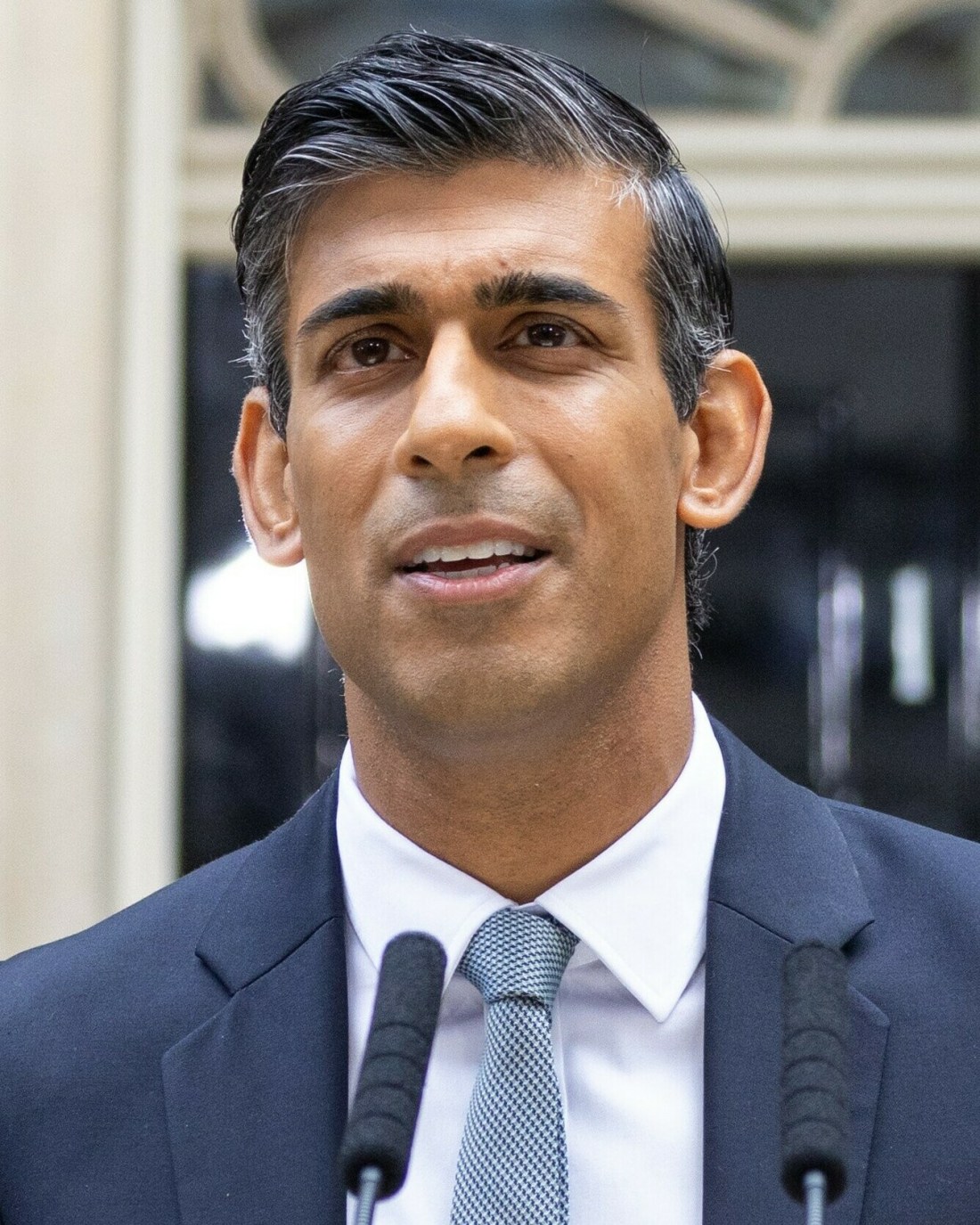
25/10/2022. London, United Kingdom. Prime Minister Rishi Sunak arrives in Downing Street. Picture by Lauren Hurley / No 10 Downing Street

The Truss libertarian experiment, described by Paul Goodman editor at Conservative Home as the economic experiment, which blew the roof off the chemistry lab. The Conservatives, having learnt in 2017 that policies of austerity are electoral Kryptonite, now face the reality that small government libertarian policies much craved by many tory members, simply will not work. Sunak inherits a party bereft of ideas and vision and is now forced to increase taxes to pay down public debt and fund public services such as the NHS. Promises made in 2019 to cut taxes would have been difficult to implement before the pandemic, now they simply are not possible.

The longstanding problem with British politics, as other commentators have pointed out, there is an expectation of European levels of spending on public services, but a naive view that the country can also have American levels of taxation. This is a problem not just for the Conservative Government, but for the opposition who once in government will have the choice of increasing taxes or slashing public spending. My next blog post will address this issue further.

Brexit is adding to Britain’s economic woes. In 2021 the UK faced a 14% fall in trade with the EU. The new trade agreements have not offset this, with deals like the one signed with Singapore largely mirroring Singapore’s deal with the EU meaning no gain from leaving the single market. In the case of the Australian deal, the desire to quickly conclude negotiations resulted in terms less favourable to Britain. There is no appetite from any of the main political party’s to revisit the decision to leave the European Union and to date little evidence that another referendum would see a different outcome. However, this becomes an issue of economic management with many leading Conservative politicians having boasted that having left the EU, Britain could negotiate favourable trade deals with the rest of the world. There is little prospect of a Free Trade deal with the US and the geo-political situation means deals with China are also unlikely, and in both cases, it is unlikely any deal would be favourable to Britain. The Conservatives since 2016 have talked of the opportunities of Brexit, yet have delivered few. This may not be top of voters’ priorities right now, but certainly, for many businesses, including those who have supported and donated to the Tories in the past, this is a serious problem. This is not a problem Sunak or any Conservative leader is likely to fix without going back on earlier commitments and renegotiating terms with the EU.

The Conservative Party are the natural party of Government in Britain and is the most electorally successful party in Europe. One of their great strengths is internal unity and discipline, much more so than Labour who more often than not air their dirty laundry in public. In the last 18 months, internal infighting has dominated the Conservative Party and ground the government to a halt over the summer while they elected a new leader, only for the winner to resign and be replaced by the runner-up weeks later.

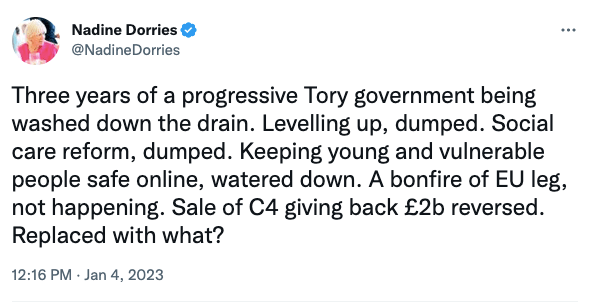
Sunak’s ascent to the top job has not reduced these internal divisions at all. The below tweet from former Minister and Conservative MP Nadine Dorries recently gives some idea of the simmering tensions within parliament:

The ‘Get Brexit Done’ coalition has fallen away with many former voters and supporters feeling disillusioned with the Tories’ performance in Government. Whereas in 2019, enough voters could get behind The Conservatives over Brexit, now there are fewer policies areas where the government have an advantage over the opposition. Attempts to attack Labour regarding recent union industrial actions have not landed so far. Many feel sympathy for striking nurses and feel health workers are not paid enough. Traditionally Rail workers get a bad rap for taking strike action without explaining their position to the public very well. RMT General Secretary Mick Lynch has been much stronger than his predecessors at making a case for his members. At the same time, with inflation above 10% many have sympathy with striking workers, and many more see the problem as poor economic management by the government even if they do not like unions going on strike. The current situation feels much more like the Ted Heath Conservative Government in 1973 than the Thatcher Government taking on the Miners Union a decade later.

It will be very difficult for the Conservative Party to win the next election. Certainly were an election held today the government will lose. But this is why there will be no election in 2023. In the best-case scenario, the economic situation is unlikely to improve until early 2024. Further to this, Sunak will want as much distance as possible from the Kwarteng Mini Budget, and this will take time. As well as an improved economy, the Tories will need to restore party unity both within their MPs and the broader party membership – who didn’t vote for Sunak.

A wedge issue, like Brexit, was in 2019, could help the Conservatives, but it is unclear what this would be. After 12 years in power, it is difficult to talk about ‘fixing the asylum system’ without it begging the question why haven’t you done so already? Slogans like a coalition of chaos about Labour and the SNP may have worked in 2015, but given the last year the Tories are in no position where they can accuse others of creating chaos. Certainly the 2017 slogan of strong and stable will not work again.

Despite everything that has happened, it would be a serious mistake to underestimate the British Conservative Party which has proven time and again to be an electoral force to be reckoned with. In England, where over 80% of British voters live, Tory is the default option in many parts of the country. The polarisation within Britain is high with tensions from the Brexit debate and ongoing calls for Scottish Independence still simmering. The Tories can certainly play these divisions to their advantage in the hope of winning support.

As the next post will discuss, Labour should be able to win the next election, but it is not a certainty yet. They have their own internal issues to resolve.

The curious case of Liz Truss

The premiership of Liz Truss will be remembered for many years to come. She will be remembered as being the shortest-serving former UK prime minister (for now), resigning after seven weeks. It will be remembered that only two days after going to Balmoral to meet the monarch, Queen Elizabeth II passed away having served 70 years on the throne, making Truss her 15th and final PM. People will also remember the Truss premiership for plunging already bad Conservative Party polling numbers down to record lows, giving the opposition Labour Party an unprecedented 30% lead. But the main thing her seven weeks as Prime Minister will be remembered for – destroying the longstanding myth that the Conservative Party are good at managing the economy.

As outlined in a post earlier this year in a global economic crisis, governments, in the short term at least, are limited in what they can do to remedy the situation. However, the one thing governments can certainly do is not make the situation worse. In this Liz Truss and former Chancellor Kwasi Kwarteng failed spectacularly.

The now infamous ‘mini budget’ or “Growth Plan” of 23 September 2022 caused the pound to hit an all-time low against the US dollar, and force the Bank of England to intervene to prevent chaotic drops in gilts prices from stinging pension funds and threatening financial stability. How on did the UK’s natural party of government, the party of sound money and fiscal responsibility manage to get it all so badly wrong? And so quickly?

Since 2008, as pointed out in my last blog post, right-of-centre governments have stepped back from full Thatcherite free market policies due to the fact that these policies directly resulted in the crisis of the last decade. Whilst free market and trickle-down economics may no longer be electorally viable, there remain many true believers in the small government crusade.

The decline and fall of Boris Johnson as PM was entirely of his own making and had been on the cards for some time. During the period, the disquiet within the Conservative Party was not so much over “Party-Gate” but the increase in taxes, namely National Insurance, to keep their manifesto commitment to fund social care, a policy area where previous governments have failed to grasp the nettle. Tory Party members were furious that a Conservative Government had raised taxes, and former Chancellor Rishi Sunak was in their eyes to blame. Enter Liz Truss.

Truss, on becoming Foreign Secretary in early 2022, began doing these strange photos where she was imitating former Tory Prime Minister Margaret Thatcher. This Thatcher cosplay was matched by sound-bite rhetoric about free markets and individualism. This really played to the home crowd with supporters in the Tory Party claiming “in Liz we Truss.”

Warnings from former Chancellor Sunak that the programme announced by Liz Truss when running for leader would make the economic situation worse were ignored by the party membership. In Liz they Trussed, in early September she became Conservative Party leader and Prime Minister.

A decade before coming to power, a group of right-leaning Tory MPs authored a book titled Britannia Unchained, a treatise, arguing that Britain should adopt a different and radical approach to business and economics or risk “an inevitable slide into mediocrity.” These MPs belonged to the Conservative Party ‘Free Enterprise’ group and included Liz Truss and the person a decade later she was to appoint as Chancellor, Kwasi Kwarteng.

In a later attempt to shift the blame to former Prime Minister Liz Truss for what happened, claiming he warned her the government were moving too fast. Kwarteng has not yet apologised for his mini budget on 23 September or the catastrophic fallout. In fact, his frustration seems more with the fact that Truss ended up sacking him, not long before being forced to resign herself. The truth is, the throwing caution to the wind approach of slashing taxes, removing restrictions on banker bonuses, and slashing other regulations such as IR35 were all consistent with what he and Truss had argued in Britannia Unchained a decade earlier. And these ideas found favour with the Conservative Party membership – with the idealised view of Thatcher’s vision of small government, deregulation and low taxation. For the general public, this was not so much ‘Britannia Unchained’ as ‘Libertarians Unhinged.’

Where this mini-budget really hit the rocks, especially with the financial markets, was the unfunded tax cuts and spending increases. The Tories, having implemented austerity policies during their first term in office with the Lib Dems, found out the hard way that underfunding the Police or the NHS was simply not an option. The 2017 election where they lost their overall majority, and Corbyn’s Labour had an unexpected surge in support largely due to increased turnout by young voters, was largely due to an anti-austerity backlash. In Kwarteng’s mini-budget, the solution was that the government borrow to pay for tax cuts and spending increases. The former Chancellor argued that cutting taxes and red tape this would stimulate economic growth meaning the government would soon be able to repay the debt.

Many were surprised to see financial markets react to a right-wing Tory budget in this way. Threats of capital withdrawal and other measures are not uncommon when centre-left governments try to implement their agenda. Yet here we had a right-wing budget and the market responded badly. One issue was that Truss and Kwarteng completely ignored the Office for Budget Responsibility before preparing the mini-budget. This office was set up by former Conservative Chancellor George Osborne, in response to his claims that Labour had acted financially irresponsibly when in power. This office was designed to be a check and balance for the left, yet it was the right who fell foul of it. One of Britain’s key selling points is that is a rules-based economy. By not consulting the OBR before the mini-budget, Truss and Kwarteng damaged Britain’s brand.

Cutting taxes at a time of high inflation is not a terribly smart move as it will drive up inflation further. Borrowing money to cut taxes and increase spending is what the Government in Greece did prior to the 2008 financial crash, with devastating consequences. Add both of these to a world economy struggling in the wake of the pandemic and the Russian invasion of Ukraine, it is no surprise that the markets reacted as they did.

Within days, Truss was forced to sack Kwarteng and announce a U-turn on the mini-budget, to much tormenting that “the lady is for turning” with reference to Margaret Thatcher’s famous quote. Within 44 days of becoming Prime Minister, Truss announced her resignation, having days earlier replaced her friend Kwazi Kwarteng with Jeremy Hunt as Chancellor and almost all measures in the mini-budget had to be reversed.

It was would easy to blame Truss and Kwarteng for this specular failure. Many have cited her shocking performances in the media as why ultimately she resigned and question how someone got to the highest level of public office when so clearly unable to perform. Leadership qualities play a significant role, and in modern politics media presentation is critical. But this was not a problem of style and presentation alone, as abysmal as this was under the Truss premiership.

The initial reaction to the Mini Budget in September was very positive from many in the Conservative Party and their cheerleaders in the tabloid media.

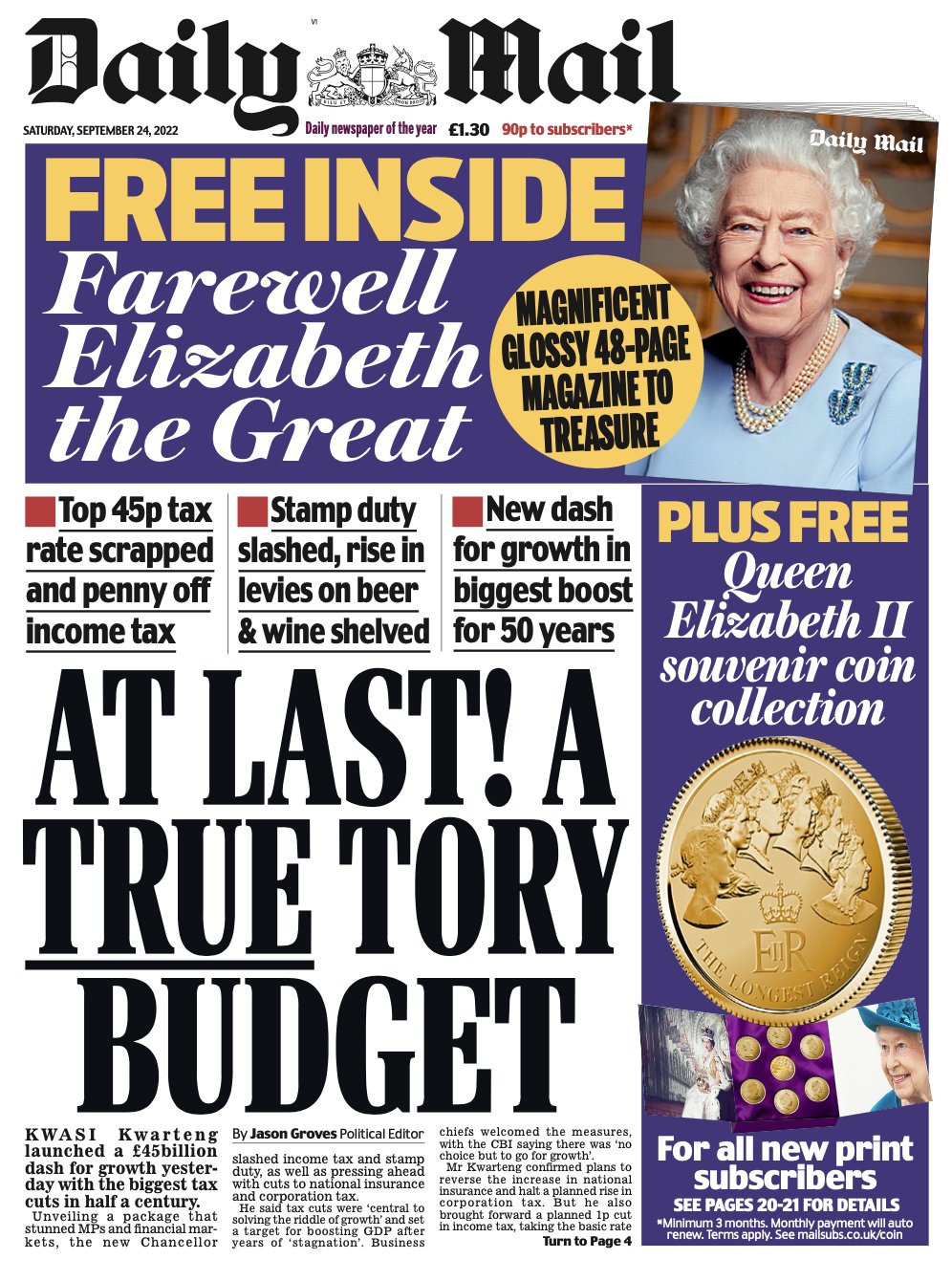
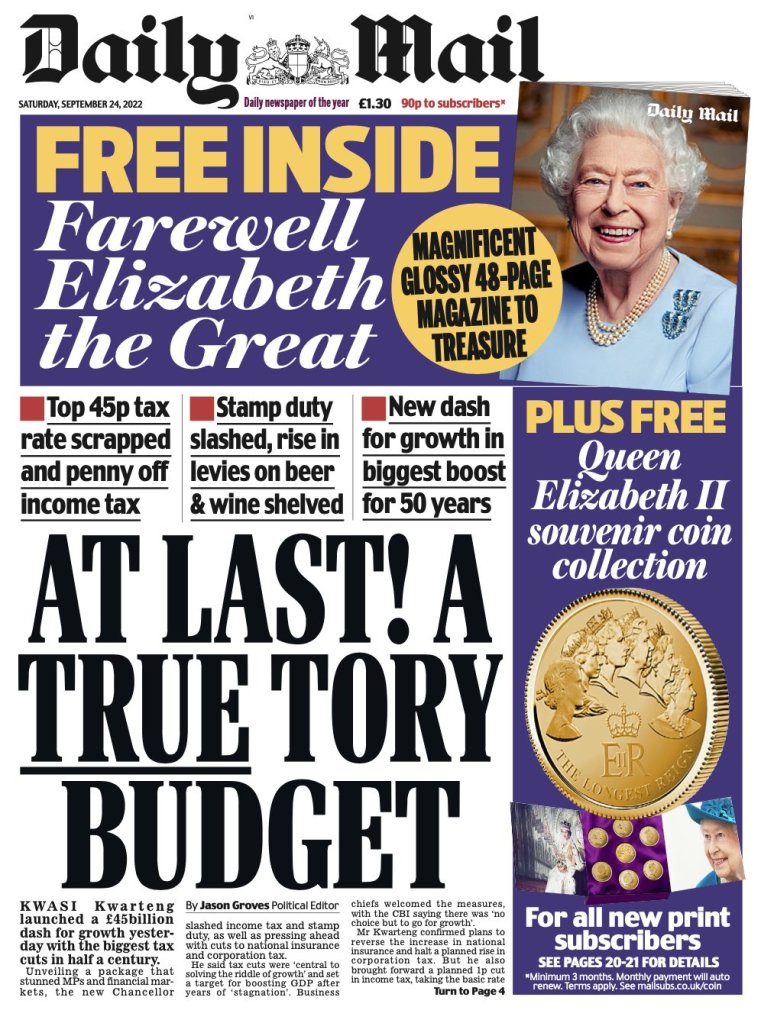
For Tory Party members and Daily Mail readers, this was the budget they had been waiting for. Far from being a surprise, the mini-budget was implementing not just the promises of Truss’s leadership campaign, but the wishes of many rank-and-file Conservatives. After enduring Sunak’s National Insurance increase the free market wing of the party finally had their way, at last, a true Tory budget. Never mind Britannia Unchained, this was Conservative Party unleashed.

The ‘get Brexit done/anti-Jeremy Corbyn’ coalition that won the Conservatives the 2019 election now finds itself in tatters. Not only were so-called red wall voters from the North East of England put off by the return of trickle-down economics, but polls show that large swaths of traditionally Conservative voting south of England were also in despair. Within the Conservative Party, those who still subscribed to Edmund Burke’s view that no “generation should be arrogant enough as to only think of themselves” and that borrowing for tax cuts would harm future generations, found themselves in the minority. In fact, the enduring influence of one-nation conservatism made popular by Benjamin Disraeli, of pragmatism and paternalism was replaced with an unwavering belief in small government and the market.

That Conservative MPs managed to avoid another membership ballot and Rishi Sunak replacing Liz Trus is the topic of the next blog post. Needless to say Conservative MPs, many from Constituencies once considered save tory, are now terrified by recent polls. Allowing the party membership a say risked a further dose of trickle-down right-wing economics, making the Tories unelectable for a long time. It was the party members who supported Truss, while in the first round, only 50 backed Truss for leader, though other candidates who had MP backing early on also espoused not dissimilar economic views.

Some who supported Truss may now have reflected on what happened and perhaps realise that these policies not only do not work, but electorally they are poison. But many on the right will blame it on Truss, her leadership style and the speed with which she tried to implement the reforms. In many ways, the fact that the mini-budget changes were done quickly and communicated poorly was a good thing, as it meant these policies were reversed quickly. A more media-savvy and gradual implementation would have done more harm in the long term. It is no accident that since 2008, free market trickle-down economics has been out of fashion. The Truss premiership has been a timely reminder that these policies do not work and should not be tried again.

Boris Johnson – why he fell and can he come back?

The demise of Boris Johnson’s premiership in 2022 was both a surprising political upset and entirely predictable at the same time.

It was a political upset when considering the large majority the Conservative Party won in 2019 under his leadership, the best result of any political party since Thatcher’s 1979 election victory. Yet, after months of reports about Party Gate and scandal after scandal involving both Boris Johnson and various other MPs, his eventual resignation in June 2022 became inevitable. Indeed back in February last year my blog post questioned how he was still in post and argued that his brand was damaged. Five months later, after yet another scandal involving Deputy Chief Whip Chris Pincher, he was forced to resign.

It is still too soon to say how history will judge Boris Johnson, not least because there is still the possibility that he may return as Tory Leader someday. Few can deny that his ascent to the role of Conservative Party Leader and Prime Minister in 2019 profoundly impacted British politics for many years to come. In 2019 I said that one of Boris’s strengths as a politician was that he could tap into people’s hopes and fears. He would have been a formidable Leader of the Opposition, and if the Conservative Party do not win the next election this theory may be put to the test.

Yet, Boris Johnson is a deeply flawed character whose political ambition has and continues to come first. What little political or policy conviction he held was primarily about staying on brand and winning votes. This in itself is not unusual and in modern politics, one can have quite a successful career by being transactional and self-promotional.

Boris Johnson was ultimately undone by both his own character flaws and by the direction of the Conservative Party, the latter being seriously out of touch with the mood of the British public.

Plenty has already been said about Johnson’s character flaws, which were well-known long before he became Prime Minister. For those who backed him, there was plenty of evidence that things would turn out as they did. The fact is that like Johnson, his backers promoted him for short-term gain. Specifically to break the political deadlock caused by Brexit and to win an election largely on that issue. It worked.

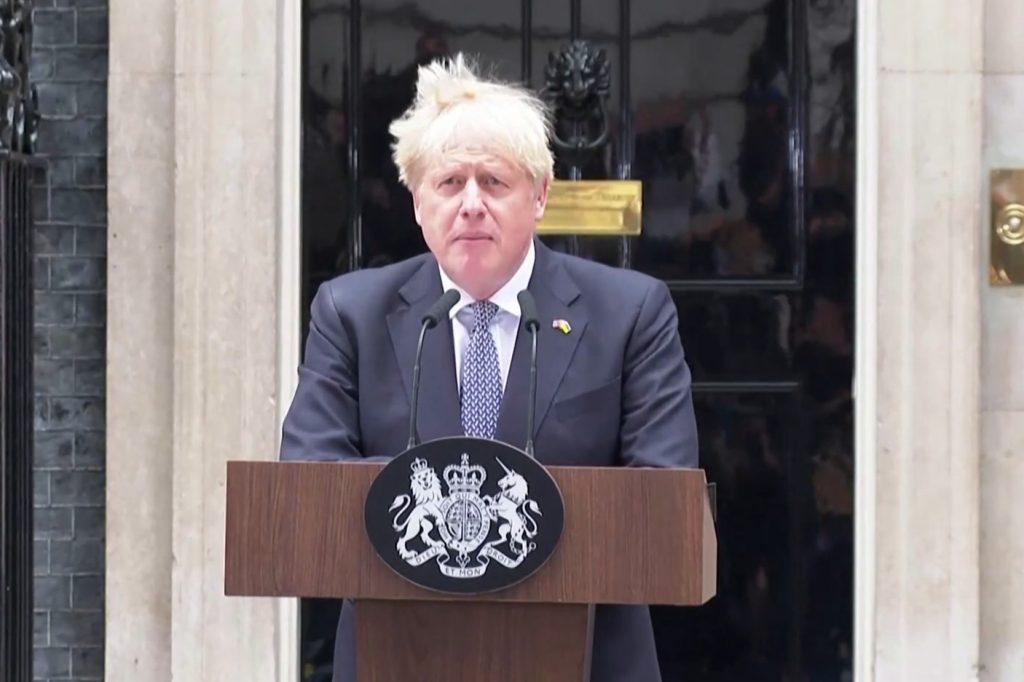
But the fixes the Johnson leadership provided, under the guidance of Dominic Cummins and others, were largely short-term. His oven-ready Brexit deal may have won the election in 2019, but has resulted in a long-term stand-off over the Northern Ireland Protocol causing ongoing problems. The bold assertion during his resignation speech that his government had fixed social care is simply not true, with the system overwhelmed and the system still facing serious workforce shortages and lacking proper integration with the NHS.

The three years of Johnson’s premiership will be largely remembered for the Government’s management of the coronavirus pandemic. As I have addressed in earlier posts, the Government failed in its response to the pandemic. Yes, the rollout of the vaccine was a success, in no small part because this task was administered by the NHS, one of the most trusted British institutions, rather than being contracted out to businesses with close association with the Conservative Party. Examples of favourable business deals, such as those given to Dido Harding or Michelle Mone, whose companies were awarded lucrative government contracts and failed miserably in delivering have left a sour taste in voters’ mouths.

This all happened under Johnson’s watch and he was simply not fit to lead the country during this crisis. But he did not act alone. It was a failure not only of the Conservative Government but also of the British state. The crisis highlighted the country was not prepared for a pandemic, and longstanding underfunding of the NHS made this much worse.

A month before Boris Johnson’s resignation at PM, I argued that during the current time when inflation has increased globally, national governments are limited by what they can do, in the short term at least. Incumbent governments of all political persuasions have struggled in the last year, so it is not surprising that the Conservative’s polling numbers have been poor during this crisis. But in the same way that the Tories blamed Labour’s spending levels for the 2008 financial crisis, despite strong evidence that this was not the case, they cannot now claim economic problems are beyond the control of the nation-state without looking like hypocrites. Again, the short-term electoral gain in 2010 has now made a rod for their backs a decade on.

Boris Johnson is unlikely to return to any leadership role in the short term, not least because the Privileges Committee is yet to investigate party gate and his actions during the pandemic. If this investigation does not go Johnson’s way, he may face a byelection that he is not certain to win. 1922 Committee Chair Sir Graham Brady has suggested that Johnson had the numbers to run for the Tory leadership against Rishi Sunak in October 2022, though others claim Johnson made a desperate bluff talking up his support during this leadership race. Given the number of MPs who called for him to resign only weeks earlier, including the 57 ministers who resigned themselves in protest, for him to return anytime soon is unlikely and unwise.

Yet he retains core support within the Conservative Party, and with a group of Tory MPs. He also enjoys a surprising level of support still with the British public, though nowhere near the level he enjoyed in December 2019. His two months as caretaker Prime Minister in July and August 2022 during a cost of living crisis certainly did not help matters, where he partied in the Cotswalds and took holidays in Greece while many voters struggled to pay their bills. Meanwhile, the Tory Party spent the summer holding a leadership election, where, as the next post will discuss, the least competent candidate was elected by Tory members.

Boris Johnson believes that like his hero Winston Churchill, he can return to power one day. He probably believes that he fixed social care, did a good job during the pandemic and did a good job with his Brexit deal. Or he knows that if you repeat a lie often enough people start to believe it. When you have a legacy to protect and want a future in politics, you say what you need to say and do what you need to do. And the Tory Party? Would they put him in power again? If they thought it would increase their vote, yes they would. That he is not suitable or trustworthy is no matter, when the motivation is power at all costs.

Were Johnson to return as Tory Leader for the 2024 election, he would almost certainly lose. However, he may motivate a section of the Tory base and Brexit supporters, possibly mitigating the losses. On the other hand, this might spur on a wave of tactical voting by Labour, Lib-Dem and Green voters to punish the Tories for putting Johnson back after all that has happened.

It is risky to make predictions, but it is safe to assume we have not heard the last of Boris Johnson. And much like Berlusconi in Italy, the results will undoubtedly be bad both for politics and the country.

How is Boris Johnson still in Number 10?

I answer the question posed in the title by returning to what I wrote on my blog when Alexander Boris de Pfeffel Johnson became Prime Minister in 2019:
Make no mistake, Boris Johnson has talent. He knows how to make a stirring speech and can tap into people’s hopes and fears as a politician My blog post written shortly after Johnson became UK Prime Minister
Now one might think being the Prime Ministers of the worlds fifth-largest economy requires a great deal more than this, and indeed it does. It requires a mixture of luck, animal cunning and being able to use both to maximum effect.
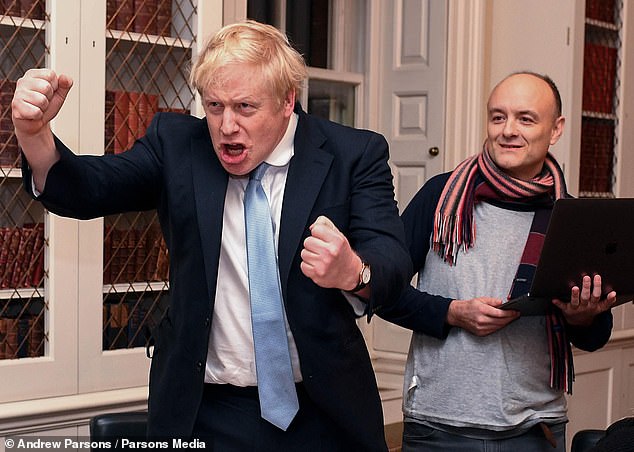
Above: Prime Minister Boris Johnson and former Chief Advisor Dominic Cummings
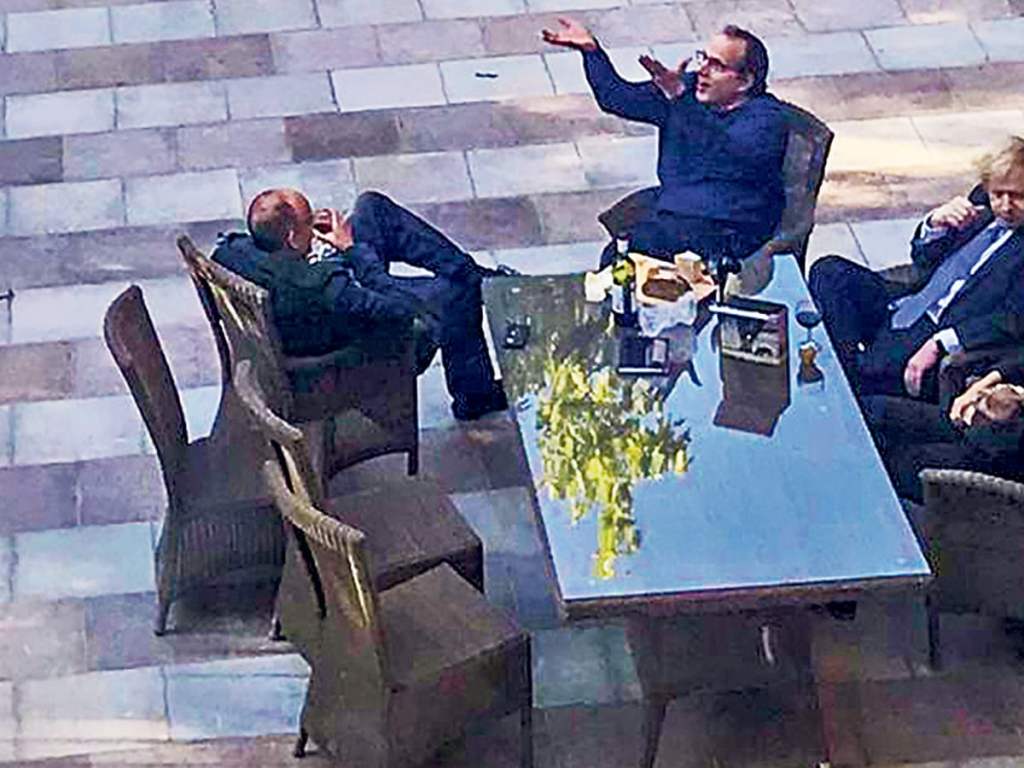
My last post in December outlined some of the issues the Conservative Government in the UK had been having in the latter half of 2021. Yet the position still seemed quite recoverable, indeed only a few months earlier, the former Red Wall constituency of Hartlepool had been won by the Conservatives. Local Elections in May 2021 also were very positive for the Tories. Things were bad by the end of 2021, very bad in fact, but it still did not seem fatal. 2022 was not the start of the year the government were hoping for. Despite repeated denials that there was party’s at 10 Downing Street during the lockdown, further evidence emerged that there were, including a photo showing the Prime Minister with staff sitting in the garden at 10 Downing Street having “a work meeting” where there was wine and cheese in May 2020, when social gatherings were illegal in the UK. This was at a time when people could not visit dying loved ones and the public were told not to socialise in this way. The investigation by Civil Servant Sue Gray found that there were “failures of leadership and judgment by different parts of Number 10 and the Cabinet Office” in allowing these events to occur, and then a number of these events are now being investigated by the Metropolitan Police. None of this was made better by the Prime Minister’s response that nobody had warned him that these parties were against the rules, rules that he had announced as Prime Minister in March 2020. Former Conservative Prime Minister John Major has said that Johnson broke the rules by holding these parties and believes he should resign. Others close to the Conservative Party including financial donors have also called on him to go. As Conservative polling takes a hit and MPs get increasingly restless, it is still a surprise to many that Johnson stays on. Indeed most other PM’s would have resigned by now. So why does Boris Johnson stay on and why do the Conservatives let him. For Johnson, he knows if he leaves office now, he’ll likely never return. Having only served in the role just over two and a half years and most of that time leading (badly) during a pandemic, he has to try and stay on. But why on earth do the Conservative Party let him? Because despite everything, including the quite serious long term damage to the reputation of the party and indeed of the United Kingdom, he is probably still their best chance of winning an election. Boris Johnson does not play by the normal political rules. Many claim Johnson uses the Trump playbook, and his election outcome in 2019 certainly benefited from Trump’s intervention which helped get the Brexit Party not to stand against the Conservatives in crucial leave voting constituencies, specifically the so-called Red-Wall. Yet Johnson plays by his own rules, which include fast and loose morals, including talk of beating up journalists. He has a level of confidence that has helped him get away with things other politicians simply would not. His clown reputation and building the brand “Boris”, the clown who got stuck on a zip wire at the 2012 London Olympics during his time as Mayor. Johnson won the London Mayoralty by seeing an opportunity, specifically that London voters were tired of Ken Livingston. Further, the clown reputation meant Johnson’s opponents underestimated him in not just one but two London Government elections. His ascent to the Conservative leadership was far from smooth, with his first attempt in 2016 being undermined by Michael Gove. His record as Foreign Secretary was also far from successful, especially regarding the Nazanin Zaghari-Ratcliffe issue. Yet his stance on Brexit, specifically undermining Theresa May’s attempts to negotiate a withdrawal agreement, paid off. He proved ruthless in his first few weeks as the leader, withdrawing the Tory whip from 21 MP Conservative MPs who would not back his Brexit plan, including his own brother. His decision to prorogue parliament when he could not get MPs to agree to a general election ultimately worked for him. Despite losing legal challenges to this prorogation, eventually, he got MPs to agree to an early election, winning the best result for the Conservative Party since 1983. His victory in 2019 was due to two things, tapping into the hopes and fears of those frustrated by attempts to thwart Brexit and a deeply divided opposition. His performances as an orator during this campaign were far from his best work, and despite arguable receiving fairly favourable press coverage during the campaign, felt the need to hide in a fridge to avoid doing a media interview days before the election. Those who in recent weeks, having previously supported Boris Johnson, now believe he is not fit to be prime minister seem to have only just worked out what he is really like when the signs have been there from the start. One of Johnson’s strengths throughout his career has been his ability to bring people in that can carry him. Dominic Cummings, loathsome as many may find him, was a driving force behind the Brexit campaign in 2016 and the 2019 Conservative election victory. There were of course plenty of others, including some who have been with him since he was mayor of London who has recently quit. The problem with being an advisor or a ‘back roomer’, is that ultimately the candidate will not always do what you wish they would. It is immensely frustrating to feel you are the brain behind the power, yet never to get credit, and worse to have your clever strategy ignored. The other issue Johnson faces is that despite his show of strength, for better or for worse, in getting Brexit done, he is not ideologically in step with much of the traditional Tory base. This in part explains his appeal to voters who traditionally have not voted Tory, certainly, this proved the case both in London and in the 2019 election. For many Conservatives, winning a strong majority and remaining in power was worth the compromise, even if it meant accepting a level of what the late Margaret Thatcher would have decried as corporatist policy. The recent decision to increase National Insurance has certainly tested the tolerance of many Conservatives who subscribe to the Thatcherite philosophy of low taxation and small government. As I have written earlier, social care has been a blight on the political landscape and one that neither Labour nor Conservative governments have adequately addressed. With demand for social care increasing, governments have been under pressure to increase funding. Both Blair’s New Labour and Cameron’s Conservative Governments lacked the political courage to increase taxes to pay for social care. Whilst there are strong arguments against the way the government have decided to increase taxes, specifically that rather than an across the board increase to National Insurance there were other options whereby the heaviest burden would have fallen on those best placed to contribute, nonetheless, an increase in taxation to pay for social care was inevitable. Any serious analysis of relying on the private sector and savings to address this need show this is not viable. Is it a coincidence that the announcement of the National Insurance increase in September 2021 happened just before the government and in particular Boris Johnson started having problems? It would be a mistake to think that the open civil war within the Conservatives under Theresa May was only about Brexit or that the 2019 election result put these to bed. It is quite clear that the stories of lockdown parties and other scandals have been disclosed by people within the government. Plenty of Tory MPs would be quite happy to see Johnson fall or to apply maximum pressure on him so he backs down on the National Insurance increase. Boris Johnson may not be a Thatcherite ideologically, but so far it does seem he is not for turning and understands that doing so would ultimately be more harmful. For small-government laissez-faire Tories, a leadership challenge may not serve them well. Were Johnson to go, the likely successor would be Rushi Sunak who talks free market but in practice has been one of the most interventionist Chancellors in modern times during the COVID-19 crisis. It is unlikely that Sunak as PM would reverse the National Insurance increase, given he has been its main advocate thus far. The rights favoured candidate, Liz Truss, is simply not credible. Boris Johnson remains Prime Minister of Great Britain and Northern Ireland. He does so, for now, due to the lack of a strong viable alternative within the Conservatives. Despite everything, he is still the leader most likely to help the party regain support, despite him now being severely damaged. Some in the Conservatives may be thinking it best to leave him in place at a time when the cost of living is increasing significantly when the May Council elections will likely not be good for the Conservatives (the particular boroughs having elections this year are less favourable to the Tories, but a backlash to “party gate” will likely play a role) and the National Insurance increase. Better to find a new leader nearer to the election. But this is a risky strategy, as the Prime Minister has damaged not just his reputation, but that of the Conservatives and the government he leads. His attempts at statesmanship during the Ukraine crisis may have helped him a little, but his reputation on the global stage is also tarnished by what has happened at home. Boris Johnson, should not on balance still be Prime Minister and in the long term, the Conservatives risk being severely punished for not removing him. But despite everything, he remains in post and still, we cannot write him off.