Radical Socialism

In an earlier post I wrote about my expulsion and later re-joining of the New Zealand Labour Party. I’ve also written about ideology and some of the limitations this can cause. I have experience of this, as in the years following me leaving Labour, I became active in the radical socialist movement.

So to put this into context, in 2002-03 the Iraq war resulted in a global mass movement built. At this time I was elected to the student executive (a subject for a future post) and was also becoming a union delegate on the cleaning site I was working on. The late 1990s anti globalisation movement had lost some of its initial steam, but anti capitalist and certainly anti neo liberal politics and ideas were still being discussed at university. To me and many of my friends at the time, the third way Labour Government was on the wrong side of these issues, and something more radical was needed.

I first became aware of the Anti Capitalist Alliance in 2002, shortly after it formed. It was a coalition of a couple of other smaller socialist groups, and ran a couple of candidates in that years NZ general election. The grouping had a 5 point platform:

The five-point policy platform of the Workers Party is as follows:

  1. Opposition to all New Zealand and Western intervention in the Third World and all Western military alliances.
  2. Secure jobs for all with a living wage and a shorter working week.
  3. For the unrestricted right of workers to organise and take industrial action and no limits on workers’ freedom of speech and activity.
  4. For working class unity and solidarity – equality for women, Maori and other ethnic minorities and people of all sexual orientations and identities; open borders and full rights for migrant workers.
  5. For a working people’s republic

After a few months of flatting with one of its members (who in 2003 arrested at a Wellington anti war protest for throwing his lunch at Australian PM John Howard), I eventually joined the group.

I became a regular contributor to the organisations paper The Spark writing about my time as a cleaner and various critiques of the government such as this one demanding equality for same sex couples during the 2004 Civil Union debate. This also meant many cold Saturday mornings selling the paper on the streets of Wellington and Porirua (often hungover).

In 2004 I ran for Mayor of Upper Hutt against incumbent Wayne Guppy. And in 2007 I was one of a number of candidates to run unsuccessfully against Mayor Kerry Prendergast.

By 2008 the Anti Capitalist Alliance had changed its name to the Workers Party, a somewhat generous description of the tiny socialist group. It gained 500 signatures allowing it to appear on the ballot nationally in the 2008 general election (NZ has Proportional Representation, thus party’s with over 500 members can run as a party on the national ballot as well as standing local candidates).

The ideological debates within the groups were about Trotskyism verses Maoism, and peoples assessments over Russia and China. These historical debates always interested me, but I generally entered them usually to wind others up rather than seeing them as the pressing issue of the day. Other debates such as whether New Zealand was a junior imperialist state or a semi colony of the US was more somewhat more interesting, as it was assessing the current state of the NZ economy. I also enjoyed studying volume 2 of Karl Marx’s capital addressing the Tendency of the rate of profit to fall, a theory that many economists on the left and the right of the political spectrum believe explains why the post war boom and subsequent neo liberal policies were implemented from the late 1970s onwards.

On the issue of revolution verses reform, or working within the parliamentary established structures or outside of them was always a big questions. While my time in Labour and subsequent views leaned me heavily towards creating change outside of parliament, looking back I wasn’t consistent on this. For most of my time in radical socialist groups I was an elected student representative, working within the university structures to achieve change. Later I was elected a union president and representative. While both involved encouraging members to become active and pressure for change, both roles also involved working within the system. I later realised the revolution/reform, working inside or outside the system dichotomy was a false and limiting one.

Eventually the inevitable happened with small socialist groups, and those who have seen the Life of Brian know how this goes down. My then girlfriend (soon to be ex) and I ended up leaving the group in 2009. A rather long polemic ghost written by me was issued by Jasmine, you can read it here, but I don’t recommend it. The organisation became dysfunctional, and I certainly don’t claim to have been totally in the right. In the end it was a group built on 19th century ideology, and unsurprisingly this didn’t work out. The group disappears not long after I left.

The global financial crisis of 2008 was I think the end of it for me. Capitalism had ended up in another crisis due to its own inherent flaws. The free market that had been trumpeted as the ideological way by the right had to be abandoned as governments bailed out the banks. Yet left and socialists politics went into decline rather than growth after this crisis. Yes the banks and markets had failed. But socialist idea’s, while perhaps providing some useful analysis did not have much to offer during this.

So I was a radical socialist. Do I regret it? It was an experience I learnt from, so why would I regret it. By taking part in radical politics many dismiss you as a nutter, and years later some still view me in this light. This is disappointing. Yes some of the positions I took at the time were (literally) out of left field. But sometimes radical or out there ideas can be right. Blindly following ideology is limiting, but so is totally dismissing someone who has these ideas and everything they say as “nuts.”


Walk 3 St James

The third in this series of London walks using a 1980s AA guide book takes us to St James. So Trafalgar Square, Pall Mall and all that stuff. Its rather good.

2E38B231-48AC-4431-A28A-9CF24D9DE619

Above: Walk 3 St James, Done February 11 2018

The walk commences in Trafalgar Square, outside the National Gallery.

IMG_6930

Above: Statue of George Washington outside the National Gallery. 

Then around the block past the National Portrait Gallery to Leicester Square. The Guide book says a ‘Statue of of Shakespeare in the centre.’ Also ‘Cinemas abound in this area.’ Probably fewer cinema’s 30 years on, but this is still the place to get cheap tickets to shows.

IMG_6932

Above: Shakespeare, allegedly didn’t write all of his plays.

Following this the tour took me past New Zealand House in Haymarket and down Pall Mall. Eventually I ended up at the Duke of York’s Column – the geeza marched his 10,000 men up the hill and down again. The guide informs me that these same men had to pay for his memorial.

Above: Top left  – NZ House, Top right and bottom – The Duke of York Column.

The tour then took me past Carlton House Terrace, a collection of nice 17th century houses.

Above: Carlton House Terrace and surrounds.

The tour then took me to Jermyn Street. I had recently purchased some shirts in Canery Wharf which said were from Jermyn Street. I was pleased to wander around and window browse the area. Some great old shops and interesting old church in the Street.

Above: Jermyn Street.

Above: Piccadilly Arcade off Jermyn Street.

Next I headed down St James Street. According to the 1980s guide book “many of the best known gentlemen’s clubs in London are situated in this genteel street.” I did not enter any ‘gentlemen’s clubs’, especially after recent controversies. In stead I continued down to the Stable Yard.
Above: Left – St James Street, Centre Left – Berry Bros and Rudd, wine merchants, Centre right – St James Palace, Right – Cleveland Row.

After this my 1980s guide wanted to take me to the Stable Yard, the system of interlocking courts between St James Palace, Lancaster House and at the time of publication the Queen Mothers residence Clarence House. On attempting to take this route I was greeted by a polite but serious looking police officer holding a semi-automatic weapon. I showed him my guide book and he did a wee smile and said “yes you used to be able to walk through here, but not anymore.” Given this I elected to deviate from the guide books recommended tour and took another entrance to St James Park.

IMG_6950

Above: To the right of the stop sign was the police officer.

Above: St James Park

Following a nice walk through St James Park, I proceeded onto the Banqueting Hall which is part of the old Palace of Whitehall.

Above: Top Left – Whitehall, with a London Eye peeping out the top (not there in 1987), Top right and bottom left – A man on a horse, Right centre and bottom: The Banqueting Hall.

Finally the Walk 3 Tour concluded back at Trafalgar Square.

IMG_6962

Above: The Admiralty Arch separating Trafalgar Square from The Mall.  

Hope – A powerful but dangerous tool.

Hope is one of the most galvanising and powerful emotions. It is the thing that has driven some of our greatest achievements as a species. It has kept people alive in times of despair and sorrow. It has driven movements for social change, such as the abolition of slavery and the civil rights movement. Hope is essential. Without it, humanity cannot move forward.

But when hope is lost, it can be utterly devastating. Worse it can result in other powerful emotions, ones that drive people not to do good, but ill.

It is now a decade since the rise of Barack Obama in the 2008 US Presidential Primary. After 8 years of the Bush administration, American liberals and much of the world were very cynical about US politics. At the start of the presidential primary, the likely Democrat nominee was Hilary Clinton, who like her husband Bill was seen as Republic Lite. Chicago Lawyer and Senator Barack Obama surprised many in the political class through his upset victory in the primary.

Obama offered hope. He ran on a platform of improving health care, closing Guantanamo Bay, improving labour (labor in the US) rights and being a genuinely reformist president. The first since the Reagan years. In short, Obama offered hope to the poorest, disenfranchised and alienated sectors of American society who’d been ignored for decades.

When elected president later that year, the Democratic Party also held majorities in both houses. He was the first Democrat President to achieve this since the 1970s. This wasn’t to last long.

Weeks into his presidency the financial crises were really starting to bite. Banks, having been bailed out by the US government, proceeded to pay their executives bonuses and foreclose on working people who couldn’t pay their mortgages. Meanwhile, Obama’s economic team was packed with Wall Street insiders.

His big achievement in his first term, and in fact his presidency was healthcare. He did more than any other president to pursue this cause. However, the Republicans fought him every step of the way. The end product was very much a compromised Obama Care package, which low to middle-income Americans had to pay the cost of.

For most of Obama’s time in office, he faced a hostile Republican Party from 2010 had a majority in Congress and eventually also in the Senate. However early in his presidency, he didn’t help himself. One of Obama’s criticisms of the previous Bush administration was the way it tried to force Congress and Senate to support the President’s legislation. During the health care reforms in 2009, Obama at first tried to find a compromise with Republicans and wanted to respect the independent powers of both houses. Very noble. Politically inept. The Bush administration knew how to drive a policy agenda, and used this to its full advantage after 9/11. By contrast, Obama’s respect for the constitution, gave Republicans space to have a go.

I regard Obama as the best US President in my lifetime (I was born in the 80s during the Reagan era). On Gun Control for example I think he did the best he could. He was ultimately a disappointing President. Obama promised hope and intended to deliver that through the US political system. The problem is, that system is flawed. He gave people hope in a political system which couldn’t deliver on the promise.

We all know what happened next. Hope turned to Anger. Donald Trump’s call to drain the Swamp in Washington resonated. Both Democrat Bernie Sanders and Republican Trump surprised commentators with their rise in support. Both talked of a broken political system, a message that clearly resonated with large sections of the American public.

America isn’t the only country where people have been offered hope, only to be bitterly disappointed. This little ditty about Nick Clegg, former Liberal Democrat leader in the UK shows similar frustration in a politician who in 2010 had given much hope for change. Recent Italian elections saw the crushing defeat of the Democratic Party, which only a few years earlier had won on a promise of hope.

The reality is that hope is a very powerful tool to use on an election campaign. Nothing motivates people to head to the ballot box like the hope that their lives may get better. But nothing will turn people off politics more than having this hope dashed. Worse it can drive people to the politics of anger and hate, which sadly the world is seeing more and more of.

In politics, and life generally people should be offered hope. But this hope needs to be real. If you give people hope in something, you need to be able to see it through. Giving people hope, only to disappoint later is cruel, damaging and irresponsible. To give people hope and then deliver, is by contrast one of the most positive and powerful things you can do as a human.

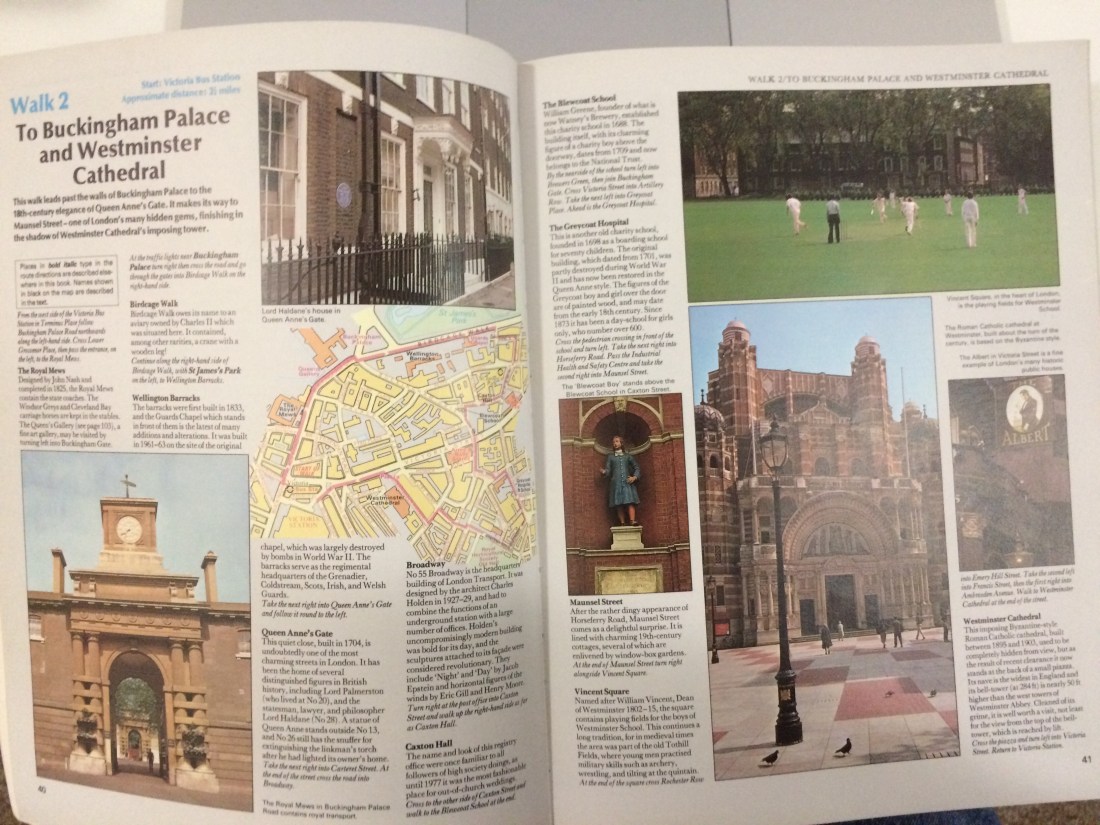
Walk 2: Buckingham Palace and Westminster Cathedral

This is the second in my series of walks out of my 1980s AA guidebook to London.

I did the second walk on 19 January 2018, a cold but sunny winter day in London. The theme for this walk is Monarch and Religion.

walk 2.jpg

This walk commenced the Queens inner city residence, Buckingham Palace. Neither she nor Phil invited in for a cuppa (very rude). I was able to walk past and see the Royal Mews where the queens carriage and horses are kept.

Above: The Royal Mews

Next to this was the Queens Gallery. I had a quick look in the gift shop

Above: Items in the gift shop at the Queens Gallery. The style didn’t quite fit the decor of my London place. 

After walking down the Birdcage Walk, leading me to the Wellington Barracks. The Chapel and museum were closed to the public that day, so I took a photo and moved along.

Above: Wellington Barracks

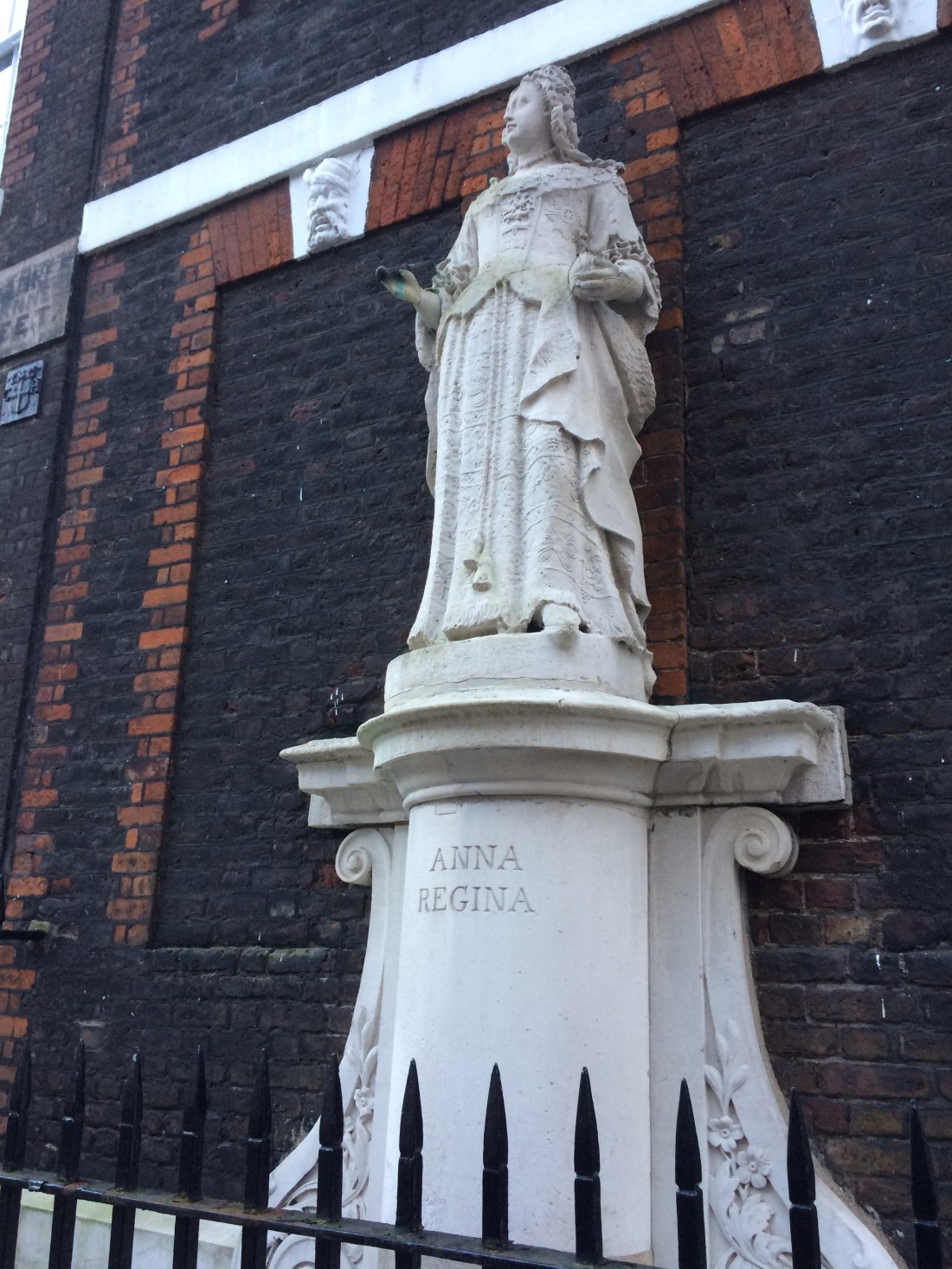
After this my 1980s guide book sent me to Queen Anne’s Gate, a ‘quite close built in 1704. Lord Palmerston used to live at number 20, and Lord Haldane at number 28. Queen Anne has a statue outside number 13.

IMG_6842

Above: Anne outside number 13.

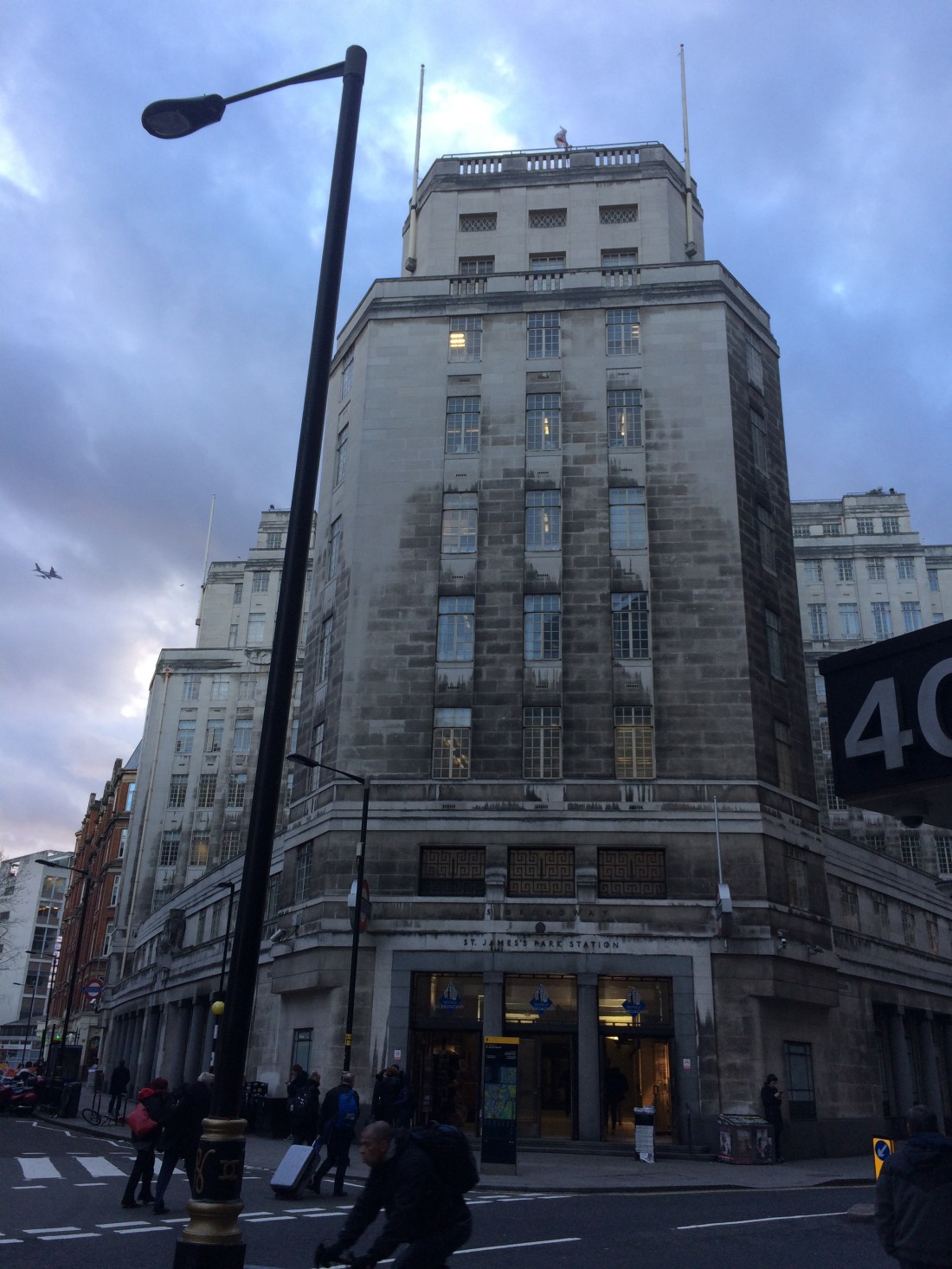
After this we head to Broadway. Not quite the glitz and glamour of the New York version, somewhat more utilitarian and functional. The main site here is the 1920s built London Transport Headquarters.

IMG_6843

Above: London Transport HQ. In 2015 London Underground were due to vacate the building and move the Headquarters to the Olympic Park in Stratford. The building was to be converted into city apartments, but Transport for London still occupy the space and the planning permission to convert to housing expires this year. Watch this space. 

The next stop on walk 2 was Caxton Hall, a former registry office, and was once the most fashionable venue for out of church weddings.

Above: Caxton Hall – fancy registry office.

Further down Caxton Road is the former site of he Blewcoat school. Since 1987 when the guide book was published, the building was refurbished and is now a clothing store.

Above: Blewcoat School

After this, the 1987 guide book suggested I stop at the Albert Tavern. Well its still there so who was I to argue…

Above: The Albert Tavern had their own Bitter, pretty nice drop too. 

Then I realised I had skipped a bit. Grey Coat Hospital, a charity school founded in 1698

Above: Grey Coat Hospital 

The final leg of the tour took me through the inner London streets on the way to the final stop.

Above: The streets of London

Final stop, Westminster Cathedral. Catholic Church built between 1895 and 1903 in the Byzantine-style. It certainly stands out, and is very different to other Cathedrals you see in the British Isles.

Above: Westminster Cathedral. Also me inside a church, a very rare occurrence.

Walk number 2 started with monarch and finished with religion. Neither have changed much since the 1980s guide book was published. I guess both are conservative institutions that rarely change, even if they should.

Driverless cars

The pace of technological development has increased phenomenally over the last century. In the 35 years I’ve been on the planet there have been huge changes. I recall at primary school in 1991 being excited that our class had a computer, a commodore 64. In 2018 most of us have a smart phones that have 1000 times more memory, and have functions we wouldn’t have dreamt of back in the early 1990s.

Driverless cars are the latest technological development people are excited about. Its amazing to think that we now have the ability to build cars that drive themselves. Further we are quickly moving into an era where many previous manual tasks can be automated. Everything from barista’s to factory workers are seeing machines able to do what humans can.

This is exciting, but also frankly terrifying. Not only because of all the dystopian science fiction novels where machines take over and wreck havoc. But socially, economically and in terms of human society there a whole bunch of serious considerations when we look at automation.

At the risk of being accused of being a luddite, a killjoy or even a cynic, I question the rationale of prioritising the development of automation of people’s jobs. I get that driverless cars reduces labour costs for business. But when driverless cars threaten 25,000 jobs a month in the US, what will the impact be on society. Even for businesses who make short term gains from this sort of automation, will significant increases in unemployment and corresponding drop in disposable income really benefit many firms in the medium to long term?

Further, at a time when we face a serious environmental disaster in the face of human caused climate change, why are we prioritising driverless cars over zero emission vehicles? Why are our lawmakers having to put their energy into thinking about how the economy will survive automation, when we are yet to solve the fact that our future survival as a species is under threat from carbon emissions?

The issue is two fold. One is that business, especially post 2008 financial crisis focus on making efficiencies to maintain or improve profit. Some are thinking bigger picture but many aren’t. So they invest in technology that fixes the immediate problem, rather than consider the issues down the road. Those who work in research and development are generally at the mercy of their funders. They focus on what they are paid to, regardless of the wider consequences.

The Second issue is the silo’s that exist between the innovators, business, law makers and those concerned with social issues. What should happen is an economic plan that looks at the major issues facing the economy as a whole, then funding research and development in areas that would help solve these. This happens to an extent, but more could be done to invest in things like zero emission technology. Government has a leadership role to play here. As I mentioned in my post about the Housing Crisis, politics is captured by electoral cycles. Long term strategic thinking is often not a good re-election strategy (though be nice to see it tried sometime).

To conclude, I’m not against driverless cars or other forms of automation. But we need a society where there is full employment. If we put the livelihoods of millions at risk by developing new technology without creating alternative jobs, the negatives far outweigh the positives of this development.

Moving your business to the UK? Talk to Paul Beare LTD

Piko Consulting UK would like to make the following recommendation for Paul Beare Ltd:
Expanding our business from New Zealand into the UK market was never going to be easy. Building up a networks and a client base takes time and money. As a business we needed to be getting on with that straight away. Unfortunately for new businesses, much of your time will be spent getting set up. Registering your company, registering for VAT, setting up National Insurance for you and your employees. And as for trying to set up a bank account, it takes months.
Piko engaged Paul Beare 3 weeks prior to us setting up in London. Within a month Piko Consulting UK was registered as a UK subsidiary of Piko NZ. Days later we were registered for VAT and had the National Insurance set up. Setting up bank accounts has taken little longer. Fortunately Paul Beare Ltd offer a service where your business can set up a temporary bank account through their firm. This has allowed Piko to invoice and receive payments.
Paul Beare Ltd also went above and beyond working through our first VAT return. VAT is quite different to the NZ GST system, as VAT is not charged on everything like GST is in NZ. Piko was helped through this process, saving Piko valuable time and money.
If you are looking to expand your business into the UK, Paul Beare Ltd are the people to talk to.

Why the Labour Party?

In November I attended a screening at Cambridge University of My Year with Helen, the documentary about former NZ Prime Minister Helen Clark running unsuccessfully for Secretary-General of the United Nations. I briefly spoke to Helen after the screening. She appeared not to remember me, it was probably easier for us both.

I joined the NZ Labour Party in January 1997 at the age of 14. Within a year I had become very active in the party and spent many hours campaigning in the 1999 election when Labour came to power. New Zealand had since 1984 been a world leader at implementing a hard Neo-Liberal economic agenda. Privatisation, user-pays and free-market deregulation were all the rage. As a teenager, it became apparent that a widening gap between rich and poor was the inevitable result of this agenda. I decided the thing to do was join Labour and help change the country’s direction.

By 17 I had been elected chair of the Rimutaka Labour Electorate Committee. By 18 I was the Young Labour Wellington Representative. I was regularly attending meetings with MPs and was building a reputation as an up and coming Labour Party activist in Wellington.

But in 2001, things changed. After a year of Labour being in office, I started to become critical of the 3rd way and specifically the governments continued support for trade liberalisation. The conflict quickly ensued:

Read the story of how I publicly fell out with Labour here.

Sacked as the chair of the electorate committee and soon after from the Young Labour exec for opposing free trade deals that put 20,000 jobs at risk. Then 9/11 happened and the US led war on terror commences. I got dragged out of the 2001 Labour conference for interrupting Prime Minister Helen Clarks Speech opposing NZ troops being sent to Afghanistan.

Labour fires teenaged rebel

Above: Photo on the front page of the Wellington Evening Post under the headline “Labour fires teenage rebel”

Eventually, I got expelled from the NZ Labour Party in 2002 for running against sitting Labour MP and Cabinet Minister Paul Swain in the Rimutaka Electorate. I got 376 votes, and Paul got significantly more.

Looking back, I managed quite successfully to gain the attention of the national media. Specifically, my initial media release about free trade was 14 pages long, that it still got reported is quite a feat. Amusingly when a Dominion post reporter rang my home my mother answered. The reporter explained that I’d put out a media release attacking the government’s stance on free trade and was scathing about government economic policy. Mums reply was “typical, mothers are always the last to know.”

Getting turfed out of Labour didn’t harm my prospects, in fact, my lifted profile probably helped me get elected to student politics shortly after. Further, in the short term it did help create some debate about both free trade and globalisation, and the connection between that and NZ aligning with the US to send troops to Afghanistan.

I don’t regret what I did, and on issues like sending troops to Afghanistan, I still think the west’s intervention in that country was short sighted. But tactically I would take a different approach today. NZ Labour remained in government for 6 years after my expulsion and attempts to build new political organisations in opposition to Labour on the left failed. Further, the relationship between myself and Labour members in the following years remained quite strained, and there were faults on both sides. In student politics and in other campaigns certain opportunities were missed as a result. It wasn’t until 2008 that this started to change. Even today there are those who remember the events of 2001 and remain suspicious.

I remain critical of placing any party/tribal allegiances over policy. Political parties and organisations are a tool. Parliamentary Parties like Labour can help achieve significant social change. But they are only one way. Community campaigns, unions, lobby and other pressure groups are just as important in achieving social change.

Back in 2002, I was often dismissed a nutty or far left. Policies like free tertiary education, opposing sending troops to Afghanistan and ending youth rates for young workers are all policies of the current NZ Labour led Government. In 2001 these things were considered insane. Labour MP Trevor Mallard suggested I “lay off the hallucinogens, or take them, whichever is appropriate” in response to voicing such opinions.

Did getting kicked out help make things change? Or would I have been better off staying inside? It possibly made life easier for 3rd way Blairite types not having to face dissenting views internally? But possibly making noise on the outside was effective?

Fast forward 11 years to 2013. At a Mayday function, I was asked if I would re-join Labour. My reply (after a few drinks) was that Paul Tolich who had helped drag me out of the 2001 Party Conference would have to come to sign me up. The next day Paul Tolich turns up at the Public Service Association where I worked and signed me up. Unlike my 2002 expulsion, my 2013 re-joining of Labour was a low-key affair. My aim was to quietly slip back unnoticed, and avoid picking up any roles or responsibilities.

This wasn’t to last long…

In 2014 Labour suffered one of its worst election defeats in the Party’s history. A leadership election was held after former leader David Cunliffe resigned. Former trade union and student leader Andrew Little put his hat in the ring. Labour leaders in NZ are elected by party members, trade union affiliates as well as by MPs. Andrew had only just made it back into parliament in 2014 and was far from being the front runner for the leader. I was asked to be his Campaign Manager, which I agreed to.

Andrew 1

Above: Campaign image used during the 2014 campaign to elect Andrew Little NZ Labour Leader.

Andrew narrowly won the leadership contest becoming Labour Leader and Leader of the Opposition. One of the reasons I supported Andrew’s Campaign was having worked with him before I’d seen he was a leader unafraid of making hard decisions. I also liked that he opposed raising the retirement age from 65 to 67, whereas previously the party had supported raising the age and alienated a number of voters.

After getting Andrew elected my involvement decreased. I went back to my work at the Public Service Association and concentrated on other things like finishing my Post Graduate degree. While far from perfect under Andrew’s leadership, some important things were achieved. Labour managed to ban zero hours contracts from the opposition benches with the help of a strong campaign by unions and social justice groups. In 2017 Andrew stepped down as leader and was replaced by Jacinda Ardern who shortly afterwards became NZ Prime Minister. The work Andrew and his team did from 2014 to 2017 helped Labour get into government, even if he wasn’t leader during the election. Andrew is now Minister of Justice. He also is doing good work supporting the families of the Pike River Mining Disaster as the minister with responsibility for this.

So from young up and coming Labour member, to kicked out and expelled, then returning and running a successful campaign for the Party leadership, my history with the NZ Labour Party has been eventful. Over the last 20 years, I have certainly grown and changed, as too has NZ Labour. Now back in government, Labour has an opportunity to make a real difference both at home and internationally. I now watch with interest from London.


Cryptocurrency and the nation-state

This is a topic I make no pretence at being an expert in. It has only been recently that I have started learning about Bitcoin and other cryptocurrency. However in the short time I have been educating myself about this issue, I have made some fairly obvious but also quite profound observations. The rise in cryptocurrency occurred after the 2008 financial crisis, and in part was a response to a loss in confidence in traditional banking. Secondly as cryptocurrency increasingly enters the main stream, this poses a significant challenge to the nation state.

For those who like me are still new to the concept of cryptocurrency, below is a brief definition:

a digital currency in which encryption techniques are used to regulate the generation of units of currency and verify the transfer of funds, operating independently of a central bank.
“decentralized cryptocurrencies such as bitcoin now provide an outlet for personal wealth that is beyond restriction and confiscation.
In an era where people can buy and sell all over the world from their smart phones, the internet has increased global transactions at a phenomenal rate. Cryptocurrency is the logical next step. Bitcoin has played a similar role in cryptocurrency to that which Napster played in the music industry in the late 1990s. Being the first out the gate Napster got bashed by the establishment. Ultimately however the music industry was never the same again.
Other cryptocurrencies such as Ethereum may well surpass Bitcoin, as I gather builds in a programming language on top of the blockchain, allowing for far greater functionality, and the creation of executable ‘smart contracts.’ If one is looking for the best big investment, the time for Bitcoin has possibly been and gone. But other cryptocurrencies will likely rise in its place.
For libertarians, cryptocurrency is a wonderful development. An encrypted currency the state cannot regulate or track. While currency and banking regulation is not the only significant thing the state does, its certainly one of its major functions.
There has been attempts in the US and elsewhere to regulate cryptocurrency and in particular Bitcoin. The concern being that if all transactions are encrypted and cannot be traced, this technology can be used for illegal activity. While this is true, the same argument can be made for someone taking money out of an ATM machine. But the fundamental problem is regulating a currency that operates outside of the nation state.
The monetary system that we use today replaced barter just over two thousand years ago. Currency as we know it today was developed much later. For example the British pound was first established in the year 760. Cryptocurrency has the potential to be the biggest change to the way we use money in over 1000 years. The impact this could have on the nation state should not be underestimated. How do governments set monetary policy for cryptocurrency? What does the future hold for existing currencies? Will cryptocurrency replace them? Again, I am no expert at all. But its clear that these are huge questions. Its not clear that governments, or global governance organisations are yet seriously facing up to this challenge.
Predicting how things will turn out is always risky. Too many variables are at play, especially when it comes to technological developments. But as disruptive technologies go, cryptocurrency is likely to be one of the biggest in the next decade. If the nation state tries to resist or control this force with 20th century methods, it may come off second best.

Guns

Mexico has a reputation for being a dangerous place, especially when you talk to people living in the United States. It has a reputation for violent crime and drug trafficking and illegal migrants. A couple of years ago I travelled south across the border to the Baja Peninsular in Mexico. Below was the warning we were given as we headed south:

Guns in MexicoAbove: Advise given to Americans crossing the border to Mexico

While Mexico does have a reputation as being dangerous, for many Mexicans they equally have fears about their northern neighbour. Specifically they are concerned that the United States Government has failed to pass adequate gun control laws, and consider this to be very dangerous. The Mexican Government in the interest of public safety of heavily police the US border for guns. As the above shows, it severely punishes those who try to bring weapons into Mexico.

Today the news reported that 17 high school students have been killed in a mass shooting in Parkland Florida. There have been 291 school shootings in the United States since 2013. Today’s shooting is the 8th school shooting resulting in injury or death in 2018, 7 weeks into the school year.

Calls for US gun control laws are nothing new. After former Beatle John Lennon was murdered in New York in 1980 there was calls for tighter gun control. But the 1776 US Constitution second amendment protects the rights of gun owners:

“A well regulated Militia, being necessary to the security of a free State, the right of the people to keep and bear Arms, shall not be infringed.”

This constitutional freedom apparently extends to semi automatic weapons designed solely for the purpose of mass killing. The fact that such weapons were invented long after the second amendment was written is irrelevant, apparently. That the perpetrator of this horrendous killing in Floria was not part of a ‘well regulated Militia’ again is apparently irrelevant. This individual had the constitutional right to own the weapon he used.

This highlights yet again the folly of having a constitution that fails to adapt and grow with the times. Specifically it has failed to protect American citizens from gun violence. The US could implement gun control. It isn’t an easy process, but it could repeal the second amendment. There is growing public support for tighter gun control in the USA. But weak political leadership has failed to put the US gun lobby in its place – that place being prison for aiding mass murder.

I don’t have much positive to say about the John Howard Liberal Government of Australia from 1996 to 2007. However the gun control laws this government implemented after the Port Arthur massacre in 1996 are a model for the rest of the world. These laws require all guns in Australia to be registered to an owner. Gun owners are heavily vetted and any breach of the law will see all guns confiscated. When gun owners wish to get rid of their weapons, the state will buy them back at market value. The result has been a sharp decline in gun violence in Australia.

The counter argument to stronger gun control is that guns don’t kill people, people kill people. I can’t disagree with this. While strong gun controls laws are needed, we also need to look at why people commit these horrific mass murders. While stopping perpetrators gaining access to these weapons may reduce the number of fatalities, these people can still harm people with other weapons such as knives. We need to understand why people become so alienated and full of anger and hate that they would do these terrible things. The US need tighter gun control laws. But this is only part of the solution.