2024 UK Election – the Tories finally lose power

Welcome to my 200th blog post, the first since the 2024 UK General Election.

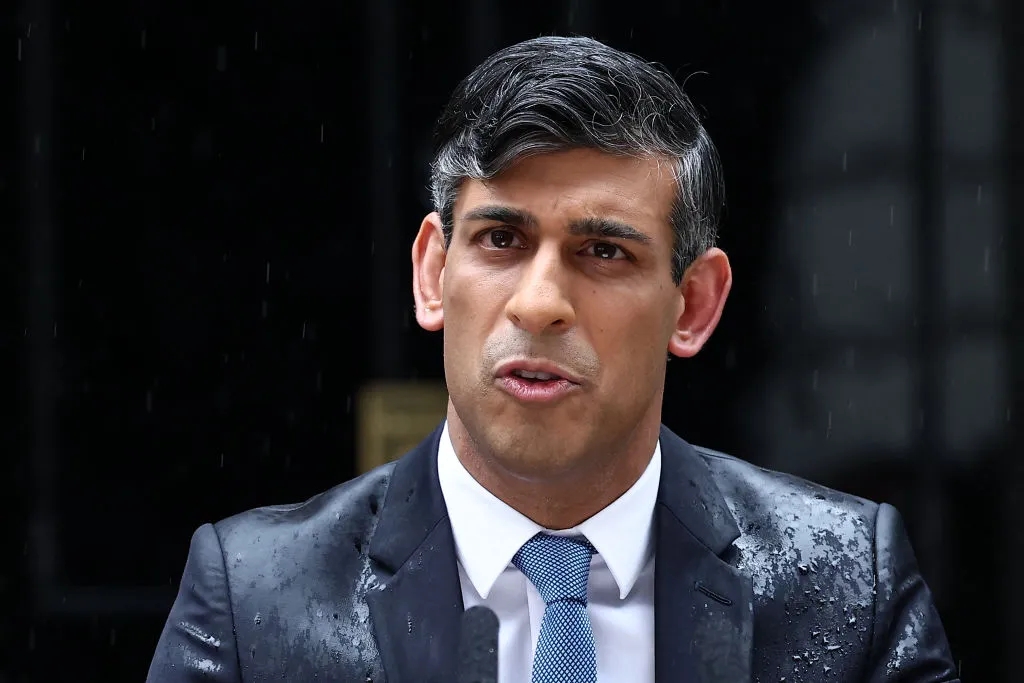
In what came as a shock to absolutely no one, the Conservatives lost. Badly.

Today the corridors of Westminster felt like the first day of school. 334 new MPs have come in to get their passes working, set up their email and find a desk. A couple of freshers nervously asked if they were allowed on the red carpet/ the House of Lords end (they are). Many were walking around steering in awe at the statues and artwork and excitedly looking around the Commons.

The election result was a massive swing against the Tories. 121 MPs will be the lowest number of Conservative MPs elected in the party’s history. Labour is by far the largest party and will govern with a majority of 172. Below are the full results showing the results for all MPs and parties elected:

PartySeatsSeats (change) Total VotesShare of the Vote
Labour412+2119,704,65533.7%
Conservatives121-2516,827,31123.7%
Liberal Democrats72+643,519,19912.2%
SNP9-39724,7582.5%
Sinn Fein70210,8910.7%
Independent6+6564,2432.0%
Reform UK5+54,117,22114.3%
Green4+31,943,2656.7%
Plaid Cymru4+2194,8110.7%
DUP5-3172,0580.6%
SDLP2086,8610.3%
Alliance Party10117,1910.4%
UUP1+194,7790.3%
TUV1+148,6850.2%
The 2024 UK General Election results

In 2019, Labour received 10,269,051 votes and won just 202 seats. In 2024, Labour received 9,704,655 votes but won 412 seats. In 2017, Labour won 12,877,918 or 40% of the vote, compared with 33.7% of the vote in 2024.

I will come back to the elephant in the room, the lack of proportionality in the First Past the post-electoral system.

The feedback on the doorstep is reflected in the numbers above. Many voters were undecided leading up to the election and unenthusiastic about either main party. When pressed, it became clear many former Conservative voters would not be supporting that party again. 2024 was the election that the Tories lost, and badly.

On the surface, 33.7% may not seem like a strong result for Labour, in terms of overall support. We need to consider some of the following factors:

  1. Tactical voting played a significant role in this election. Many would-be Labour voters living in places like Devon voted Liberal Democrat to stop the Tories. Curiously, the Liberal Democrats went from 3,696,419 votes, equating to 11.6% in 2019, whereas on Thursday their total votes went down to 3,519,199, but due to lower turnout, this equates to 12.2% of the vote. The Lib Dems now have 71 MPs, instead of the 8 they got in 2019.
  2. The voter coalition built by Jeremy Corbyn’s Labour in the 2017 election of younger progressive voters, has now moved to the Greens. On Thursday the Greens received 1,943,265 votes equating to 6.7% of votes cast. In 2019, the Greens received 865,715 votes or 1.1% of the vote.
  3. In New Zealand or other countries with more proportional voting systems, it is common to look at the centre-left and centre-right bloc rather than just what the parties received. Labour and the Greens together received 40.4% of the vote compared with the Conservatives and Reform who received 38%. The Liberal Democrats were largely targeting Tory seats this election. They stood on a broadly social democratic platform and made it clear that unlike 2010 they would not support a Conservative Government after the election. So adding their 12.2% to the Centre-left bloc we get to 52.6%.
  4. So while First Past the Post has produced a result that is not proportional, and in my view is an appalling voting system, a different voting system like the one used in Germany and New Zealand would have still resulted in a Labour Government (though almost certainly in coalition) and a crushing defeat for the Tories.

The UK Electoral Reform Society have put together modle showing what the result would have looked like using the Additional Member System used in Scotland and Wales:
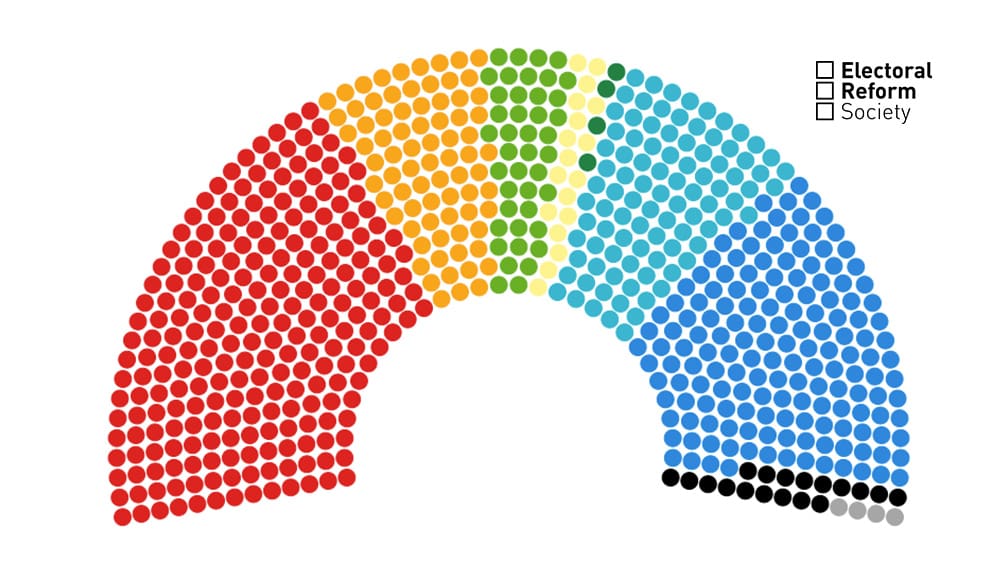
https://www.electoral-reform.org.uk/how-the-2024-election-could-have-looked-with-proportional-representation/

The problem with this is that if there were a different voting system, people would likely not vote the same way.

The broader problem with the proportional representation debate in the UK is they tend to advocate only specific alternative voting systems like AMS or AV. This election result will rightly see more people call for proportional representation. Just as New Zealand did before changing voting systems in 1993, UK voters need the opportunity to explore all viable alternatives to First Past the Post.

Those who blame the rise in Reform for the Tory Party’s misfortune need to look at the bigger picture. In 2015 UKIP, Farage’s old party, received 3.8 million votes compared with Reform’s 4.1 million last week. While Farage’s new political vehicle certainly cost the Tories votes in key marginals, there is evidence of former Labour voters also switching to Reform.

The Conservative Party lost because their vote went from 13,966,454 votes or 43.6% in 2019 to 6,827,311 or 23.7% in 2024. The number of people who voted Tory halved in just five years. Why? Their response to the pandemic, party-gate, the Liz Truss mini-budget and their failure to manage the small boats crisis in the channel. They were terrible at managing the economy allowed public services to decline.

In terms of the two major party’s vote share, in 2019 the Labour and the Conservatives together received 75.% of the vote, and in 2017 82.3%. Last week the two combined received 57.4% of the vote.

One feature in this election is the 6 independent candidates, many of whom ran on the issue of Gaza. In one case it caused former Labour front-bencher Jonathan Ashworth to lose his Leicester South seat. Other senior Labour MPs such as Wes Streeting or Jess Phillips saw their majorities reduced drastically as many Muslim voters abandoned Labour for Independent candidates, or refused to vote. Starmer’s Labour Party was initially reluctant to call for a ceasefire in Gaza. Had there not been a significant swing against the Conservatives, Labour losing support from large sections of the British Muslim community could have been very damaging.

Former Labour Leader Jeremy Corbyn was also elected as an Independent MP in Islington North. Again, his position on Gaza was a factor in Corbyn’s success.

In Scotland, support for the embattled Scottish Nationalist Party (SNP) collapsed. Labour now has 37 of Scotland’s 57 seats, compared with one seat in 2019. It would be a mistake to view this as a collapse in support for Scottish Independence as a cause. A Norstat/Sunday Star Times poll published just a fortnight ago found that 47% of Scots still support independence, while 47% support staying in the union. Other recent polls on Scottish independence have also been quite close. The election result, rather than spelling the end for Scottish Independence, instead may result in the SNP being the main political vehicle for this cause.

In Northern Ireland, Sein Fein won the most seats. This is consistent with the most recent Stormont and local government elections in Northern Ireland. The decline of the Democratic Unionist Party post-Brexit has in part fuelled division on the Unionist side with two other rival parties challenging them.

Wales no longer has any Conservative MPs. Labour has controlled the Welsh Senedd since it was created in 1999. Despite the recent scandal surrounding Vaughan Gething the new Welsh First Minister, Labour continue to dominate politics in that nation.

This was a change election. Not only is there a new Government, but politics will be different. After this election, there are 264 women MPs, a record in Westminster. The Cabinet will also have more women than any before it. There will also be more MPs from ethnic minority backgrounds, though there is some concern that this diversity is not fully reflected in the cabinet.

Britain has been in decline in recent years. It will be difficult for the incoming government as they inherit a poor economy, crumbling public services and a country whose standing internationally has diminished considerably since Brexit. It is no wonder voters lacked enthusiasm during this election.

For Labour, the next five years will be an opportunity to show the country they can be trusted with power. Things will be tough and any honeymoon could be short-lived. That said, voters will take time to forget, let alone forgive the mess left by the previous Conservative administration. While people may not yet be enthusiastic about Labour, they can could no longer stomach the Tories.
UK General Election – the mood on the doorstep

Originally published in The Standard

This past Sunday I spent a day canvassing for the Labour Party in Gillingham and Rainham – a Kent constituency where 2019 the Conservative Party candidate won with a 15,000 majority. Conservations with constituents made it clear that the Conservatives are in trouble. Like the first person I spoke with, an 80-year-old man who told me he’s voted Tory all his life but was starting to lean Labour’s way. The main thing holding him back was Keir Starmer’s promise to lower the voting age to 16. Voters having reservations about Labour but feeling utterly betrayed by the Conservative Party turned out to be a reliable theme across many doorsteps throughout the day.

Conservative Party strategists hope that lifelong Tory voters will return to them by election day. But if Conservative supporters are still betting the polls are wrong, they will get little comfort on the doorstep.

The UK still has the First Past the Post Electoral system. Something New Zealand should have absolutely no nostalgia for. This means that, while the campaign is UK-wide, a lot of campaign activity is directed into constituencies that are deemed marginal. In marginal constituencies, a General Election brings a conveyor belt of the good and the great supporting their prospective parliamentary candidate. In “safe seats” voters get much less attention. I live in Lewisham North, a part of London where Labour historically have done very well. The local Labour Party have been twinned with the Gillingham and Rainham as it is deemed that campaigning there will have a greater impact.

In the past, overturning a 15,000 majority would have seemed near impossible. But the message on the doorstep this weekend suggests this is not the case in 2024.

Gillingham and Rainham like much of Kent voted for Brexit in 2016. During the 2019 General Election, parties calling for a second referendum struggled in ‘leave’ voting constituencies. In 2024, the key issues are the economy and the cost of living, the state of public services like the National Health Service (NHS), increased levels of immigration, the housing crisis and the under-resourcing of the criminal justice system. On these issues, voters in Gillingham and Rainham felt let down, in particular those who previously voted Conservative.

Just one term ago the Conservative Party notched up the best result they’d seen since Thatcher defeated Michael Foot in 1983. The common wisdom in Labour was rolling that win back would take longer than a single electoral cycle. Yet five years later it is credible that Labour may pick up seats that had not even featured in the list of the party’s target constituencies. Recent by-elections have seen Labour overturn 20,000 Tory majorities in seats such as Mid-Bedfordshire and in Tamworth. The Liberal Democrats have also enjoyed by-election victories in previously “safe” Conservative Seats. As a result, there has been much more interest in candidate selections, especially for Labour.

Last week, these selections, and the internal disputes that accompanied a few of them, overshadowed the election campaign more generally. In the Conservative Party, many sitting MPs including quite senior Ministers are stepping down this election. The week started with outgoing Conservative MP for Telford Lucy Allan being suspended for backing a Reform UK candidate, Nigel Fararge’s latest political party. Three days later, another outgoing Conservative MP, Mark Logan made a statement saying he is backing Labour at the next general election, as the party could “bring back optimism into British life”.

This, plus the double-digit poll lead, should have meant a good week for Starmer’s Labour. Instead, the party’s campaign messages were overshadowed by infighting over selection issues as factions positioned for power ahead of the expected win

Probably the most high-profile of these stoushes has concerned Diane Abbott’s candidacy. A Labour MP since 1987 and first ever black woman to be elected to the UK parliament, Abbott is regarded by many as an inspiration and a role model. Yet last week, there was a public spat over whether she would be allowed to stand again as the Labour candidate in Hackney North and Stoke Newington. The reason for this was a letter published in the Observer Newspaper over a year ago where she said:

“Many types of white people with points of difference, such as redheads, can experience this prejudice. But they are not all their lives subject to racism.”

Abbott claimed this sentence was from a first draft of the letter but ended up being published by mistake but was suspended from the Labour caucus pending an investigation which only ended last week.

On Wednesday it was announced Abbott would have the party whip restored. However, shortly afterwards news broke that Labour’s National Executive Committee were going to block her as a candidate.

The resulting furore dominated the news cycle for much of last week. Deputy Labour Leader Angela Rayner, London Mayor Sadiq Khan and many others including the online Tory publication Conservative Home all came out in support of Abbott. It took Keir Starmer three full days to state that she should be allowed to run. Starmer’s statement was strong and praised her as a trailblazer in UK politics but its lateness cost Labour two days of election coverage it didn’t need to lose.

The set-tos about Abbott and around the selection of other, less high-profile, candidates are due to party factionalism and internal politicking. Something that is patently ill-advised so close to a General Election, and especially against such an iconic figure as Abbott. To succeed in Government for any length of time, Labour needs to build a broad coalition of support, including those on the left of the party.

Understandably, the winning faction would want their people in key positions, including in candidate selections. But long-term, to be successful in Government, people from different parts of the party need to work together. There are plenty of historical examples in both UK and NZ politics of factionalism undermining the long-term success of the parliamentary party, especially when in government.

Finally, on a more lifestyle/entertainment note, one constituency of interest in the upcoming UK General Election will be the previously “safe” Tory seat of Mid Sussex. The Labour candidate is David Roundtree, drummer for the iconic Brit Pop band Blur. Due to both his profile, and ability to fund the campaign, Roundtree may be elected next month. If elected, the mountain of constituency casework may really make him think that modern life truly is rubbish.

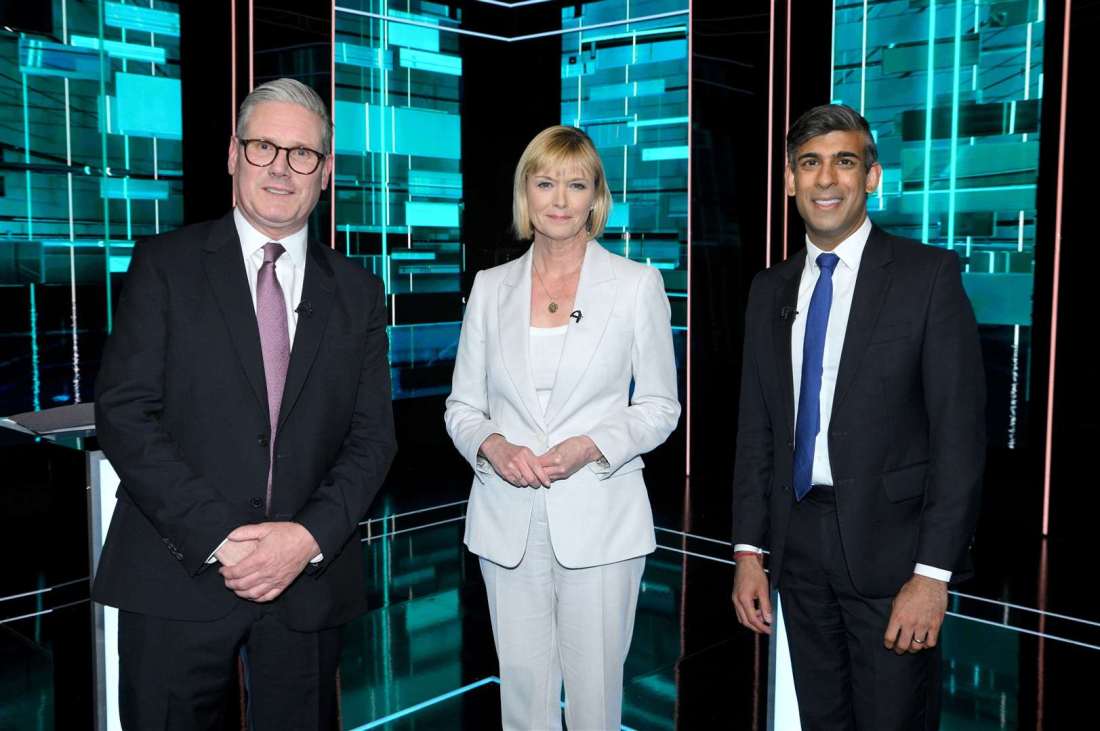
Who won the ITV Leaders Debate?

Who won last night’s ITV leaders debate? Certainly not ITV.

If undecided voters were hoping the first leaders debate hosted by ITV would enlighten them on the key issues, they would have been sorely disappointed.

The short answer quick-fire nature of last night’s debate lent itself to an environment where the leaders spoke over each other and the adjudicator at times appeared to struggle.

At certain times, the leaders were asked yes or no questions on important policy topics. Important policy questions should not be left binary yes or no.

The slightly longer 30-second answers also barely gave the leaders time to say anything of substance.

Generally, I am not a fan of going after the media. But last night, British voters were let down by the fourth estate.

In terms of which leader won the debate, a YouGov snap poll released just after the debate said 51% thought Sunak performed better compared with 49% for Starmer. However, another poll conducted by Savanta said Starmer with 44% performed better than Sunak with 39%.

In terms of who was better at interrupting the debate to repeat pre-prepared attack lines, it was Sunak. He continued his line about Labour increasing taxes by £2000, again and again. Starmer responded that this was garbage. BBC fact-checkers on Radio 4’s Today Show said the £2000 figure was based on presumptions rather than a statement of fact.

Starmer got a line in about Rishi promising NHS waiting times would come down when in fact they have gone up. He landed a similar body blow on Sunak’s promise to reduce immigration numbers when again, the numbers have gone up under his premiership. The cringe moment with Starmer is when he reminded viewers, more than once, that his father was a tool-maker.

One important area of policy that was addressed in the debate was Britain’s membership of the European Court of Human Rights (ECHR). This court is separate from the European Union and was set up at the end of the Second World War to uphold human rights in Europe. Starmer expressed his continued support for the ECHR and reminded Sunak that Conservative Prime Minister Winston Churchill had been a strong advocate for the court.

Sunak’s response was that the UK should withdraw from the ECHR. He is doing so to stop the drift of his more right-wing supporters over to Nigel Fararge’s Reform Party. It seems populism has triumphed over human rights, at least on the right of UK politics.

Only the Labour and Conservative Party leaders were part of the debate. One commentator on Conservative Home has suggested it is not impossible the Tories come third in this general election (though not likely). While these two parties have dominated Westminster since the Second World War, other parties should have been included. But given the terrible format of last night’s debate, it is unlikely viewers would have heard much of substance from them either.

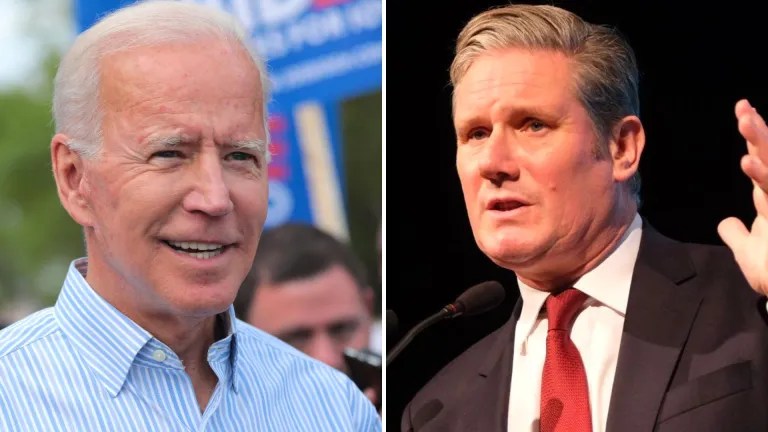
Joe Biden learning lessons from Keir Starmer?

A recent article on the Labour List authored by Ed Owen raised some interesting points about the respective elections coming up this year in the US and the UK.

The two most recent by-elections in England certainly were encouraging for Labour, as is recent polling. But we still maybe months away from a UK General Election and lots of thing can happen between now and then.

Before I delve into the various observations made in the article, there are a few key points to remember. UK Labour last won a general election back in 2005. Since then, the US Democrats have won three of the last four presidential elections. While Labour is ahead in the UK polls and has been for over two years, this is in no small part due to support for the Conservative Government collapsing.

I quote Ed Owen below:

Yet, ironically, with President Biden trailing Donald Trump – the soon-to-be anointed Republican candidate after primary victories in Iowa and New Hampshire – by up to six points in one recent opinion poll, many Democrats are now asking themselves whether they might have been in a stronger position if they had followed the experience of Labour and Keir Starmer.

While most Democrats are publicly rallying around Biden, some are privately despairing of how, through a combination of poor political strategy and personal misjudgments, he appears to have lost the confidence of a significant number of key swing voters he won in 2020.

Foremost among these mistakes, these critics allege, was the President’s willingness to indulge rather than confront the liberal left of the Democrat Party as represented by former rivals Senators Bernie Sanders and Elizabeth Warren. Both are kept close, and some of their leading advisers were brought into the administration’s ranks at its outset.

https://labourlist.org/2024/02/joe-biden-us-election-2024-donald-trump-democrats-swing-voters/

One of the great successes of the Biden campaign in 2020 was building bridges with the Sanders campaign and building what has so far been an enduring electoral coalition with the “liberal left grouping”.

Contrast this to 2016, where Hilary Clinton’s campaign failed to properly win over Sanders supporters or indeed many traditional Democrat voters. The so-called Rust Belt states such as Michigan were traditionally blue-collar Democrat strongholds but in 2016 voted for Trump, much to the surprise and upset of the Clinton campaign.

When President Biden joined the UAW picket line last year in Michigan, this was not about “indulging the left”, it was very smart electoral politics.

Contrast this to recent polling showing that support for Labour amongst UK Muslim voters has halved since the Starmer’s cack-handed response when asked if Israel had the right to cut off water and power to Gaza. Recently, New Statesmen Claudia Cokerell made the point that this, combined with many younger voters now disappointed at Labour ditching the £28bn green policy, may cost Labour quite a few votes. Though the Labour motion in parliament on a ceasefire should go someway to restoring confidence of those unhappy abour Labour’s Gaza position.

In the UK, the repeated kicking given to those who supported Corbyn and even some on the soft left of Labour is short sighted. In a post last year I wrote the Corbyn was “not fit to be Prime Minister” in reference to his position on Russia’s invasion of the Ukraine. His handling of the antisemitism issue in Labour also showed he was not capable of leading the party. But to treat anyone whose politics is to the left of New Labour as dangerous and not worthy of Labour membership or mainstream politics, is not smart and could do considerable harm in the long term.

The Tories have had a disasterous term in office, and much of their base are threatening not to vote. But Labour should not be complacent. There are plenty of examples where Labour were polling well during the term, only to lose the General Election. If polls narrow Labour needs to build a strong coalition of progressive support to win.

Ed Owen then goes on:

Trashing your party’s record in office is bad politics

Yet, despite serving as Vice President for eight years in the Obama administration, Biden has often appeared to side with the Warren/Sanders worldview. Indeed, only last April, National Security Adviser Jake Sullivan made a keynote speech that implicitly dumped on the economic philosophy of previous Democratic Presidents.

Trashing your party’s record in office is bad politics as Ed Miliband discovered in 2015, and PPI’s president Will Marshall agrees. “Is it really necessary to debate progressives again over Bill Clinton’s legacy?” he wrote last month. “With a vengeful Donald Trump thrashing about our political waters like a blood-frenzied shark, it seems like a distraction. What’s more, the left’s revisionist history of the Clinton years strikes me as a facile exercise in presentism – reinterpreting the past to score present-day ideological points.”

https://labourlist.org/2024/02/joe-biden-us-election-2024-donald-trump-democrats-swing-voters/

I wonder, if Will Marshall has ever reflected that the economic policies starting with Regan in the 1980s, continued by Clinton et al up to the 2016, directly contributed to the election of Trump. Exporting jobs and failing to rebuild new industries like in Michigan or Ohio. Might this have led to populist Trump winning the electoral college in 2016…maybe?

In terms of trashing the legacy, the Bill Clinton Presidency ended 23 years ago. Nearly a quarter of a century on, we have hindsight and perspect to see what the impact of policies from that time. Also, the reason progressive raise the Clinton legacy is because many in the Democrats think that these policies and strategies would still be successful now. Just as too many in UK Labour continue to use the 1997 election as the playbook for 2024 – ignoring some fairly major economic and social shifts that have taken place since.

It is not trashing the Legacy of either Clinton or Blair, to say that things should be done differently now. By that measure, were the legacies of Roosevelt or Attlee being trashed in the 1990s? The reality in politics is that you constantly need to adapt to the times. It is not the 1930s or the 1990s, though important lessons can be learnt from both.

Ed follows up with this:

Biden’s critics argue, that having been elected in 2020 as a bipartisan President (not least winning votes from Republicans and independents who could not stomach another Trump term), he has too often sought to govern in a partisan way driven more by a desire to avoid being attacked from the left than from the right.

“Keir Starmer has shown that when you stand firm with the concerns of real voters and take on the minority interests pursued by the left, you win the public’s trust and confidence,” one centrist Democrat observed recently. “This was a lesson we had to learn through the 80s and 90s but is one that appears now to have been forgotten.”

https://labourlist.org/2024/02/joe-biden-us-election-2024-donald-trump-democrats-swing-voters/

A bipartisan President? Really? Biden won the Demcratic nomination in 2020. Yes he did win support of voters who may have previously voted for different party’s, including some who had previously voted Republican. Yes, Trump has taken the Republican Party in different direction from the days of Regan and both Bush Presidencies, meaning moderate Republican’s now have not political home. But the programme of Biden and the Democratic Party should not just pander to this group. It is no good saying oh well liberals/the left will vote for us anyway, only to get angry when a few million people for a Green candidate in a close election.

Since becoming leader, Starmer has helped lift support for Labour. Under his watch, Labour have been calling out the failures of the current Government, including Party Gate, the Liz Truss Mini-Budget and the failed Rwanda Refugee policy. Again though, Starmer is yet to win a general election. Yes there have been some positive polling numbers, but we are yet to see much in the way of detailed policy from Labour as yet.

Biden has not been seen to be addressing voters’ key concerns

This strategic weakness has been compounded by what many see as Biden’s unwillingness or inability to address or connect with voters on the key issues of the day, notably the cost of living and immigration.

High inflation has undoubtedly hurt the administration and, while there have been significant falls in the last months, there are fears that long-term, transformational measures such as the Inflation Reduction Act – which invests more than $600bn into the clean energy transition – come at a time when many swing voters believe that public spending needs to be reined back, not least after the significant increase in government intervention during Covid.

https://labourlist.org/2024/02/joe-biden-us-election-2024-donald-trump-democrats-swing-voters/

High inflation and the cost of living has hurt governments around the world. Most incumbant governments have struggled in recent years. One example being New Zealand where Labour went from 50% of the vote in 2020 to 25% in 2023. Is it that Biden has not connected with voters on key issues, or is it that it takes time for policies to take effect, especially when the world economy is so unstable.

Biden has been a strong performer in terms of passing legislation. I was previously somewhat skeptical on Biden, but his list of achievements in office has been impressive. Not least of these was the Inflation Reduction Act, which pumped billions into clean energy and other US infrasture in desperate need of investment. These projects take years to roll out, but will no doubt be an incredible legacy of the Biden administration. Should Biden not have pushed to get this Act passed because some swing voters in a focus group said they don’t like the government spending money. Governing is about leading. It is about making the tough calls that need to be made. If we are serious about tackling climate change, or to invest in the economy and help people in the medium to long term.

Reining back spending at times maybe necessary. But not if it will do more long term harm than good. Those who have concerns about the levels of spending from the Inflation Reduction Act, may later reflect that ultimately it helped the US economy. Leadership is about having courage and doing what is needed.

Similar questions are being raised within the Labour leadership about the party’s £28bn green investment commitment. As a keen observer of US politics, Rachel Reeves has seen how Bidenomics has failed to land effectively with the American public since her very public embrace of the President’s economic policies when she was in the US in May last year.

Immigration continues to be a major public concern too, with “encounters” on the US-Mexico border last year numbering 2.5 million – the highest level for more than 20 years. As with higher prices, it’s an issue that a President who prides himself on understanding the concerns of middle America has been oddly detached and absent from.

https://labourlist.org/2024/02/joe-biden-us-election-2024-donald-trump-democrats-swing-voters/

To paraphrase Limp Bizkit’s Full Nelson, their mouth was writing cheques that their ass could not cash. When Labour announced their £28bn green investment pledge in 2021, it was quite clear that the global economy was not doing well as it emerged from the pademic. Yes, it is certainly worse now after the Liz Truss Mini Budget. But back then it was clear making a bold spending promise would be a challenge. Labour should not have announced the figure back then, especially if it couldn’t hold its nerve and see it through.

Bidenomics, as Ed Owen terms it, has not failed to land. Rather, the Biden administration has like all governments struggled with the economic situation. Recently this has resulted in not so great approval ratings for Biden. This is what happens in Government. Labour are not in Government, and have not been since 2010. The lesson Rachel Reeves should be taking from this is that being in power means making tough calls, which at times may reflect in polling numbers. A strong leader will ride this out.

The point about immigration in the above is important. Rightly or wrongly, in difficult economic times public opinion tends to shift swiftly against immigration. In both the UK and the US, significant sections of the economy rely on migrant workers. But it is a policy area where the right, especially the populist right of Trump, will attack progressive governments. When they do, progressives need a strong response.

Biden’s experience shows the challenge ahead for Starmer’s Labour

There’s still nine months to go until the US elections, and the combination of a strong and improving economy and Trump’s legal battles offers hope to Democrats that they can still win a second term with Biden.

But, after four days speaking to Democrats on the Hill and in the state legislature of Virginia, the visiting group of Labour PPCs returned to the UK both with a stark view of the task ahead for the Democrats and a renewed sense of purpose of what is required in the UK.

“Looking at US politics is pretty sobering for anyone tempted to get carried away about Labour’s poll lead,” said Kirsty McNeill, the party’s candidate in Midlothian. “The President’s colossal policy achievements are not translating into political support and our US trip was to help us work out why.

“The main conclusion I’ve drawn is that winning the election means getting to base camp – scaling the mountain of getting sustained support for our ambitious missions is the actual task. Keir’s reminders we should have zero complacency about the ease of either winning or governing in these conditions was brought into sharp relief in DC.”

https://labourlist.org/2024/02/joe-biden-us-election-2024-donald-trump-democrats-swing-voters/

There is still nine months to the US election. In that time the economy may improve, and the policies of the Biden administration should help that. There is still a strong possibility of Biden winning a second term, and indeed of the Democrats taking back Congress.

Trump needs to be defeated politically, with another overwhelming popular and electoral college vote against him and for Biden and the Democrats. While it is understandable the desire to prosecute Trump for his various crimes, to Trump’s base the legal campaign is further proof of the utterly false claim that he is being pursecuted by the establishment.

US politics is always very sobering. In earlier blog posts I have highlighted the many limitations of the flawed US political system. Biden has got as far has he has by having a programme, and by building a coalition of support which includes those on the left of the Democrats.

For Labour, if they win in 2024 it will be a difficult term in Government. In many ways they are right to under promise and possibly over deliver later if the economy improves. Labour needs to win over the trust of voters, and this includes voters on the left who may still be deciding whether to vote Labour.

UK Labour – can they finally beat the Tories?

Labour in the UK currently has a double-digit lead in polls ahead of the Conservatives. The Polls immediately after the Truss/Kwarteng mini budget gave Labour their biggest lead ever, with a lead of 33% over the Tories. This has since fallen back to a 20% lead, still making Labour the strong favourites were an election to be called today. For this reason, there will be no election in the next year if the Conservatives have anything to do with it. The next election must be held at the latest in January 2025, and in all likelihood will be sometime in mid-2024. Given how terribly the Government has performed, it is hard to see how they could make it back even if the economy begins to recover.

However, just as one should never underestimate the UK Conservative Party as an electoral force, one also should never underestimate the UK Labour Party’s ability to clutch defeat from the jaws of history. It is just under two years ago that Labour under the current leadership of Keir Starmer lost the Hartlepool byelection, a so-called red-wall seat previously held by Labour since 1964. Much has happened since then but given how quickly things change in the current political climate, who knows what will be happening in 2024.

After the last UK election, I wrote a series of posts assessing why the UK Labour Party Lost. Shortly after this, a leaked report showed that factionalism was so bad within Labour that members of the Party head office tried to sabotage the 2017 election for the party as their favoured faction was not in charge. At the time few could see Labour making it back to power in 2024, with many predicting that Boris Johnson would be Prime Minister for the coming decade.

Writing those posts got me some interesting feedback. My post critical of the role of the ‘Blairite faction’ resulted in various Labour members associated with Progress and Labour First contacting me to say that I was obviously an insane Corbynista and dangerous. Later that day I posted another post critical of the role Momentum had played in the 2019 election, to which various supporters of the Corbyn loyal faction accused me of being a Blairite and a dangerous right winger. Whilst it was water off a ducks back to me, it showed how deeply divided and unwilling to engage all factions were at that time.

Starmer was elected Leader of the party in April 2020 having run on a platform of trying to bring the factions together. Specifically, Starmer’s campaign would continue the popular policies from Labour’s 2017 manifesto would be the ‘basis of the Party’s ‘foundational document’ for policy under his leadership. This recognised the fact that whilst Corbyn and the Momentum faction supporting him had become quite unpopular, the social democratic platform Labour ran on in 2017 was popular, more so than the party in itself. Now, in 2022, Starmer has said this document is being put to one side and instead the party will be “starting from scratch” leaving many to ask, what will Labour’s next policy manifesto look like?

The backdrop of course is the coronavirus pandemic and the economic chaos it has caused, followed by the Russian invasion of Ukraine. Added to this is the economic ineptitude of the Truss and Kwateng mini-budget has meant the UK find itself in a very difficult economic situation. The challenge for Labour now, is that it needs to be seen both as credible economic managers who can repair the damage caused by the current government, yet also present a programme that addresses growing inequalities. In particular, it needs to address the fact that most people under 40 in the UK are now significantly worse off financially than their parents were at that age. The younger voters who supported Labour in the 2017 ‘youthquake’, who were disproportionately disadvantaged after the last decade of austerity, are looking to the opposition to address the growing inequalities and to create a new social contract that works “for the many, not the few.”

It is not clear how the current Labour leadership will address this, with the prevailing thinking in the party now being that people on the left have nowhere else to go, and the priority for Labour now being to win former Tory voters over. The risk is that younger voters and voters on the left become disillusioned and stay at home, or cast a protest vote for The Greens or some other candidate. This may not seem a problem now, but if polls begin to narrow by 2024, stay-home or protest-left votes in a First Past the Post electoral system could be fatal in marginal constituencies.

The current Labour leadership wish to put as much daylight as possible between the Party now and the Corbyn years. This has meant distancing themselves from some of the more popular parts of the 2017 manifesto, including public ownership of rail, energy companies and other public services, despite most party members and the British Public favouring nationalisation in this area. Starmer and shadow chancellor Rachel Reeves have said such policies do not stack up against the Party’s fiscal rules. This could create tension for a future Labour Government. Internally, the Government would be fighting both the ‘soft’ and ‘hard’ left on these issues. Also, many voters, not only those who vote Labour, would become frustrated if the private companies continue to profit from a rail system that’s expensive and unreliable or an energy market that forces people into poverty.

At the same time, those on the left of Labour need to accept a few hard facts. The 2019 election defeat was a devastating loss caused in no small part by missteps, poor tactics and wrong policy calls by Corbyn, his advisors and Momentum. Also, Labour may have increased its vote considerably in 2017, but despite losing seats, the Tories also increased their overall percentage of the vote and got more votes than Labour.

Jeremy Corbyn’s suspension from the party has seen hundreds of members, including many branch chairs, have their membership also suspended for allowing motions of solidarity with Corbyn to be moved. Corbyn’s comments in response to the antisemitism report were ill-advised, but so too has been this clumsy night of the long knives against his supporters in the party. The party has suspended members or excluded them from MP selecton for sharing articles from proscribed organisations, mostly socialist. In the case of one Milton Keynes Councillor Lauren Townsend, she was blocked from standing as an MP for liking a tweet about Sturgeon testing negative for Covid-19, hardly an act of supporting a political rival. Labour also expelled filmmaker Ken Loach, maker of ‘I, Daniel Blake’, again for associating with proscribed organisations rather than actually belonging to them.

Corbyn has done himself absolutely no favours with his frankly idiotic position on Russia’s invasion of Ukraine, calling on the west to stop arming Ukraine and aligning with the Stop the War coalition’s position which appears more critical of NATO than Russia. This has now made it very easy for Starmer’s team to say that Corbyn will not have the whip restored. The left has now spent two years wasting energy trying to defend Corbyn and campaigning for him to get the whip restored. This absolutely plays into the hands of their opponents who now have good reason to expel leftists for not showing solidarity with Ukrainians.

Compare this to the US Democrats where Jo Biden’s former rival Bernie Sanders is now chair of the Senate Budget Committee, and a clear pact was made between the left and the moderate factions of the party to help beat Trump in 2020. Electoral politics is about building coalitions. The left in the UK needs to accept they alone do not have majority support and need to work with what they term the “soft left” and more centrist factions to win. The current Labour leadership need to ensure that the left still has a stake in Labour winning, and give enough to motivate the left to vote and campaign for Labour. In 2020 the Democrats learnt the hard lessons from 2016 when Sanders supporters were shunned by Hillary, resulting in many not supporting her campaign after the primaries and ultimately allowing Trump to win. In 2020, the Biden campaign made sure the left had a stake in a Democrat victory, and it paid off.

The fact is that to win elections, especially in a First Past the Post electoral system, a party needs to build a coalition of support. In 1997, UK Labour was able to build a coalition which in addition to the people who’d supported it throughout the Thatcher years, voters who’d supported the Thatcher project and its broad economic programme, but by the mid-1990s wanted something new, more socially liberal and slightly more moderate economically. This coalition held for three elections, but in 2010 many from this group of voters had drifted to the Lib Dems under Nick Clegg or back to the Conservatives under David Cameron who promised a more socially liberal and compassionate conservative party.

Starmer and the faction around want to build back the same coalition of voters they had in 1997. The problem is 25 years later, which included a decade of austerity, the voter demographics are more polarised and complex. The Conservative Party in 2022 has been forced to abandon Thatcher economics that Truss and Kwarteng tried to resurrect from the dead, and instead are now raising taxes, including for top income earners. The so-called centre-ground in politics is not the same as that in 1997. In fact, the term ‘centre’ is lazy political shorthand as if voters are easily categorised into ‘left’, ‘right’ and ‘centrists’ the latter swinging between the two and acting as king-maker. It has always been more complex than this, with people being more socially conservative on certain issues or economically liberal on others. The Brexit debate cut right across the old political divides with people across the spectrum, across class devices and cultural backgrounds being completely divided on the issue. A working-class voter in Hartlepool was not considered a swing voter until very recently, nor was an upper-middle-class voter in Kensington. Yet in the 2020s these voters will be part of the much larger ‘swing vote’ that will decide the next government.

Then there are the four nations of the United Kingdom. The majority of UK voters live in England, so inevitably this is where elections are won and lost. Historically, Labour has performed well in Scotland and Wales, with Northern Ireland having its own difficult history and different parties. Labour still performs well in Wales, having controlled the Welsh Senate since its creation in 1999. The 2021 deal between Welsh Labour and the Welsh nationalist party Plaid Cymru has been clever in securing broad support of support within the devolved government there.

The situation in Scotland is nowhere near as rosy. Traditionally, Scotland was a Labour stronghold, yet in the 2019 election, the party won only one seat up there. The Scottish National Party (SNP) have controlled the Scottish Parliament since 2007. There was a small amount of comfort for Labour in the 2022 local council elections where Labour came second to the SNP, but still a long way behind. Even the polls showing Labour with a 33% lead over the Tories nationally, had Labour was far behind the SNP in Scotland. Whilst support for independence hovers around the 50% mark in Scotland, it is consistently higher now than during the last independence referendum in 2014. The SNP have been clever to build a coalition of former Labour left voters and Scottish nationalists including some from the centre-right. By contrast, the various deals being done by Labour with the Conservatives and Lib Dems to stop the SNP risk doing more long-term harm to Labour’s chances in left-leaning Scotland.

For Labour, the strategy to win not only the next election but to start winning more often in the UK is to win over more English voters, as over 80% of the population live there. English voters have traditionally been small ‘c’ Conservative and large the ‘C’ Conservative Party usually do well, especially in the South outside of London. A wholesale return to Corbyn’s era politics is unlikely to shift this. In the short term, Labour with more of a 1997 flavour may win the next election, but it is not 1997, and very soon voters will grow restless.

English voters might be conservative but may see the need for economic reform so more people have opportunities. They will expect serious government interventions in housing, employment, education and transport. Already we have seen a Tory Government partially renationalise the railways, increase taxes to fund social care and lift Univeral Credit (the UK’s universal benefit), things the Tories would not have considered in the 1990s. The fact is society has changed. And in politics. you need to adapt. Traditionally the Conservative Party are much better at this than Labour. Whilst the Tories will probably now lose the next election, but, the size of their loss and Labour’s win will determine how long they spend in opposition. For Labour, winning more often will require nuisance and being adaptable. Yes, learn the important lessons from 1997, but know that times are now different and so too are policies and tactics. The left may not be strong enough to win, but they are still too big a block now to ignore and are more significant than in the 1990s. Like the Biden campaign, Starmer’s team will need to give the left something that means they can at least give grudging support. In turn, the left need to accept that a few important gains are better than none at all and the great cannot continue to be the enemy of the good or even the ok-ish.

The next election could well go to Labour, or at least be lost by the Tories due to their ineptness at running the country in the last few years. Labour’s internal problems have not gone away, it is just that the Conservative Party’s internal issues are now a lot worse and unusually for them have been aired in public. The opportunity for Labour is to build a winning coalition that helps them win not just the next election, but to start winning more than they lose.