An antimissile system targets an Iranian aerial attack on Israel 14/04/2024
This attack was in retaliation for the Israeli bombing of the Iranian consulate annexe building adjacent to the Iranian embassy in Damascus, Syria,killing 16 people. This was part of Israel’s broader campaign to target Hezbollah assets in Syria since 2011. This has escalated since October 7 2023 and the intensified conflict between Hamas and Israel.
In October I described the attacks by Hamas on 7 October as horrific and appalling. I went on to say:
Hardliners in both Israel and Palestine are in control, which makes the prospect of peace or a lasting resolution to the conflict in the region seem a distant prospect at this stage. Whether it is a two-state solution, a one-state solution with power sharing, or some other construct, there needs to be a way that Israelis and Palestinians can live in peace. Until this happens, this conflict will destabilise not only the Middle East but the whole w
This conflict has indeed now escalated and the region is increasingly unstable. This is the first time that Iran has directly attacked Israeli territory. US President Joe Biden has told Israel that it will not participate in a counter-strike against Iran. However, Netanyahu and his hard-line coalition have ignored similar wise words of caution from the US in recent weeks. If Israel does respond, Iran has already signalled there will be further retaliation.
Since the 7 October attacks, Israel has argued that it has a right to defend itself. Israel does have this right, but it also has a responsibility to comply with international law and to the human rights of people living in Gaza. Israel also has a responsibility to stop the settler attacks in the West Bank, which have intensified since the 7 October 2023 attacks. It has a responsibility not to escalate violence by attacking Rafah, again something Biden has warned Israel against.
The South African Government has taken the Israeli Government to the International Court of Justice (ICJ), alleging that Israel is responsible for violations of the Genocide Convention in respect of its actions taken in Gaza. While it will likely be years before any decision is made by the ICJ, there is growing evidence that Israel has attacked hospitals and other civilian targets.
Historically the US Government has been Israel’s strongest ally, under both Democrat and Republican Presidents. Therefore it is no small thing that in a recent UN vote calling for an immediate ceasefire in Israel-Gaza, the US abstained rather than using their power of veto. Many supporters of Palestine and those on the left have been critical of the Biden Administration over its response to the Gaza conflict. In reality, Biden has pushed back on the Netanyahu Government much harder than his predecessors. Unfortunately, the response of the Israeli Government to the horrific attacks by Hamas on 7 October has escalated the violence and has now drawn Iran into active conflict against Israel.
Israel should not have bombed the Iranian consulate buildings in Damascus. Iran should not have fired 300 missiles at Israel in response. Neither of these actions should have happened, but they now have. The world now watches to see if there is further retaliation and escalation of violence, or if calmer and wiser heads prevail.
The prospect of peace or a lasting resolution to the conflict in the region seems more distant than ever. But only by doing everything possible to achieve such an outcome will there be any chance of this conflict de-escalating and a lasting peace being achieved.
In an episode of The Rest is Politics recorded shortly after 7 October, Alastair and Rory interviewed historian Yuval Noah Harari who had family caught up in the Hamas attacks on Israel. During this interview, Yuval rightly said that for people living in places like London instead of taking a side in this conflict, we need to be seeking long-term solutions to this conflict. I do not claim to have these solutions. But as a first step, an immediate ceasefire and a return to peace talks is an essential first step. By contrast, any escalation in this conflict will do untold harm both in the region and globally.
On Sunday 30 October, a watershed run-off election was held in Brazil where former President Luiz Inácio Lula da Silva (Lula) narrowly defeated incumbent President Jair Bolsonaro 50.9% to 49.1%. There was a lot at stake in this election, not least the lungs of our planet, the Amazon forest. In the four years of Bosonaro’s presidency, more than 34,000 square km of the Amazon rainforest disappeared. The return of Lula to power in Brazil certainly will not fix everything, but another term of Bolsonaro would have been a devastating defeat in the fight against climate change.
On Tuesday 8 October, another critical election will take place, this time in the northern part of the Americas, the United States midterms where control of Congress and Senate will be determined, along with elections to State Legislatures and for State Governors.
Historically there are two common trends with mid-terms:
Turnout is significantly lower than in presidential elections
The party with control of the White House usually performs poorly
On point one, turnout has historically been lower for midterm elections. For example, in 2008 President Obama on a platform of hope won by a significant margin with a voter turnout of 57.1%. Two years later in the 2010 midterms, voter turnout was just 40.9% and the Republican Party took back control of Congress. This was at the height of the Tea Party movement pushing the Republican Party to the right. Much of Obama’s “hope” agenda was blocked by this newly energised rabid right-Republican Congress. Had everyone who came out to support Obama in 2008 once again returned to the polls 24 months later (and 22 months after his inauguration) he may well have achieved more.
But this is the second point, whichever party controls the White House, tends to do poorly in the mid-terms. The exception to this was President George W Bush in 2002, who the September 11 Terror attacks were able to keep control of both houses, a situation that continued until his second mid-terms in 2006. Most other Presidents, Regan, Bush Senior, Clinton and Trump all lost midterms to the other party.
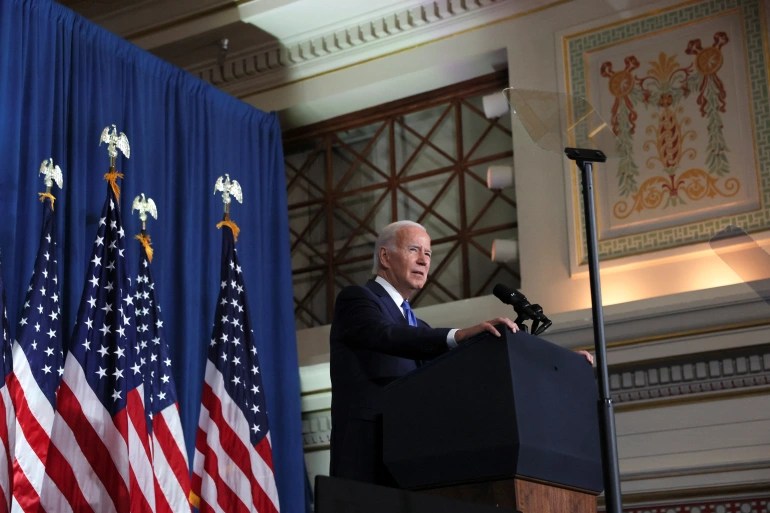
President Biden “Make no mistake, democracy is on the ballot for all of us”
The US Constitution is designed so that the Legislative, Executive, and Judicial branches of the United States government are kept distinct in order to prevent abuse of power. Whilst there is much wrong with the US Constitution, the theory behind the separation of powers is a good one. The problem is, in a First Past the Post two Party system choices are limited. The temptation is to give whichever Party is not in control of the White House control of the Legislature as a check and balance. But what if that other Party ignored scientific advice during a pandemic causing death and misery to millions? What if this other Party is anti-democratic and refuses to accept it lost the previous election and encourages its supporters to turn to violence? What if, rather than being the ‘Grand Old Party’ of the Conservative American right, the Republican Party of 2022 has become a Party of deranged Trumpians where truth and evidence are out and hate-fuelled rhetoric is in vogue? Is allowing a party like this to control the legislative branch of government, either by voting for them or by staying at home really preventing “abuse of power”?
The Judicial branch of government should of course be separate from the Legislative and Executive branches, but is this really the case in the US? The decision in June 2022 to overturn the 1973 Roe v Wade Supreme Court decision, which legalised abortion throughout the United States, was the result of Republican Presidents appointing socially conservative judges and Republication Legislatures doing their best to block Democrat Presidents from appointing liberal ones, as Republican Senators did in 2016. Despite the fact that a majority of Americans oppose the decision to overturn Roe V Wade, manipulation of the constitution by the Republican Party has meant the Supreme Court has a socially conservative majority which can be used to undermine abortion rights in the US.
It is easy to be dishearted by the US political system, indeed I have previously argued in relation to Gun Control the following:
The United States is further held back by a Constitution that is cumbersome and difficult to change. Trying to bring about any sort of serious change to allow Gun Control in the US, something that polls suggest a majority of Americans support, would require a change to the Second Amendment of the US Constitution. How can the US Constitution be changed? It requires 2/3 support for a proposed constitutional amendment in both the Congress and Senate (see above about how these houses are NOT representative). On gaining this, it then needs to be approved by the legislature of 34 of the 50 US states and then ratified by 38 of the 50 states (again the smaller conservative states get a much greater say than larger ones). A full explanation of this can be seen here.
In the above article I went on to mention Trump appointing anti-abortion Supreme Court Judges and that with the “country’s highest court is so clearly partisan, again a system protected by the constitution means one can have little confidence in this country’s justice system.”
Yet, as flawed and in desperate need of reform as the US political system is, it is still paramount that all eligible voters turn out to vote. The initial response from US voters to the Supreme Court decision appeared to be a backlash. In traditionally Republican voting states of Alaska and Kansas, Democrats made surprise gains. The coming mid-term elections could be an opportunity to send this message on a national level, but polls suggest there are several senate races which are tight and there is a projected national swing to Republicans. Of course, like all elections, there are many factors at play, but turnout will be a significant factor.
As already explained, mid-term elections generally go against sitting presidents. In the case of Biden, he faces low approval ratings due to the state of the economy, which is hurting incumbent governments globally and the lingering backlash from withdrawing troops from Afghanistan. Biden has a track record of being gaff-prone, often making silly comments and going off script. But in terms of delivery, in the last 22 months, the United States Government has done surprisingly well. Since January 2022, Democrats and the Biden Presidency have achieved the following
Rolled out the $1.9 trillion COVID relief deal, rolled out the COVID vaccine and got control of the virus unlike Biden’s inept predecessor
Got both Congress and Senate to approve the $1.2 trillion infrastructure package which drastically increased investment in the national network of bridges and roads, airports, public transport, national broadband internet, as well as waterways and energy systems.
Made serious commitments to stopping climate change and unlike his predecessor ordered all government agencies to immediately halt the financing of new international carbon-intensive fossil fuel projects, and instead work towards clean energy use.
Has reduced the US unemployment figure from 6.3% under Trump to 3.9% today.
The current cost of living crisis and high inflation are hurting the American people, and it is understandable that there is anger at the US Government and the political and economic system that has allowed this to happen. But allowing the Republican Party, in its current state to control the Legislative branch would be a terrible mistake.
Last week Nancy Pelosi’s husband was the victim of a violent attack, a symptom of the increasingly volatile mood in the United States. The intended target of the attack was Nancy Pelosi, the Speaker of the House of Representatives, something that should be quite shocking to anyone who supports democracy. The response from the Republican Party was a mixture of silence, baseless conspiracy theories or in the case of Donald Trump Jr, mockery.
These are deeply troubling times and the stakes could not be much higher. Mid-term elections are a time to send a signal. In response to Russia’s brutal invasion of Ukraine, Trump has described Putin’s actions as an “act of genius.” In light of this, what message does it send voting Trump-aligned Republicans in charge of Congress? Trump continues to deny he lost the 2020 election, or accept responsibility for his part in the violence on Capitol Hill on January 6 2021, should people who condone these actions be given a majority in the Senate? Given the recent decision to overturn Roe V Wade, should Republicans be allowed to control many state legislatures and block women’s right to choose?
At a campaign event last week President Biden said that in these mid-term elections “democracy is on the ballot”. This is absolutely true, and the outcome will be decided by those who show up to vote.
Two weeks after one of the most tumultuous elections in US history it is now clear that Joe Biden has won. This was not clear on election night as much of the in-person vote favoured Trump in key swing states. But as the postal votes came in it became obvious that in Arizona, Pennsylvania, Wisconsin, Nevada and Michigan were going with the Biden/Harris ticket. Whilst traditional swing states of Florida and Ohio went to Trump this would not be enough for him to get the required 270 electoral college votes to win.
My previous post outlined the importance to America and the world of a Trump defeat in these elections. It also outlined the many limitations the US political system put in place to make much needed political, social and economic reform in that country difficult (though not impossible). It also highlighted the absurd electoral college system that twice this century has allowed a presidential candidate who received fewer votes than their opponent to win the presidency. The 2020 election could well have been the third such election based on election night results, but postal ballots make it clear that Trump is on his way out. In an election where one of the main dividing issues now is whether or not to believe science, those worried about COVID-19 were more likely to postal vote and thus these votes were more likely to go to the Democrats.
Trump is mounting a legal challenge to the election result claiming the election was rigged. In many cases, the state authorities running the ballot system were under the control of the Republican Party. Trump is unlikely to succeed in any of his legal challenges and even if he does this will unlikely result in him gaining the required 270 points to win. There is little chance of a repeat of the 2000 Presidential election where the Supreme Court ordered the recount of votes in the State of Florida to stop, a disgraceful chapter in the history of US elections and one which exposed how flawed the US system really is.
In 2016 Donald Trump received 62,984,828 votes nationally. In 2020 his national vote increased to 71,927,381. Biden’s apparent victory was down to increased voter turnout nationally and specifically increased turnout and in the swing states listed above. When looking at the results in both Congress and Senate, the Republicans have reduced the Democrats’ majority in Congress, and the Senate is now split with Republicans only losing one senate race last week and now having a runoff election in January 2021 which will decide which party has control of the upper chamber.
The projected ‘blue wave’ that many pundits predicted (and this author hoped for, but did not expect) did not eventuate. There are plenty of possible explanations for this but ultimately it comes down to the simple fact that support for Donald Trump and indeed for the Republican Party did not collapse in 2020. If anything, the Republican Party held the line with their base and even won some new support despite a woeful mishandling of the pandemic and having a President who was blatantly dishonest and self-serving. This is disappointing, but not at all surprising. Trumpism did not just come out of nowhere, and nor is it likely to disappear anytime soon.
The election for Congress saw the Republicans reduce the Democrats’ majority. This was probably the Democrats greatest failure this election, given they only gained control of Congress two years earlier in 2018 and already their grip on power here is slipping. This is reminiscent of 2006, where Nancy Pelosi led the Democrats to victory during the Mid-terms as President George W Bush’s popularity was waning. By 2010 the Democrats had lost control of the House in Obama’s first mid-term. Despite the loss, Pelosi remained the Democrat leader in Congress, and in 2018 became the speaker once again when Democrats capitalised on anti-Trump sentiment to gain control of The House. The issue for Pelosi and the team around her in Congress is that twice they have won during mid-terms when opposition to a Republican President is strong. Now a Democrat is President, Pelosi cannot just be an oppositional figure, she and her team need to put forward a policy agenda to address the issues facing the country. Just like when Obama was elected President in 2008, Biden’s win this year is happening in the middle of a serious economic crisis. Democrats in Congress need to be offering policy solutions to this crisis. Now maybe time for new Democratic leadership in Congress that can step up to this challenge.
Nancy Pelosi tearing up her copy of Donald Trump’s state of the union speech in February 2020.
The Senate currently hangs in the balance with Republicans holding onto more senators this month than expected. In early January 2021 a runoff election will be held for the two Senator seats in the state of Georgia. The race between Biden and Trump was very close in this state which has traditionally been safe Republican. The change in Georgia was down to voter registration and turnout campaigns led by Stacy Abrams who narrowly lost the Georgia Governor race in 2018. This campaign is one Democrats should be looking to replicate nationally as it has been widely praised as successful.
In early 2018 I wrote a blog post about hope in which I said the following about the Obama Presidency of 2009 to 2017:
Obama promised hope and intended to deliver that through the US political system. The problem is that system is flawed. He gave people hope in a political system which could not deliver on the promise.
Hope – A powerful but dangerous tool, April 2018
When trying to understand US politics we need to understand that it is indeed a flawed and inflexible system. This criticism could be made of most democratic systems, but the flaws in the US are stark and very hard to shift. In another 2018 blog, I wrote about the issue of Gun Control, a prime example of where the US system, despite public opinion has successfully blocked any form of gun control for decades.
In August this year, Rolling Stone Magazine published an article by Anthropologist Wade Davies called The Unraveling of America. I would recommend anyone who has not yet read this to do so. In this article Wade outlines how the COVID-19 pandemic has furthered the decline of the United States. Wade claims that one-fifth of all COVID-19 deaths were from that country. He highlights how the United States has lost its moral authority on the world stage, citing the below example:
Trump’s performance and America’s crisis deflected attention from China’s own mishandling of the initial outbreak in Wuhan, not to mention its move to crush democracy in Hong Kong. When an American official raised the issue of human rights on Twitter, China’s Foreign Ministry spokesperson, invoking the killing of George Floyd, responded with one short phrase, “I can’t breathe.”
The Unraveling of America Anthropologist Wade Davis on how COVID-19 signals the end of the American era. Rolling Stone August 2020.
And indeed, the Black Lives Matter Movement has like COVID-19 shown the world that the United States Government is neither interested nor capable of looking after its own population. Given this it is little wonder many throughout the world no longer view it as a moral authority on the world stage. Wade also argues that Donald Trump is a symptom of the decline, rather than the cause of it.
On the morning of the US election results, the BBC Today Show interviewed former UK Foreign Secretary Jeremy Hunt. He expressed concern that an uncertain result would be used by dictators in countries like China to discredit democracy. The reality is that the United States is a poor example of a functioning democracy in 2020. The country’s widespread voter suppression, its antiquated and undemocratic voting system, its cumbersome and difficult-to-change constitution, its poor record on climate change, its institutional and systemic racism, its increasing inequality and last but not least its shocking record on the international stage of supporting dictators like Pinochet and Suharto, discredit it as any sort of moral authority. When looking for examples of modern, functioning democracies we should look at places like Germany, Scandinavian nations like Norway or Sweden, New Zealand, Canada, Uruguay and Costa Rica. Even in the United Kingdom, though in recent years has faced considerable challenges in response to Brexit and a fairly ugly General Election in 2019, not to mention a voting system that does not deliver proportional outcomes, the political culture in the UK is still much healthier and far less divisive than in the US.
This is not to beat up on the United States or to say that it does not still have the potential to play a positive role in the world. The point is that for the United States to do this it needs significant reform. Biden, even if he gains a majority in the Senate will not be able to deliver this in one term. And the level of opposition this administration will face internally from Trump/Republican Party supporters is formidable. But this too can change. In 2020 increased voter turnout stopped Trump getting a second term and may still help the Democrats narrowly win a senate majority if Georgia goes their way. Hope can be dangerous if it gives people the false idea that a broken system is ok. But in understanding that there is a fundamental problem, there is then the opportunity for real change, something which would be cause for some cautious optimism. At the very least, the more people understand the problem, the greater the chance of things improving.


 Nick Kelly