
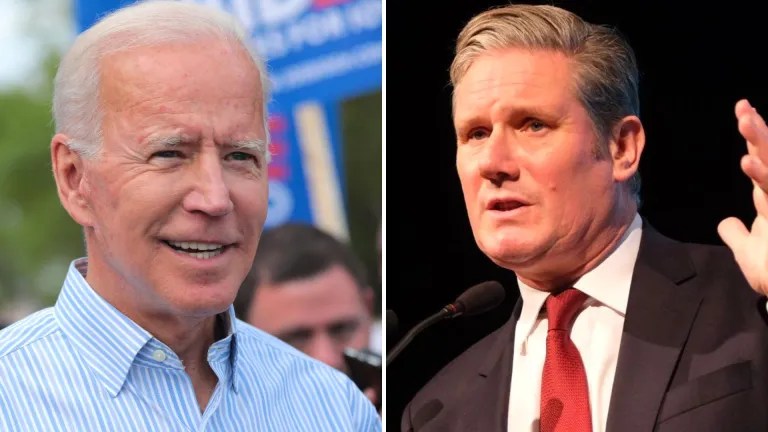
A recent article on the Labour List authored by Ed Owen raised some interesting points about the respective elections coming up this year in the US and the UK.
The two most recent by-elections in England certainly were encouraging for Labour, as is recent polling. But we still maybe months away from a UK General Election and lots of thing can happen between now and then.
Before I delve into the various observations made in the article, there are a few key points to remember. UK Labour last won a general election back in 2005. Since then, the US Democrats have won three of the last four presidential elections. While Labour is ahead in the UK polls and has been for over two years, this is in no small part due to support for the Conservative Government collapsing.
I quote Ed Owen below:
Yet, ironically, with President Biden trailing Donald Trump – the soon-to-be anointed Republican candidate after primary victories in Iowa and New Hampshire – by up to six points in one recent opinion poll, many Democrats are now asking themselves whether they might have been in a stronger position if they had followed the experience of Labour and Keir Starmer.
While most Democrats are publicly rallying around Biden, some are privately despairing of how, through a combination of poor political strategy and personal misjudgments, he appears to have lost the confidence of a significant number of key swing voters he won in 2020.
Foremost among these mistakes, these critics allege, was the President’s willingness to indulge rather than confront the liberal left of the Democrat Party as represented by former rivals Senators Bernie Sanders and Elizabeth Warren. Both are kept close, and some of their leading advisers were brought into the administration’s ranks at its outset.
https://labourlist.org/2024/02/joe-biden-us-election-2024-donald-trump-democrats-swing-voters/
One of the great successes of the Biden campaign in 2020 was building bridges with the Sanders campaign and building what has so far been an enduring electoral coalition with the “liberal left grouping”.
Contrast this to 2016, where Hilary Clinton’s campaign failed to properly win over Sanders supporters or indeed many traditional Democrat voters. The so-called Rust Belt states such as Michigan were traditionally blue-collar Democrat strongholds but in 2016 voted for Trump, much to the surprise and upset of the Clinton campaign.
When President Biden joined the UAW picket line last year in Michigan, this was not about “indulging the left”, it was very smart electoral politics.
Contrast this to recent polling showing that support for Labour amongst UK Muslim voters has halved since the Starmer’s cack-handed response when asked if Israel had the right to cut off water and power to Gaza. Recently, New Statesmen Claudia Cokerell made the point that this, combined with many younger voters now disappointed at Labour ditching the £28bn green policy, may cost Labour quite a few votes. Though the Labour motion in parliament on a ceasefire should go someway to restoring confidence of those unhappy abour Labour’s Gaza position.
In the UK, the repeated kicking given to those who supported Corbyn and even some on the soft left of Labour is short sighted. In a post last year I wrote the Corbyn was “not fit to be Prime Minister” in reference to his position on Russia’s invasion of the Ukraine. His handling of the antisemitism issue in Labour also showed he was not capable of leading the party. But to treat anyone whose politics is to the left of New Labour as dangerous and not worthy of Labour membership or mainstream politics, is not smart and could do considerable harm in the long term.
The Tories have had a disasterous term in office, and much of their base are threatening not to vote. But Labour should not be complacent. There are plenty of examples where Labour were polling well during the term, only to lose the General Election. If polls narrow Labour needs to build a strong coalition of progressive support to win.
Ed Owen then goes on:
Trashing your party’s record in office is bad politics
Yet, despite serving as Vice President for eight years in the Obama administration, Biden has often appeared to side with the Warren/Sanders worldview. Indeed, only last April, National Security Adviser Jake Sullivan made a keynote speech that implicitly dumped on the economic philosophy of previous Democratic Presidents.
Trashing your party’s record in office is bad politics as Ed Miliband discovered in 2015, and PPI’s president Will Marshall agrees. “Is it really necessary to debate progressives again over Bill Clinton’s legacy?” he wrote last month. “With a vengeful Donald Trump thrashing about our political waters like a blood-frenzied shark, it seems like a distraction. What’s more, the left’s revisionist history of the Clinton years strikes me as a facile exercise in presentism – reinterpreting the past to score present-day ideological points.”
https://labourlist.org/2024/02/joe-biden-us-election-2024-donald-trump-democrats-swing-voters/
I wonder, if Will Marshall has ever reflected that the economic policies starting with Regan in the 1980s, continued by Clinton et al up to the 2016, directly contributed to the election of Trump. Exporting jobs and failing to rebuild new industries like in Michigan or Ohio. Might this have led to populist Trump winning the electoral college in 2016…maybe?
In terms of trashing the legacy, the Bill Clinton Presidency ended 23 years ago. Nearly a quarter of a century on, we have hindsight and perspect to see what the impact of policies from that time. Also, the reason progressive raise the Clinton legacy is because many in the Democrats think that these policies and strategies would still be successful now. Just as too many in UK Labour continue to use the 1997 election as the playbook for 2024 – ignoring some fairly major economic and social shifts that have taken place since.
It is not trashing the Legacy of either Clinton or Blair, to say that things should be done differently now. By that measure, were the legacies of Roosevelt or Attlee being trashed in the 1990s? The reality in politics is that you constantly need to adapt to the times. It is not the 1930s or the 1990s, though important lessons can be learnt from both.
Ed follows up with this:
Biden’s critics argue, that having been elected in 2020 as a bipartisan President (not least winning votes from Republicans and independents who could not stomach another Trump term), he has too often sought to govern in a partisan way driven more by a desire to avoid being attacked from the left than from the right.
“Keir Starmer has shown that when you stand firm with the concerns of real voters and take on the minority interests pursued by the left, you win the public’s trust and confidence,” one centrist Democrat observed recently. “This was a lesson we had to learn through the 80s and 90s but is one that appears now to have been forgotten.”
https://labourlist.org/2024/02/joe-biden-us-election-2024-donald-trump-democrats-swing-voters/
A bipartisan President? Really? Biden won the Demcratic nomination in 2020. Yes he did win support of voters who may have previously voted for different party’s, including some who had previously voted Republican. Yes, Trump has taken the Republican Party in different direction from the days of Regan and both Bush Presidencies, meaning moderate Republican’s now have not political home. But the programme of Biden and the Democratic Party should not just pander to this group. It is no good saying oh well liberals/the left will vote for us anyway, only to get angry when a few million people for a Green candidate in a close election.
Since becoming leader, Starmer has helped lift support for Labour. Under his watch, Labour have been calling out the failures of the current Government, including Party Gate, the Liz Truss Mini-Budget and the failed Rwanda Refugee policy. Again though, Starmer is yet to win a general election. Yes there have been some positive polling numbers, but we are yet to see much in the way of detailed policy from Labour as yet.
Biden has not been seen to be addressing voters’ key concerns
This strategic weakness has been compounded by what many see as Biden’s unwillingness or inability to address or connect with voters on the key issues of the day, notably the cost of living and immigration.
High inflation has undoubtedly hurt the administration and, while there have been significant falls in the last months, there are fears that long-term, transformational measures such as the Inflation Reduction Act – which invests more than $600bn into the clean energy transition – come at a time when many swing voters believe that public spending needs to be reined back, not least after the significant increase in government intervention during Covid.
https://labourlist.org/2024/02/joe-biden-us-election-2024-donald-trump-democrats-swing-voters/
High inflation and the cost of living has hurt governments around the world. Most incumbant governments have struggled in recent years. One example being New Zealand where Labour went from 50% of the vote in 2020 to 25% in 2023. Is it that Biden has not connected with voters on key issues, or is it that it takes time for policies to take effect, especially when the world economy is so unstable.
Biden has been a strong performer in terms of passing legislation. I was previously somewhat skeptical on Biden, but his list of achievements in office has been impressive. Not least of these was the Inflation Reduction Act, which pumped billions into clean energy and other US infrasture in desperate need of investment. These projects take years to roll out, but will no doubt be an incredible legacy of the Biden administration. Should Biden not have pushed to get this Act passed because some swing voters in a focus group said they don’t like the government spending money. Governing is about leading. It is about making the tough calls that need to be made. If we are serious about tackling climate change, or to invest in the economy and help people in the medium to long term.
Reining back spending at times maybe necessary. But not if it will do more long term harm than good. Those who have concerns about the levels of spending from the Inflation Reduction Act, may later reflect that ultimately it helped the US economy. Leadership is about having courage and doing what is needed.
Similar questions are being raised within the Labour leadership about the party’s £28bn green investment commitment. As a keen observer of US politics, Rachel Reeves has seen how Bidenomics has failed to land effectively with the American public since her very public embrace of the President’s economic policies when she was in the US in May last year.
Immigration continues to be a major public concern too, with “encounters” on the US-Mexico border last year numbering 2.5 million – the highest level for more than 20 years. As with higher prices, it’s an issue that a President who prides himself on understanding the concerns of middle America has been oddly detached and absent from.
https://labourlist.org/2024/02/joe-biden-us-election-2024-donald-trump-democrats-swing-voters/
To paraphrase Limp Bizkit’s Full Nelson, their mouth was writing cheques that their ass could not cash. When Labour announced their £28bn green investment pledge in 2021, it was quite clear that the global economy was not doing well as it emerged from the pademic. Yes, it is certainly worse now after the Liz Truss Mini Budget. But back then it was clear making a bold spending promise would be a challenge. Labour should not have announced the figure back then, especially if it couldn’t hold its nerve and see it through.
Bidenomics, as Ed Owen terms it, has not failed to land. Rather, the Biden administration has like all governments struggled with the economic situation. Recently this has resulted in not so great approval ratings for Biden. This is what happens in Government. Labour are not in Government, and have not been since 2010. The lesson Rachel Reeves should be taking from this is that being in power means making tough calls, which at times may reflect in polling numbers. A strong leader will ride this out.
The point about immigration in the above is important. Rightly or wrongly, in difficult economic times public opinion tends to shift swiftly against immigration. In both the UK and the US, significant sections of the economy rely on migrant workers. But it is a policy area where the right, especially the populist right of Trump, will attack progressive governments. When they do, progressives need a strong response.
Biden’s experience shows the challenge ahead for Starmer’s Labour
There’s still nine months to go until the US elections, and the combination of a strong and improving economy and Trump’s legal battles offers hope to Democrats that they can still win a second term with Biden.
But, after four days speaking to Democrats on the Hill and in the state legislature of Virginia, the visiting group of Labour PPCs returned to the UK both with a stark view of the task ahead for the Democrats and a renewed sense of purpose of what is required in the UK.
“Looking at US politics is pretty sobering for anyone tempted to get carried away about Labour’s poll lead,” said Kirsty McNeill, the party’s candidate in Midlothian. “The President’s colossal policy achievements are not translating into political support and our US trip was to help us work out why.
“The main conclusion I’ve drawn is that winning the election means getting to base camp – scaling the mountain of getting sustained support for our ambitious missions is the actual task. Keir’s reminders we should have zero complacency about the ease of either winning or governing in these conditions was brought into sharp relief in DC.”
https://labourlist.org/2024/02/joe-biden-us-election-2024-donald-trump-democrats-swing-voters/
There is still nine months to the US election. In that time the economy may improve, and the policies of the Biden administration should help that. There is still a strong possibility of Biden winning a second term, and indeed of the Democrats taking back Congress.
Trump needs to be defeated politically, with another overwhelming popular and electoral college vote against him and for Biden and the Democrats. While it is understandable the desire to prosecute Trump for his various crimes, to Trump’s base the legal campaign is further proof of the utterly false claim that he is being pursecuted by the establishment.
US politics is always very sobering. In earlier blog posts I have highlighted the many limitations of the flawed US political system. Biden has got as far has he has by having a programme, and by building a coalition of support which includes those on the left of the Democrats.
For Labour, if they win in 2024 it will be a difficult term in Government. In many ways they are right to under promise and possibly over deliver later if the economy improves. Labour needs to win over the trust of voters, and this includes voters on the left who may still be deciding whether to vote Labour.

 Nick Kelly